
The AI boom not only makes chip giants rich, but also nourishes Wall Street's “super toll booths”! BlackRock (BLK.US)'s asset management scale broke 15 trillion US dollars in one fell swoop
The Zhitong Finance App learned that Wall Street's largest asset management giant BlackRock (BLK.US) released its latest pre-market performance report on Wednesday. The asset management products under the asset management giant received a total net inflow of US$1920 billion from customers in the second quarter. Against the backdrop of an unprecedented boom in AI investment that swept the global stock market, investors fervently poured into the huge exchange-traded fund product line issued by BlackRock (that is, many ETFs issued by BlackRock), which pushed its total assets under management to break through the $15 trillion supermark for the first time. BlackRock can be described as representing the core monetization method of the AI super bull market on the asset management side, and is becoming the most important indirect beneficiary and capital allocation platform for the AI boom.
The performance and outlook of Wall Street's four financial giants, which were recently released on Tuesday, shows that the boom in artificial intelligence investment has been upgraded from a semiconductor industry cycle to a supercycle of capital formation on an unprecedented scale: hyperscale cloud vendors, data center operators, AI application unicorns, and chip giants need to continuously transform huge capital expenses into deliverable computing power through corporate bonds, stock issuance, mergers and acquisitions, project loans, and structured financing. Wall Street banking giants earn income from underwriting, consulting, financing, and market transactions at every step.
BlackRock, on the other hand, is striving to turn an unprecedented boom in AI investment into a more sustainable compound of asset size and management fees. Through the rise of popular technology stocks related to AI computing power infrastructure, the scale of fund management assets for high-net-worth customer groups was raised, investors actively poured into technology and themed ETFs, and continued high management fees were collected through large-scale private equity and infrastructure funds participating in data centers, power grid systems, and energy infrastructure construction.
Global ETF capital inflows in the first half of 2026 set a record of 1 trillion US dollars, and stock ETFs absorbed 680 billion US dollars, and the technology, energy and industrial sectors became the main direction of ETF capital inflows in the industry; BlackRock's own research team's forecast report shows that by 2030, global technology companies, including US tech giants, will still need to accumulate about 5 trillion to 8 trillion US dollars in AI computing power infrastructure-related capital, and clearly indicate that no matter what type of model or AI application model wins, electricity, memory/storage, AI chips, data center CPU and optical interconnection systems AI data center computing power infrastructure assets are indispensable and scarce resources.
According to Goldman Sachs, the AI computing power super bull market is far from over. Instead, it has moved from the “AI chip purchase frenzy” to the second stage of “large-scale AI factory construction” — that is, the next round of excess alpha revenue will no longer only belong to the list of the strongest leaders in the AI GPU/AI ASIC field, but will also spread systematically to data center high-performance CPUs, DRAM/NAND/HBM storage, AI PCBs, liquid cooling systems, data center optical interconnection systems, ABF carriers/glass substrates, MLCC, electronic distribution, and extensive foundry of “AI factories” full-stack AI computing Power infrastructure layer.
Brian Nowak, a senior analyst from Wall Street financial giant Morgan Stanley, led the analysis team and released the latest research report on July 12, which once again significantly raised the 2027/2028 capital expenditure forecasts for the five largest hyperscale cloud computing and vendors (Meta, Amazon, Microsoft, Google, SpaceX) in the global market, to about $1.2 trillion and $1.4 trillion, respectively. The agency's capital expenditure forecast for major US tech giants in 2026 was drastically raised from 433 billion US dollars a year ago to 805 billion US dollars.
Morgan Stanley's latest study raised Meta's 2027 and 2028 capital expenditure forecasts by 29% and 22%, respectively, to US$225 billion and US$250 billion; Amazon's corresponding forecasts were raised 15% and 29% to US$308 billion and US$318 billion. Morgan Stanley said that the capital expenditure supercycle is not over yet, but 2026 and 2027 are probably the steepest years of growth. After 2028, what determines the stock price will no longer be just “who spends the most money,” but “who can quickly turn AI computing power resources into revenue, profit, and free cash flow.”
BlackRock's assets topped $15 trillion for the first time! A single quarter attracted US$1920 billion and increased buybacks
BlackRock said in a performance statement on Wednesday that investors increased their net holdings of actively managed funds by 53 billion US dollars, driving the asset management giant's overall revenue in the second quarter up 31% over the same period last year to 7.1 billion US dollars.
Generally speaking, the main sources of BlackRock's revenue data include investment advisory and administrative fees collected according to the size of assets under management, revenue from securities lending, performance rewards from private equity and alternative products, revenue from technology and subscription services such as Aladdin, and other expenses such as distribution and consulting; as managed assets rose to about US$15.3 trillion, the share of high-rate active products and private equity assets increased by 31% year-on-year to about US$7.1 billion — significantly higher than the market's previous expected range of about US$6.7-6.8 billion.
BlackRock's net profit increased sharply by 20% to about 1.9 billion US dollars, and the adjusted operating margin rose to 45.9%, the highest level in the past five years.
“The fundamentals of the market are strong and well supported. Increased profit margins and strong profit momentum brought about by new technology are becoming an extremely strong positive catalyst.” BlackRock CEO Larry Fink said in the latest performance statement.
The CEO added that the asset management company's confidence in its growth prospects prompted it to increase the planned share repurchases in 2026 to around $2 billion.
As of 6:28 a.m. New York time, BlackRock's stock price rose 5.3% in early trading.
Obviously, it is not the $15 trillion record itself that is more valuable for investment, but rather that revenue growth is gradually breaking away from a single dependency on low-rate index funds and the natural rise in the market. Organic basic management fees increased by 8%, not only exceeding BlackRock's long-term target of about 5%, but also maintained an increase of at least 5% for eight consecutive quarters; the quarterly net inflow of liquid alternative investments and private equity assets was US$22 billion, up from US$14.6 billion in the previous quarter, of which the private equity market contributed US$15.4 billion. Rates for active ETFs, systematic investment, private equity, and infrastructure products are generally higher than traditional index funds. Coupled with the private equity credit management fees associated with the acquisition of HPS, it means that BlackRock is forming a closed loop of compound interest “expanding the scale of assets - increasing the share of high-rate products - expanding profit margins.”
BlackRock said the first half of this year recorded a record net global capital inflow of US$321 billion. The cumulative net inflow of its long-term investment funds was 1990 billion US dollars, which was higher than the average estimate of about 170 billion US dollars by Wall Street analysts. BlackRock's exchange-traded fund business (ETF business) absorbed approximately US$178 billion, accounting for the vast majority of the new capital flowing into the asset management giant, while cash and money market funds recorded a net outflow of US$7 billion.
BlackRock's adjusted earnings per share for the quarter increased 15% from the same period last year to $13.91, significantly higher than Wall Street analysts' average expectations of about $12.66.
The asset management giant reported an 8% increase in organic basic management fees. This indicator tends to rise as more customers prefer higher-paying products. The management fees associated with private market investment instruments, structured funds, and actively managed exchange-traded funds are all higher than index-type funds. The second quarter was the eighth consecutive quarter in which the company achieved 5% or more growth. Performance rewards increased by US$211 million over the same period last year, mainly driven by a sharp increase in revenue from alternative investment products.
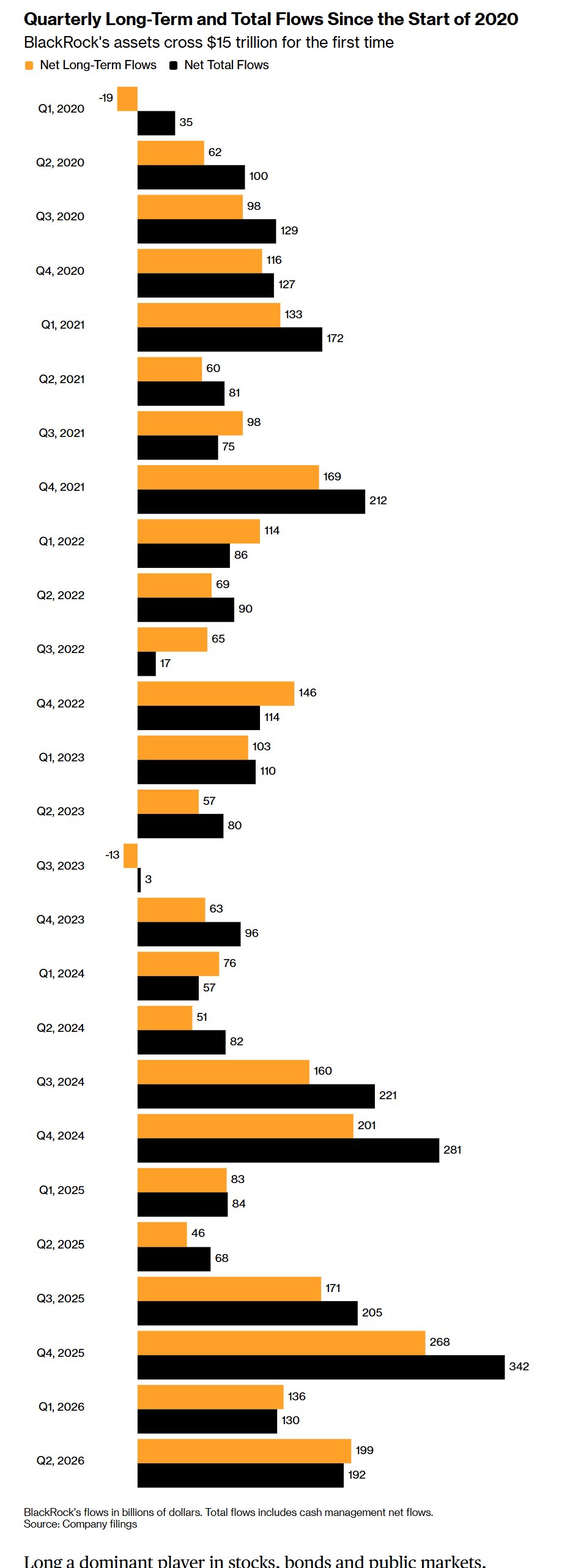
The picture above shows the quarterly long-term capital flow and total capital flow since the beginning of 2020 — BlackRock's asset size broke through the $15 trillion mark for the first time in the second quarter, and even began to approach $20 trillion.
BlackRock has long been an absolute leader in stock, bond, and open market investments, and is currently transforming itself into one of the largest asset management companies in the private equity and AI computing power infrastructure market, including the acquisition of credit company HPS Investment Partners for $12 billion in 2025. BlackRock said incremental fees associated with HPS transactions are driving revenue growth.
BlackRock absorbed $22 billion in liquidity alternatives and private equity in the second quarter, up from $14.6 billion in the previous quarter. Among them, the private equity market accounted for about US$15.4 billion in the current inflow of alternative investment capital.
By the close of the US stock market on Tuesday, BlackRock's stock price had fallen 4.2% since this year, significantly lagging behind the 10.2% increase in the S&P 500 index.
The world's largest asset manager becomes a “financial toll booth” for the AI computing power investment boom cycle
J.P. Morgan Chase, Bank of America, Citibank, and Goldman Sachs totaled about US$38 billion in stock and bond trading revenue in the second quarter, up more than one-third year-on-year, about 60% from two years ago, and investment banking fees of about US$10 billion. Meanwhile, capital expenditure for hyperscale cloud vendors is estimated to have reached about US$725 billion in 2026, and AI-related debt is close to 15% of US investment-grade bond issuance. As a result, these banks are not AI technology companies in the traditional sense, but have become financiers, transaction matchers, and risk intermediaries in the AI arms race.
BlackRock, on the other hand, turned the AI boom into a more sustainable compound interest in asset size and management fees. Managed assets rose to US$15.34 trillion in the second quarter, up about 22% from US$12.53 trillion in the same period last year; net customer inflows were US$1920 billion, with net inflows of US$19.9 billion in long-term products, higher than market expectations of US$170 billion. Exchange-traded funds absorbed US$178 billion, and the net inflow of active management products was US$53 billion. Revenue increased 31% year over year to about US$7.1 billion, and adjusted earnings per share increased 15% to US$13.91, exceeding market expectations of US$12.66-12.69, while organic basic management fees unexpectedly increased by 8%.
Furthermore, the rise in AI stocks and the influx of themed capital have boosted open market management assets, while private equity, data center, electricity and infrastructure investments have also transformed short-term market popularity into assets with longer maturities and higher rates; BlackRock has also directly entered the AI capital expenditure financing chain through private equity platforms HPS and infrastructure investments.
BlackRock is indeed becoming an important indirect beneficiary and capital allocation platform for the AI boom, but it is not accurate to call it a “pure AI concept stock.” Wall Street banks mainly earn processing fees through AI corporate debt issuance, mergers and acquisitions, stock issuance, data center loans, and transaction fluctuations; BlackRock collects ongoing management fees by boosting managed assets through rising AI stocks, large-scale influx of investors into technology and themed ETFs, and private equity credit and infrastructure funds to participate in data center, power grid, and energy construction.
BlackRock is not a hardware manufacturer related to AI computing power infrastructure in the strict sense of the word, but rather an AI wealth effect bearer and capital formation charging platform across public stocks, bonds, private equity, and infrastructure; this is more sustainable than simply relying on market transaction volume, but once AI computing infrastructure themes are valued, positions are overcrowded and heavily leveraged, and AI capital expenditure or market risk appetite is reversed, its management assets and management fees will also be subject to cyclical pressure.