
MediaTek is worried about suppressing Broadcom (AVGO.US) stock prices for half a year, and Damo has been adamant: AI's core winner status has not changed, reaffirming the “increase” rating
The Zhitong Finance App learned that in the latest research report released on Tuesday, Morgan Stanley reaffirmed the “gain” rating of Broadcom (AVGO.US) and maintained a target price of 502 dollars, clearly defining Broadcom as the “core AI winner” second only to Nvidia. The agency believes that market concerns that MediaTek (MediaTek) will greatly encroach on Broadcom's share in Google's TPU business have been seriously exaggerated.
Broadcom's stock price has remained almost unchanged since the beginning of the year, while the Philadelphia Semiconductor Index has risen close to 90% over the same period. Behind this disparate set of numbers is a market anxiety that has continued for half a year — is MediaTek taking orders for Google's TPU custom chips from Broadcom?
Morgan Stanley gave a clear answer in the latest research report released on July 14: Broadcom will still be Google's main supplier of TPU, maintaining about 80% of the market share for a long time, and MediaTek's participation is “real but not disruptive.”
The root cause of stock price failure in the sector: a game of “market fortune imagination”
Since 2026, Broadcom's stock price has only risen by about 0.1%, clearly lagging behind in the AI chip sector. Morgan Stanley analyst Joseph Moore admits that this performance was “surprising”, especially given the continued strong growth momentum of the company's AI business.
There are two main reasons for this weakness: first, investors prefer “bottleneck” AI semiconductor targets such as Nvidia; second, disputes over MediaTek's market share in Google's TPU market continue to ferment.
In March of this year, The Information reported that MediaTek is cooperating with Google to develop the next generation of TPU chips. At the beginning of June, Broadcom confirmed for the first time at an earnings conference that Google is seeking to introduce other chip suppliers, which means Broadcom will lose its exclusive supply position for TPU related design orders. Since then, pessimistic market expectations have spread further — some suggest that Broadcom's share of TPU may drop from around 95% in 2026 to 80% in 2027 and 65% in 2028.
This concern directly suppressed Broadcom's valuation repair. By the close of trading on July 14, the blog reported $389.11, which had withdrawn about 22% from the historical closing high of $481.57 set on June 2.
Morgan Stanley's core judgment: 80% share won't run
Faced with market panic, Morgan Stanley disassembled the bearish logic one by one in Tuesday's report and gave four core judgments:
First, MediaTek's participation is real but not disruptive. Moore made it clear that MediaTek has indeed obtained some of the 3nm design work for Google's next-generation TPU. This opportunity “has some credibility,” and Google is indeed motivated to reduce its dependence on a single supplier. However, he stressed that this will not cause Broadcom's market share to drop drastically — “Broadcom should maintain about 80% of the TPU market share for a long time,” and that the bearish side's argument that its share will fall to 50% or even be completely replaced is “too early to say.”
Second, Broadcom's advantages of large-scale platforms are difficult to quickly replace. Broadcom has a mature large-scale design platform in the ASIC field. Once this platform is mature, it is difficult to quickly replace it. In particular, in terms of HBM memory supply, Broadcom has locked in the relevant supply under the existing contract framework, and MediaTek's potential cost savings may be difficult to actually achieve.
Third, MediaTek faces packaging execution risks. Morgan Stanley pointed out that MediaTek will still rely on TSMC's CowOS production capacity for 2 nm TPU production, and EMIB packaging technology has not yet been verified on the large scale required by Google. This means that MediaTek is uncertain about the implementation of the technology.
Fourth, historical experience shows that similar concerns are often excessive. Morgan Stanley compared the dispute to last year's competitive landscape between Marvell and Alchip on Amazon Trainium chips — the market was also concerned about Broadcom being completely replaced, but later proved that such concerns were overstated.
How big is the real threat? Disagreement between GF Securities and Morgan Stanley
Not all agencies agree with Morgan Stanley's optimistic judgement. GF Securities pointed out in a July 1 report that Google has chosen MediaTek over Broadcom or Qualcomm to build the ninth generation TPU (codename “Triggerfish”), marking a major shift in Google's customized chip strategy. As MediaTek Zebrafish is mass-produced at the end of 2026 and Humufish is released in 2028, MediaTek's position in Google's TPU supply chain will continue to be consolidated.
Counterpoint Research predicts that MediaTek will contribute about 26% of AI ASIC server calculation shipments by 2028, making it the second largest player after Broadcom.
However, these predictions do not contradict Morgan Stanley's “80% share” judgement — MediaTek's share from zero to 15% to 20% is in perfect mathematical agreement with Broadcom's reduction from 100% to 80%. The key disagreement is: is this an “orderly dilution” of Broadcom's share or a “cliff-style decline”? Morgan Stanley is clearly betting on the former.
Broadcom's “multiple lines of defense”: More than Google TPU
Even in the face of market share dilution in Google's TPU business, Broadcom's AI narrative still has multiple support points: First, the AI revenue scale is huge. Morgan Stanley predicts that Broadcom will generate around 120 billion US dollars in AI revenue in the 2027 fiscal year, of which TPU related revenue is about 80 billion US dollars.
Second, customer diversification is progressing. Moore pointed out that Broadcom will gradually expand “multiple” new ASIC customers in the second half of 2027. This means that TPU's share of Broadcom's total AI revenue is expected to drop to around 60% from current levels.
Third, strong partnerships with major customers. In April of this year, Broadcom announced the expansion of the chip cooperation agreement with Google until 2031; Meta extended its custom chip cooperation with Broadcom; last week, Apple announced that it had reached a multi-year chip agreement worth more than 30 billion US dollars with Broadcom. The simultaneous endorsement of the three major tech giants is a strong proof of Broadcom's AI moat.
Market Reactions and Valuation Prospects
Morgan Stanley maintains its “overweight” rating on Broadcom, with a target price of $502. Wall Street as a whole remains highly optimistic about Broadcom — TipRanks data shows that out of 26 analysts covering Broadcom, 23 gave a “buy” rating and 3 had a “hold” rating. The average target price was $513.29, which meant a potential increase of over 30%.
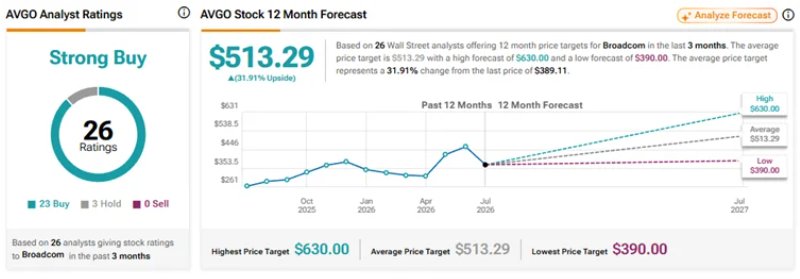
According to cMoney's analysis, Broadcom's ability to stand firm at $500 depends on whether new ASIC customers can land in the second half of the year. If management begins to specifically disclose the profile of new customers in the next few quarters, the target price of $502 will become the basic scenario; if new customer information continues to be vague and Google's TPU share is reported more negatively, market concerns about the excessive concentration of Broadcom's AI revenue will further deepen.
MediaTek's order rush is real, but Broadcom's central position is difficult to shake in the short term — this is the core judgment given by Morgan Stanley. However, the game over TPU's share is far from over. Between “orderly dilution” of 100% to 80% and “cliff fall” of 50%, the market chose to believe in the former, but the final answer depends on three variables: whether mass production implementation of MediaTek's 3 nm TPU can proceed as scheduled, whether Broadcom can launch new ASIC customers as scheduled in 2027, and the extent to which Google's supplier diversification strategy will advance. Until then, Broadcom's valuation repair path will still be accompanied by this ongoing game of “market ownership imagination.”