The US CPI completely subsided in June, and core inflation unexpectedly remained flat, but the oil price backlash and fire in the Middle East caused a sharp rise in suspense about interest rate hikes
The Zhitong Finance App learned that data released by the US Department of Labor on Tuesday showed that the June Consumer Price Index (CPI) fell short of expectations across the board. The month-on-month decline recorded the biggest decline in more than six years, and the year-on-year growth rate declined markedly. This performance has fueled the market's hopes for a marginal easing of inflationary pressure, but due to the escalation of the Middle East geopolitical conflict and a rapid rebound in energy prices, the prospects for the Federal Reserve to raise interest rates during the year have not been eliminated.
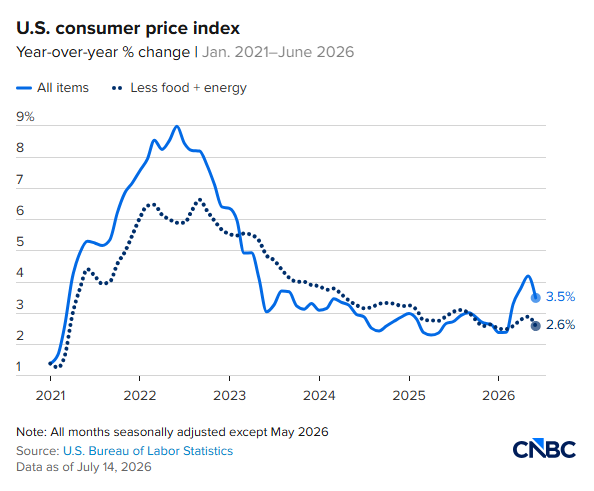
According to the data, the US CPI fell 0.4% month-on-month after seasonal adjustment, far below the 0.2% decline expected by economists, the biggest monthly decline since April 2020. The year-on-year increase slowed sharply to 3.5% from 4.2% in May, which was also lower than the 3.8% expected by the market.
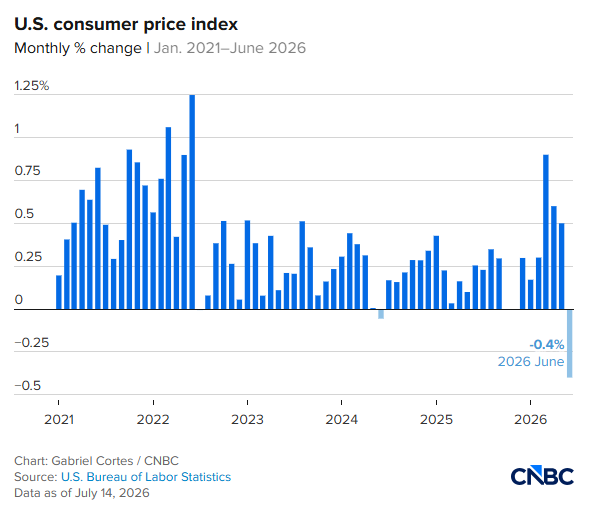
The main driver behind the cooling of inflation comes from a sharp drop in energy prices. The energy price index fell sharply by 5.7% during the month, with gasoline and fuel prices falling by more than 9%. Thanks to the fragile cease-fire that was once reached between the US and Iran last month, gas station prices have dropped from years of high levels, providing consumers with a rare respite.
However, this advantage is quickly dissipating — after the attack on merchant ships in the Strait of Hormuz last week, the cease-fire agreement broke down, another military attack broke out between the US and Iran, and US President Trump later announced a new maritime blockade against Iran. Affected by this, international oil prices jumped to a four-week high. Data from the American Automobile Association (AAA) also showed that the average price of gasoline across the US had rebounded from $3.79 per gallon a week ago to $3.86.
Heather Long, chief economist at Navy Federal Credit Union, said, “June finally brought some relief from inflation. This relieved the pressure on the Federal Reserve and allowed the central bank to wait and see the changes. What is worrying, however, is that this relief may be short-lived, particularly as the conflict in Iran escalates again. The outcome of the current inflation trend is still uncertain.”
Core inflation unexpectedly leveled off, and service and commodity prices have cooled down in many places
Excluding volatile food and energy, the core CPI remained flat month-on-month in June, better than the 0.2% increase expected by the market; the year-on-year increase fell to 2.6% from 2.9% in May, returning to a relatively moderate range, and lower than the 2.9% forecast.
Looking at the breakdown, the cost of the service sector, which Federal Reserve policymakers are closely watching, and which reflects long-term inflation trends, has also slowed significantly. Excluding energy costs, service prices remained flat month-on-month. Housing costs only increased slightly by 0.1%, while transportation service prices fell by 0.3%. Notably, after rising for four months in a row, hotel accommodation prices recorded their biggest drop in more than a year in June. Although some economists previously speculated that travel demand brought about by FIFA World Cup events held in 11 US cities might drive up accommodation costs, actual data failed to confirm this concern, and restaurant prices only rose moderately during the same period.
On the commodity side, clothing prices, which are more sensitive to changes in energy costs and tariffs, fell 0.6%, used car prices fell 0.2%, new car prices remained flat, and auto insurance costs also dropped significantly. Food prices continued to rise moderately, rising 0.2% month-on-month, and beef, eggs, and dairy products continued to drive up supermarket consumption costs.
Meanwhile, in the midst of easing, the price of computer software and accessories bucked the trend and rose sharply, rising 2.3% month-on-month, and setting a historical record of 17.4% year-on-year. This shows that strong demand driven by artificial intelligence (AI) is forming price support in some fields.
The Federal Reserve maintains a hawkish market game and raises interest rates in September
Despite positive signs of inflation data, it is far from enough to convince Federal Reserve officials that a shift towards easing is possible. Federal Reserve Chairman Kevin Walsh made it clear in his testimony prepared for the House Financial Services Committee that “zero tolerance” for continued high inflation, “The primary goal of the Federal Reserve is to formulate a reasonable monetary policy. This is the direction we have always adhered to. As long as policies are put in place, the high level of inflation over the past five years will eventually become history.”
Federal Reserve Governor Christopher Waller also emphasized earlier that several months of good inflation data are needed to make him believe that prices are continuing to fall towards the 2% target.
The minutes of the June interest rate meeting released last week show that policymakers' concerns about inflation are deepening. In particular, they are concerned about continued high inflation caused by strong AI-related demand, the Middle East conflict, and the Trump administration's tariff policy.
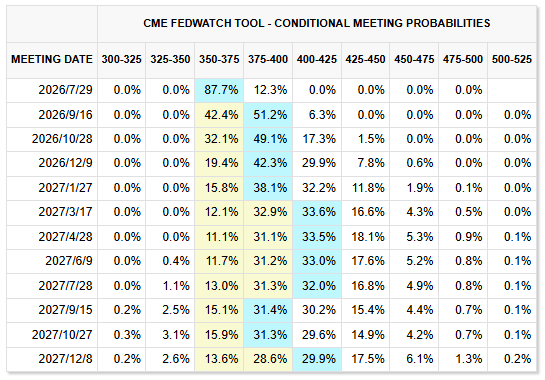
Currently, the Federal Reserve keeps the benchmark interest rate unchanged in the 3.50% to 3.75% range. Market pricing shows that the Federal Reserve almost certainly stands still at the 28-29th meeting of this month. After the CPI data was released, investors cut their bets on the July interest rate hike. Most US stock index futures rose, while US bond yields fell sharply.
However, with regard to the policy meeting on September 15-16, expectations of interest rate hikes have not been lifted. According to CME's FedWatch tool, the market's probability of a 25 basis point rate hike in September is still slightly above 50%.