
SK Hynix went public in the US and set off a demonstration effect! Samsung denies evaluating ADR issuance; is the memory chip sector facing a bottom-up opportunity?
The Zhitong Finance App learned that after SK Hynix, one of the memory chip giants, completed the $26.5 billion ADR issuance in the US stock market with $149 per copy, there is news that Samsung Electronics, another South Korean storage giant, also seems to be planning to raise huge sums of money through US stock issuance and break the so-called “Korean technology company valuation discount.” However, a representative of Samsung Electronics said that the possibility of issuing American Depositary Receipts has not been assessed at present.
Earlier, some media reported, citing information revealed by people familiar with the matter, that Samsung Electronics is in the early stages of studying the potential issuance of American Depositary Receipts (that is, US stock ADR).
People familiar with the matter said that the South Korean company has begun preliminary discussions with the bank, but has yet to decide whether to proceed. Since the relevant discussions are private matters, people familiar with the matter requested anonymity. They said that Samsung will keep an eye on sharp fluctuations in global memory chip stocks when making decisions. People familiar with the matter said that if the company promotes listing in the US, its huge consumer electronics business portfolio and repeated labor disputes may present major challenges to deal structure design.
They added that discussions are still at a very early stage and may not lead to a listing in the end.
By the close of the Korean stock market on Monday, SK Hynix had a record drop of more than 15% in a single day, Samsung Electronics fell by more than 10%, and dragged South Korea's KOSPI benchmark index to plummet by about 9% and triggered the suspension of trading. On Tuesday, Korea's KOSPI index and the stock prices of SK Hynix and Samsung Electronics, which account for 50% of the index's weight, rebounded. According to some Wall Street analysts who continue to be optimistic about the memory chip sector, “the chip cycle has peaked” is nonsense. They believe that opportunities to buy memory chip stocks are forming. In particular, SK Hynix fell nearly 40% from a higher position.
The South Korean government said this week that investing the excess taxes brought about by the memory chip boom driven by the AI infrastructure craze into cutting-edge technology fields such as semiconductors, AI data centers, and physical artificial intelligence (that is, physical AI) has greatly strengthened the South Korean government's large-scale policy commitment to long-term AI computing power infrastructure, helped stabilize and boost capital expenditure expectations surrounding Samsung Electronics, SK Hynix, and the global AI computing power industry chain, and sent a positive signal to the market that “the AI computing power industry cycle has not yet reached its peak by the policy level.”
SK Hynix's US$26.5 billion listing in the US detonated a demonstration effect. Korea's storage duo may compete for global AI capital
According to media reports, the person familiar with the matter mentioned above said that Samsung had assessed the possibility of issuing American depository certificates in the past, but ultimately decided not to proceed; however, SK Hynix successfully listed on the US stock market and is expected to break the so-called “Korean technology company valuation discount,” providing new impetus for Samsung to re-examine this idea. They said that despite this, related discussions are still in the very early stages. Currently, they are more of an evaluation than formulating a specific plan or appointing a bank to be responsible for this offering.
As Samsung's competitor in the memory chip market, SK Hynix raised 26.5 billion US dollars through the US listing last week, making it the largest listing transaction in history carried out by a foreign company in the US. This deal reflects investors' demand for companies at the core of global AI computing power infrastructure. Even though the market is concerned that the AI supply chain is already overvalued, such companies are still being sought after.
Samsung Electronics' stock price in the South Korean stock market has risen by about 120% since this year, driving the company's market capitalization to more than 1 trillion US dollars. In contrast, SK Hynix's stock price soared more than 200% during the same period, with a market capitalization of about 900 billion US dollars.
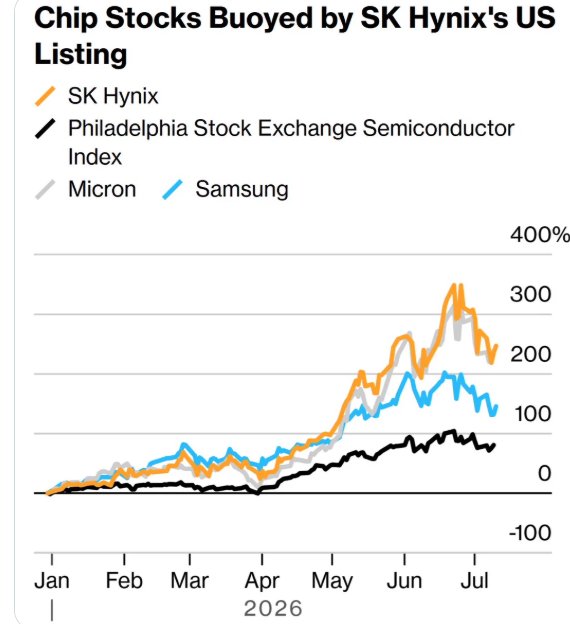
The Korean stock market has been driven by a strong rise in memory chip stocks driven by artificial intelligence. However, extreme volatility and high reliance on two superpower companies may mean that the South Korean stock market, which has repeatedly reached new highs, is an AI bubble awaiting a record burst.
The rise in Samsung's stock price has taken into account extremely high earnings growth expectations. Last week, the initial results announced by Samsung Electronics seemed to exceed market expectations, but its stock price still fell sharply, highlighting how difficult it has become to meet investors' expectations.
The prospect that additional memory chip production capacity will soon be put into production is also suppressing chip stocks, as this may ease the tight supply of memory chips and put pressure on prices and profit margins.
Last month, Samsung Group and SK Group said they each plan to build two very large memory chip manufacturing plants, with a total investment of 800 trillion won (about 536 billion US dollars) to rapidly expand production capacity and meet growing demand. The South Korean government also announced that companies, including Internet leader Naver, will invest 550 trillion won to build 8.4 gigawatts of artificial intelligence data center capacity by 2029.
After the memory chip theme plummeted, it ushered in a good opportunity to get to the bottom of the bottom?
The Korean government included tax revenue exceeding expectations from the storage semiconductor supercycle into the “Future Response Fund,” which means that DRAM/HBM/NAND memory chips have risen from a single enterprise profit cycle to a core pillar of the national balance sheet and industrial policy. Tax revenue is expected to reach at least 500 trillion won in 2027, and the government plans to prepare the largest budget in history of more than 800 trillion won, and prioritize support for the three superprojects of semiconductors, AI data centers, and physical artificial intelligence; this will reduce the execution costs of Samsung Electronics and SK Hynix's expansion through electricity, land, R&D, talent, advanced packaging and regional infrastructure, and form a positive feedback cycle of “chip profit - fiscal revenue growth - industrial reinvestment - expansion of AI supply capacity”.
SK Hynix fell more than 15% in a single day, Samsung Electronics fell more than 10%, and dragged KOSPI to plummet by about 9% and triggered the suspension of trading. It was closer to a valuation liquidation triggered by extreme positions, leveraged capital, favorable cashout, and a decline in the “second-order derivative” of profit expectations, rather than a sudden disappearance of AI server orders. SK Hynix has just completed about US$26 billion in American Depositary Receipt financing. Profits rebounded after the first day of listing. At the same time, investors began to examine the HBM4 shipping pace, long-term agreement price flexibility, and supply growth from 2027 to 2028; this makes it a leader with higher HBM purity that not only has the greatest structural profit elasticity, but also withstands the most severe expected drawdown.
From a technical perspective, this round of sharp decline has already pushed SK Hynix into the oversold range. Some analysts believe that short-term buying opportunities are being formed. In particular, SK Hynix has dropped nearly 40% from a higher position. Nico Rosti, senior analyst at MRM Research, said that SK Hynix's stock price is currently showing “deep oversold” characteristics. “Another week of decline is possible, but we see this as a major opportunity to increase our positions/increase our holdings. The rebound in the Korean market should push ADR higher even more sharply, so this is a good time to buy.” The analyst said.
According to Wall Street giants such as Bank of America and Nomura, and top market research institutes such as SemiAnalysis, this round of global memory chip and even AI computing power infrastructure investment-themed stocks generally plummeted closer to extreme expectations, extremely leveraged positions, and centralized liquidation of overcrowded bullish positions, rather than a sudden collapse in industrial demand. Profit returns after the listing of SK Hynix's American Depositary Receipts, misalignment in valuation between local Korean stocks and American Depositary Receipts, and centralized liquidation of leveraged funds have all amplified price fluctuations.
The supply side seems to continue to support mid-term multi-head logic on the topic of memory chips and AI computing power infrastructure. According to a recent research report released by Bank of America, “the additional production capacity in 2028 is only one-sixth of the original plan,” that is, SK Hynix's actual memory chip production capacity by 2028 may only be one-sixth of the original plan. This judgment not only greatly reduces the South Korean government's blueprint for capacity expansion, but also provides key evidence in the ongoing DRAM price manipulation class action lawsuit. This also means that the increase in production capacity by 2030 will be far below the “doubling production capacity by 2030” target previously set by South Korean President Lee Jae-myung.
Bank of America's forecasting direction is basically consistent with the rules of the memory chip industry: new fabs will experience land, electricity, clean rooms, equipment installation, customer certification, and yield climbing, and old production lines will also be withdrawn due to process upgrades. The actual net increase in wafer production capacity is far slower than the investment amount announced by the government. If the implementation of the new supply is delayed and HBM continues to crowd out the area of general-purpose DRAM wafers, the price cycle may be longer than traditional storage; SK Hynix CEO also publicly predicts that 2027 may experience the worst storage shortage in industry history, and demand for HBM/DRAM/NAND memory chips may even remain significantly higher than supply after 2030.
SemiAnalysis predicts that SK Hynix's comprehensive DRAM average sales price (ASP) in the second quarter of 2026 will rise by about 45% month-on-month, and the operating profit of the DRAM project will reach 55 trillion won. The company's operating profit margin is expected to reach the highest level in history. The SemiAnalysis report clearly states — “Be Greedy When Others Are Fearful” (be greedy when others are afraid), and emphasizes that despite recent sharp fluctuations in memory chips causing investor concerns, SK Hynix and other leading storage companies “are still one of the most attractive risk-to-return targets in the semiconductor industry.”
Nomura is currently the most aggressive large financial institution that favors the memory chip sector. In a research report released recently, Nomura raised the target price of Samsung Electronics from 590,000 won to 670,000 won, and raised the target price of SK Hynix from 4 million won to 4.7 million won, corresponding to a potential increase of more than 100%, which means that the two major memory chip giants, whose stock prices have repeatedly reached new highs since 2025, have not stopped.
Nomura's core bullish logic is that AI has transformed storage from traditional PC/mobile phone cycle products to long-term data center growth assets: intelligent AI inference requires huge key-value cache (KV Cache), and HBM supply lags significantly behind demand; it is estimated that global data center capital expenditure will increase from 1.16 trillion US dollars last year to 6.13 trillion US dollars in 2030, of which memory is expected to rise to 23% from the current 9%. Therefore, Samsung and SK Hynix's forward price-earnings ratio of about 6 times 12 months is clearly underestimated. Revaluation space where value systems are close together.