Economist: If the US and Iran return to the “hot war” and resume the blockade, it may soar to $125
The Zhitong Finance App learned that as the tension between the US and Iran heats up again, economist Robin J. Brooks issued a warning: if the conflict between the two sides escalates again into a full-scale “hot war” and the US resumes the blockade of Iranian oil exports, the price of Brent crude oil may soar by about 80% to about 125 US dollars per barrel.
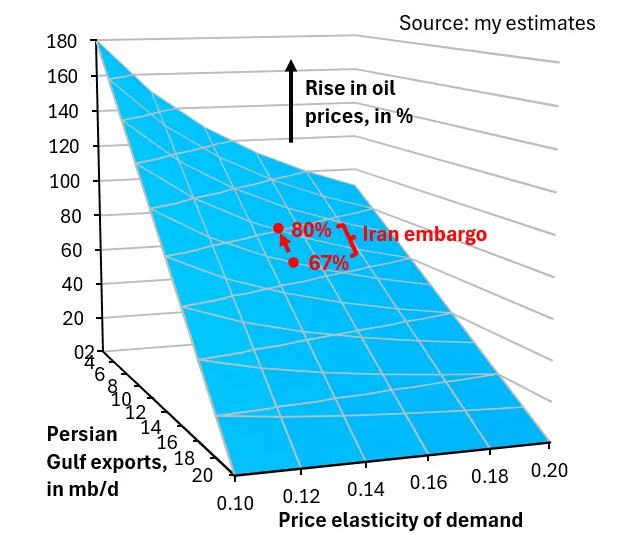
In his latest analysis, Brooks stated that the core basis for his estimates is the serious disruptions that oil transportation in the Strait of Hormuz may suffer. He assumed that in the pre-war Persian Gulf crude oil exports of about 20 million barrels per day, considering alternative pipelines that Saudi Arabia and the UAE could bypass the strait and some traffic conditions of Iranian oil tankers during the conflict, effective exports from the region would plummet to about 10 million b/d in the context of the “hot war.” If the US re-imposes a maritime blockade on Iran on top of this, and Iran's average daily exports of about 2 million barrels are cut off again, the total volume of exports from the Persian Gulf will shrink further to 8 million b/d.
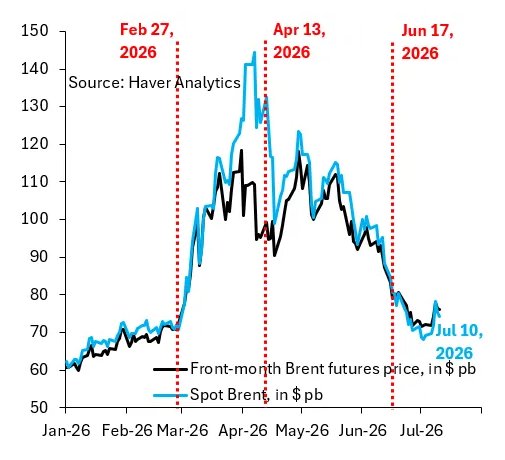
To measure the impact of this supply shock on prices, Brooks cites academic research on the price elasticity of crude oil demand — the median estimate is around 0.15, which means that for every 10% increase in oil prices, demand will only fall by 1.5%, which is characterized by a high degree of inelasticity. According to this estimate, to absorb the gap from 20 million barrels to 8 million barrels, oil prices will need to rise by about 80%. Based on the recent fall of Brent crude oil to around $70 per barrel, this round of shock will push the price peak back to $125.
The possibility of a further sharp breakthrough is limited
Notably, Brooks specifically stated that his calculation model did not take into account the investment of emergency stocks such as strategic oil reserves (SPR), but directly measured the impact of a net decrease in supply. This means that even if countries have used emergency reserves heavily in previous months to calm the market, the potential peak conclusion of $125 holds true. In fact, in March and April, when the last round of conflict was intense, it was because the release of strategic reserves acted as a buffer that Brent spot and futures prices remained below $125 for most of the time, rather than staying at the high level suggested by the model for a long time.
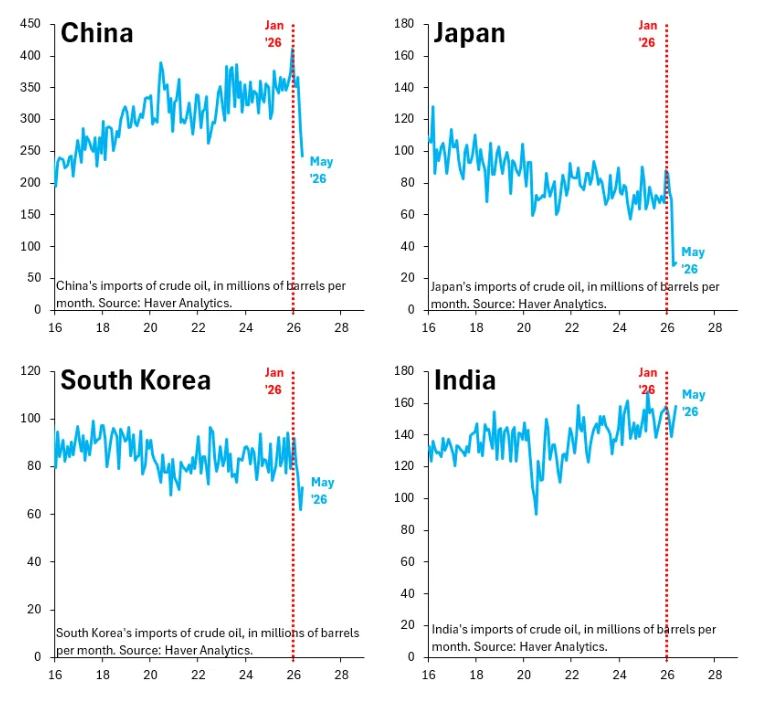
Brooks further analyzed that even if the current situation worsens again, the peak oil price may be lower than the high set earlier this year. The reason is that the market has accumulated a lot of experience in dealing with the turbulence of the previous few months. Countries have set up alternatives and redundant capacity: countries with abundant crude oil reserves, such as China and Japan, have drastically cut imports, while countries with relatively limited stocks, such as South Korea and India, are trying to keep imports at a nearly flat level. These experiences accumulated in recent months and the restructured supply chain mean that even if the conflict returns to a “hot war,” the damage to the oil market will be less severe than it was at the beginning, thus helping to curb price increases more effectively.