
Global interest rate “big reset” storm sweeps through Japan: Japanese bond yields hit a 30-year high, BlackRock warns of the risk of yen shortfall crowding
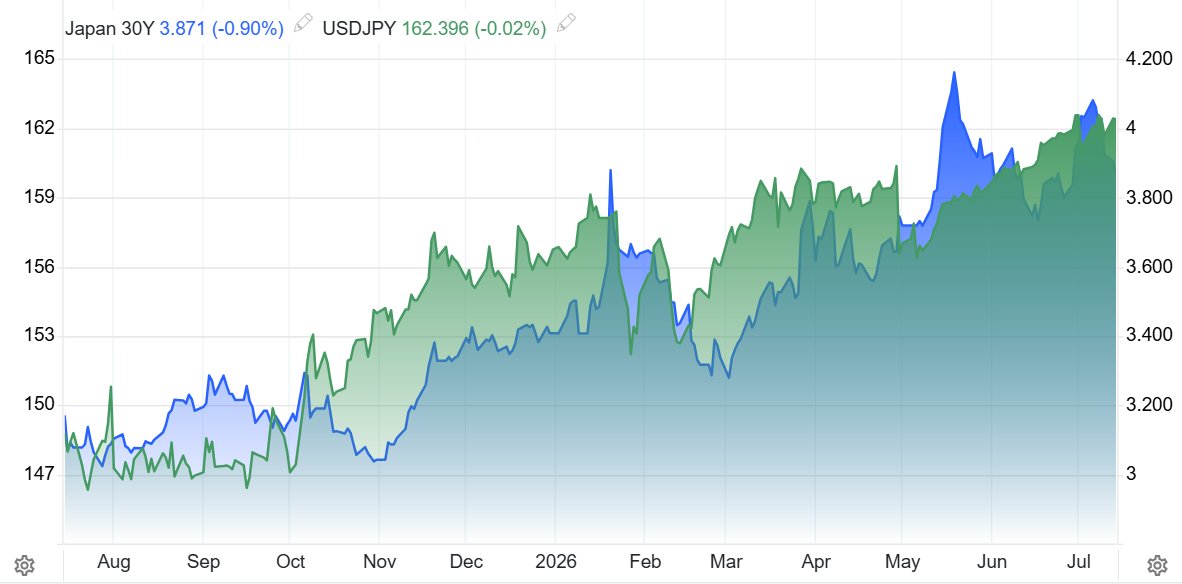
The Zhitong Finance App learned that the global bond market is undergoing a profound “major interest rate reset” — and Japan is the epitome of the most extreme transformation. On July 14, the 10-year Japanese Treasury yield rose 1.5 basis points to 2.800%, once hitting the highest level in nearly 30 years of 2.900% in the intraday period. The yen fell to around 162 against the US dollar, the lowest since 1986. BlackRock Investment Research's latest review points out that this double line is out of control confirming the reality and importance of global interest rate resets.
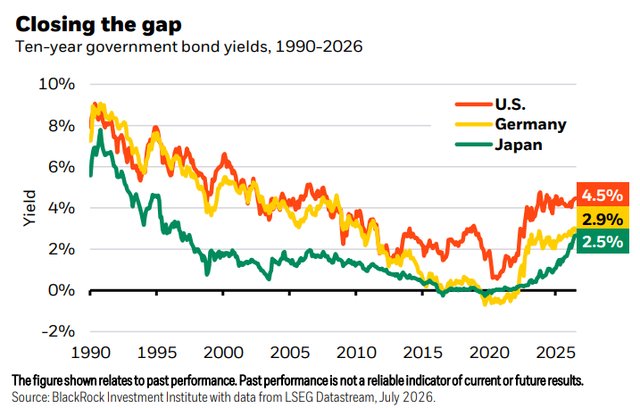
Global interest rate “big reset”: Japan is no longer a “special case”
Government bond yields in the US, Europe, and Japan have all risen markedly since 2020-2021. BlackRock pointed out that the repricing anticipated by American hawkish policies has further fueled this trend.
Currently, the implied long-term forward interest rate on Japanese treasury bonds is about 5%, the US is about 6%, and Australia is about 5.5%. Japan — which has historically been treated as a special case due to prolonged deflation and ultra-loose monetary policies — is now gradually converging with other countries in developed markets. BlackRock believes this confirms that the global interest rate reset is real and profound.
The core variables driving this convergence include: a systematic rise in global maturity premiums — additional compensation required by investors to hold long-term bonds is rising; a surge in bond supply due to fiscal expansion in various countries — the Japanese government's huge fiscal spending plan means that the issuance of large numbers of new bonds will continue to suppress prices; and a structural shift in the center of inflation.
Bank of Japan: Be wary of the “slow variables” in interest rate hikes
The Bank of Japan raised the policy interest rate by 25 basis points to 1% on June 16, the highest level since 1995. However, Ben Powell, chief investment strategist for the Middle East and Asia Pacific region at BlackRock's think tank, said that the Bank of Japan may be cautious about further interest rate hikes.
Powell pointed out that steady domestic wage growth, strong underlying inflation, and deeply negative real interest rates support the reasons for tightening policies. The “Chunto” salary increase has exceeded 5% for three consecutive years, further strengthening the Bank of Japan's judgment on a virtuous cycle between wages and prices. Externally, however, hopes that the situation in the Middle East will cool down have mitigated the threat of continued energy shocks and helped curb imported inflation.
The market currently generally expects the Bank of Japan to keep interest rates unchanged at 1% at the July 31 meeting, but most analysts still expect another rate hike to 1.25% before the end of the year. BNP Paribas expects the Bank of Japan to maintain a gradual pace of austerity with interest rate hikes every four to five months. The policy interest rate will reach 1.25% by the end of 2026, 2.00% by the end of 2027, and eventually hit the 2.50% terminal limit in September 2028.
BlackRock's core strategy: low dividend Japanese bonds, neutral Japanese stocks, and wary of yen bears
In this macro context, BlackRock has given a clear three-stage strategy:
Maintaining a low balance of Japanese treasury bonds. Powell clearly recommended “low-allocation Japanese treasury bonds.” There are three reasons: the prospect of further interest rate hikes by the Bank of Japan will continue to drive up yields; global term premiums will rise; and large-scale bond issuance will continue to put pressure on prices. This means that bond prices still have room to decline.
Neutral attitude towards Japanese stocks (6 to 12 months). Despite being supported by healthy corporate balance sheets and corporate governance reforms, the cost of imported energy is likely to drag down returns. In the long run, BlackRock remains overallocated because inflation and wage trends support corporate profitability.
Warn the risk of yen bears being congested. BlackRock strategists specifically warned that “increasingly crowded short positions in the yen deserve close attention.” The yen plays a central role in global arbitrage trading — investors borrow low-interest yen and invest in high-yield monetary assets. When short positions in the Japanese yen are too concentrated, any factor triggering bears' recovery can trigger sharp reverse fluctuations. Singaporean hedge fund Blue Edge even warned that without intervention or interest rate hikes, the yen could fall to 180 to 205 to $1 by the end of next year.
Short-term disturbances: GPIF policy expectations trigger a roller coaster in the bond market
On Friday (July 10), Japan's Finance Minister Katayama Satsuki said that the government will explore measures to encourage the Japanese Government Pension Investment Fund (GPIF) to increase investment in domestic financial assets. GPIF is the world's largest pension fund, managing around $1.8 trillion in assets.
The market reacted quickly — 10-year bond yields plummeted 17 basis points in a single day. However, Rinto Maruyama, a senior strategist at SMBC Nikko Securities, pointed out that the market was overreacting, and traders were only looking for opportunities to buy back. He estimated that GPIF could increase domestic bond allocation by up to 12.26 trillion yen. Even if 70% of it is allocated to 10-year treasury bonds and the investment is completed within 3 years, the 10-year yield will only drop by 7 basis points at most. On Monday (July 13), the yield immediately rebounded 3 basis points to 2.79%.
The end of interest rate resets is far from over
BlackRock maintains a low ratio position on Japanese treasury bonds, while favoring Japanese stocks and the short-term portion of the US and European yield curves to seek lasting returns.
The end of the resetting of global interest rates is far from over. The forward interest rate on Japanese treasury bonds implies a long-term interest rate level of about 5%, which means that the current 10-year yield of 2.8% still has significant room to rise. The triple pressure of the Bank of Japan's gradual interest rate hike, the rise in global term premiums, and the Japanese government's huge bond issuance plan will continue to suppress the price of Japanese bonds.
As BlackRock said, Japan is moving from a “special case of deflation” to a “global normal.” However, this process of convergence is bound to be accompanied by continued pain in the bond market and sharp fluctuations in the exchange rate market. When the world's largest arbitrage trading currency experiences the highest bond yield in 30 years, the next tipping point in the market is probably closer than expected.