
Escape the AI arms race storm! Wall Street funding flocked to the “king of cash,” and Apple (AAPL.US) soared to $600 billion in market capitalization in 20 days
The Zhitong Finance App notes that investors are turning back to Apple (AAPL.US) as concerns about AI spending are dragging down the stocks of chip makers and cloud computing giants.
The iPhone maker's stock price plummeted last month due to a disappointing demonstration of future AI capabilities, but since bottoming out on June 25, it has rebounded 15%, increased its market capitalization by nearly $600 billion, and pushed the stock price back to a new all-time high. Over the same period, the Philadelphia Semiconductor Index fell 7%, the S&P 500 rose 3%, while the tech-heavy Nasdaq 100 was only up 1.3%.
The stock's reversal reflects growing unease about whether high AI spending will pay off, and Apple's decision not to participate in the data center arms race is increasingly being viewed as an asset rather than a liability, even though its AI products have repeatedly frustrated investors.
Mark Bronzo, chief investment strategist at Rye Strategic Partners, said, “There is a game going on in the market, and right now Apple is benefiting from it because it is not involved in the storm at other AI exchanges.” “People are worried about how hyperscale companies can reap the rewards of their AI spending, and there are also people who think the semiconductor sector has grown too much. As a result, investors are flocking back to Apple, seeing it as a sound option to avoid these risks.”
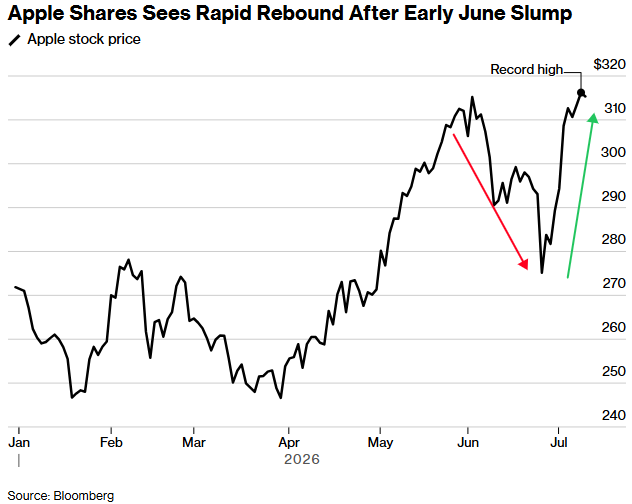
Apple shares quickly rebounded after plummeting in early June
Despite a recent pullback due to concerns about the sustainability of AI computing spending, the Philadelphia Semiconductor Index is still up 83% in 2026, which is expected to be the best annual performance since 1999.
But Apple's 16% increase this year has made it one of the top performers among the so-called “Big Seven” tech giants. These seven also include Nvidia, Google's parent company Alphabet, Microsoft, Amazon, Meta, and Tesla. Alphabet and Amazon are both down more than 10% from their May highs, while Microsoft's 20% sharp drop in 2026 puts its stock on track to record its worst annual performance since 2022.
Considering that Apple is facing headwinds brought about by a rapid rise in memory chip prices (which threatens the company's profit margins), its strong performance is even more impressive. In response, Apple raised the prices of all Macs, iPads, and smart home devices on June 25, which led to the stock's biggest one-day decline since April 2025.
Although the price increase did not include the iPhone, the company hinted that there could be more price increases in the future. According to reports, in order to obtain cheaper memory chips, Apple is in negotiations with two Chinese semiconductor manufacturers to buy chips.
Analysts are optimistic that these moves will protect the company's profit margins and believe that Apple is not as vulnerable as other hardware companies because its customers are less likely to abandon purchases due to device price increases.
“Long-term trends suggest that pricing has limited impact on sales opportunities over a multi-year span,” J.P. Morgan analyst Samick Chatterjee wrote in a July 7 report. “Apple has substantially raised the price of its entire product portfolio in the past, and despite these price increases, its sales volume continues to expand.”
Meanwhile, investors saw a potential catalyst, the folding screen iPhone, which is expected to be released in September. The device is expected to come with a hefty price tag and could attract more customers to upgrade their phones. Earlier this month, Apple told its suppliers that it was preparing to produce around 10 million foldable iPhones this year, up from the 7 million to 8 million previously forecast.
Louis Navellier, chief investment officer at Navellier & Associates, said, “Although Apple is weakly immune to AI, the main reason it won't sell it is likely to launch a huge hit.” “The pricing of folding screen phones will be very strong enough to offset the impact of storage issues on profit margins, and I think demand will be very strong to really support growth.”
Apple's revenue is expected to grow nearly 15% in fiscal year 2026 (ending September 30). This would represent its fastest annual growth since 2021, when sales of electronic devices soared due to the pandemic. Net profit is expected to grow 17%.
Although the company's profit and revenue growth is still moderate compared to its big-cap peers, its conservative spending approach means it is piling up more cash when others are going against it.
Apple's free cash flow is expected to reach a record $140 billion this year, an increase of more than 40% over 2025. In contrast, Alphabet's free cash flow is expected to drop by around 67% to $210 billion during the year.
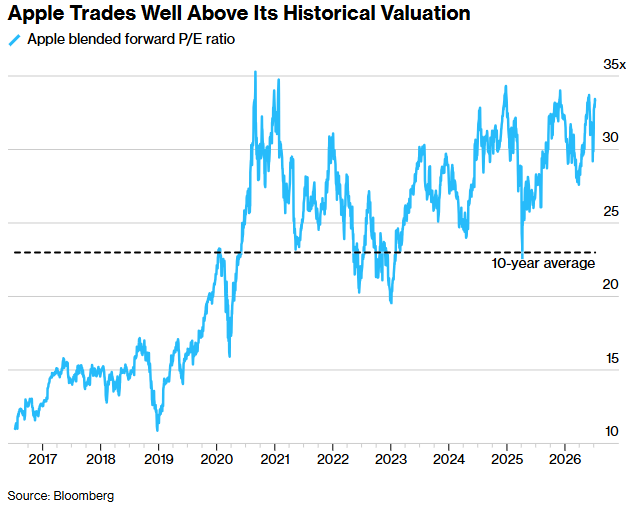
Apple's current transaction price is much higher than its historical valuation
Of course, investors are paying a hefty premium for this. Apple's price-earnings ratio based on estimated profit for the next 12 months is 33 times, making it the most expensive stock in the “Big Seven” other than Tesla, and far higher than its average of 23 times over the past decade.
This is also a key reason why only 61% of Wall Street analysts that track the stock, according to Bloomberg, recommend buying it. By contrast, 90% of analysts across Microsoft, Amazon, Meta, and Nvidia gave these stocks a buy rating.
“Right now I own Nvidia rather than Apple because Nvidia's growth and valuation seem more attractive,” Rye's Bronzo said. “However, as long as we are in an uncertain market, Apple's cash flow and microservices business will help it gradually rise. If you think AI capital spending will continue to expand, then buy Nvidia. But if you think it's going to slow down, Apple is the better choice.”
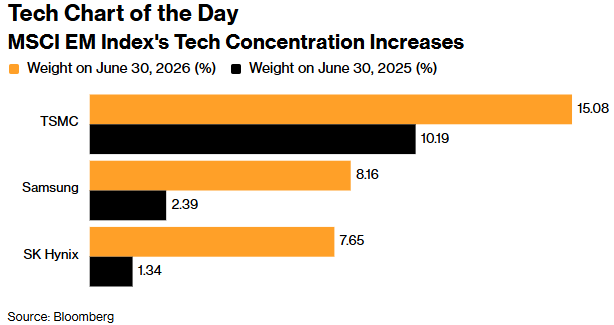
The concentration of technology stocks in the MSCI Emerging Markets Index has risen
Investors are rotating beyond AI winners in emerging markets, where just three $4.4 trillion tech stocks drive most of the returns.