
High spreads and low volatility! Goldman Sachs supports foreign exchange arbitrage trading: it is ushering in the best window in 26 years, and the yen is still the best financing currency
The Zhitong Finance App learned that Goldman Sachs Group said that in the global foreign exchange market with an average daily transaction volume of 9.5 trillion US dollars, arbitrage trading — one of the most widely used trading strategies — is facing the most attractive market environment since 2000. Goldman Sachs strategist Stuart Jenkins wrote in a report that in the Group of Ten (G10) foreign exchange market, the importance of long arbitrage trading has reached almost the highest level since 2000. He said that Goldman Sachs currently tends to use yen, Swiss franc or euro as financing currency in the next few months to carry out arbitrage transactions, that is, borrow currencies with lower yields and then invest in currencies with higher returns.
A number of factors have contributed to a significant increase in the attractiveness of arbitrage trading. Goldman Sachs said that interest rates in the world's major developed economies have stabilized at high levels with clear differences between them, creating unusually wide yield spreads for investors. Meanwhile, foreign exchange market volatility has fallen to historically low levels. A J.P. Morgan Chase index shows that foreign exchange market volatility is currently hovering near its lowest level since 2020.
Driven by the above environment, the return on G10 foreign exchange arbitrage transactions has been about 8% since this year, surpassing global bonds, gold, and Bitcoin, but it still lags behind the stock market.
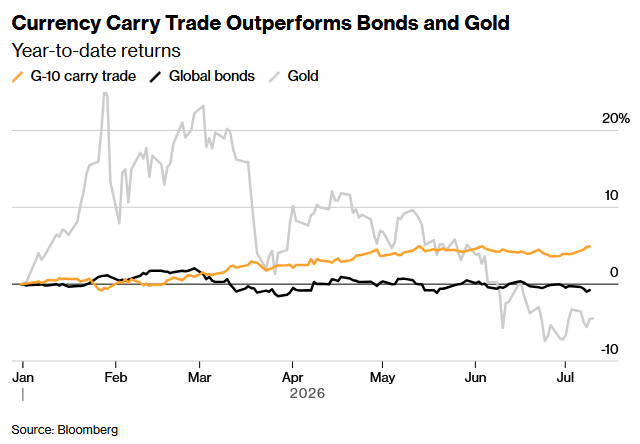
Foreign exchange arbitrage trading has outperformed bonds and gold in terms of returns since the beginning of the year
Jenkins wrote in a report released on Thursday: “It is the stability of interest rates in G10 countries in the current range — actual volatility due to interest rate differences is declining, and the market anticipates that future policy actions are relatively limited — that has enabled G10 foreign exchange arbitrage yields to rise simultaneously while volatility remains low.”
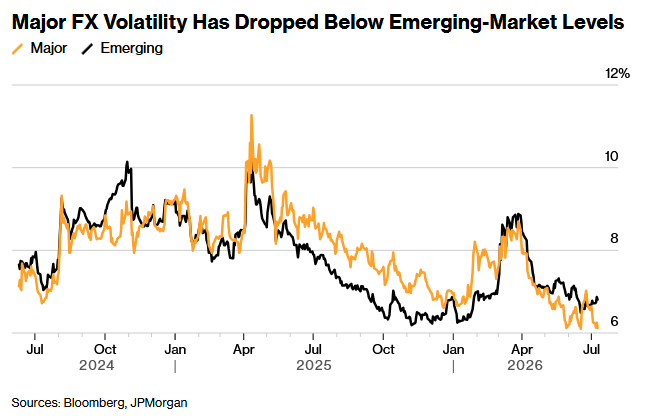
Major currency volatility remains low
Hedge funds and asset managers usually use arbitrage trading to earn interest rate differences between different markets. As long as the overall exchange rate remains stable, this strategy can continue to be profitable. However, this strategy also comes with risks. Since arbitrage gains are gradually accrued, losses due to exchange rates can occur rapidly within a few minutes. Therefore, once market fluctuations suddenly increase, it may trigger the rapid liquidation of arbitrage positions and amplify fluctuations in the entire financial market.
Barclays warned this week that the current calm in the foreign exchange market does not match the reality of high uncertainty in the global economy. The bank said that its model shows that the volatility of the foreign exchange market is more likely to rise in the future rather than decline further.
Currently, the yield on US 2-year Treasury bonds is still above 4%. In contrast, the yield on German term bonds was about 2.6%, the yield on Japanese term bonds was about 1.4%, and the yield on Swiss term bonds was only about 0.1%, making it one of the most significant interest rate differences between developed economies in recent years.
Goldman Sachs said that in the long run, the yen is still the ideal currency for arbitrage financing. Currently, the exchange rate of the yen against the US dollar is still near a low point in nearly 40 years. Although the Japanese government may intervene in the foreign exchange market at any time, Goldman Sachs expects that unless the macroeconomic environment changes, the yen will continue to weaken.
Goldman Sachs also believes that there is an investment opportunity to increase the dollar against the Swedish krona. The Markets Live strategist also pointed out, “The arbitrage gains that can be obtained by taking long positions against the US dollar against the SEK are already quite impressive.”
Furthermore, in a so-called “risk-neutral” scenario, Goldman Sachs recommended buying EUR/CHF because this pair has one of the highest “arbitrage gain/volatility” ratios among major currency pairs. Also, Goldman Sachs is optimistic about going long against the Australian dollar against the New Zealand dollar.
Jenkins said, “We believe that earning arbitrage benefits in the G10 foreign exchange market while being able to relatively effectively isolate risk asset withdrawals and even play a certain hedging role is an attractive allocation choice for multi-asset portfolios.”