
- PREMIUM
- LIVE QUOTES
- INSTITUTIONS
 Index Options


 State Street
 CME Group
 Nasdaq
 Cboe
Cboe TradingView
 Wall Street Journal
With 55% ownership, Rakus Co., Ltd. (TSE:3923) insiders have a lot at stake
Key Insights
- Rakus' significant insider ownership suggests inherent interests in company's expansion
- The top 5 shareholders own 52% of the company
- Institutional ownership in Rakus is 20%
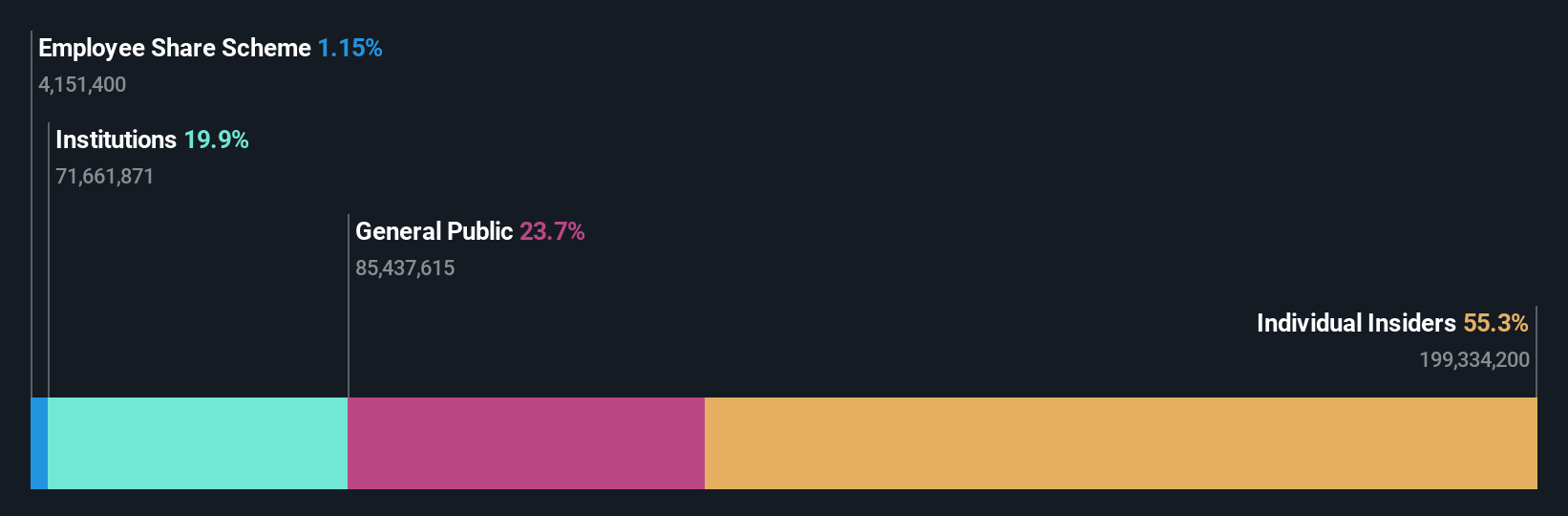
A look at the shareholders of Rakus Co., Ltd. (TSE:3923) can tell us which group is most powerful. We can see that individual insiders own the lion's share in the company with 55% ownership. In other words, the group stands to gain the most (or lose the most) from their investment into the company.
So it follows, every decision made by insiders of Rakus regarding the company's future would be crucial to them.
Let's delve deeper into each type of owner of Rakus, beginning with the chart below.
View our latest analysis for Rakus
What Does The Institutional Ownership Tell Us About Rakus?
Institutional investors commonly compare their own returns to the returns of a commonly followed index. So they generally do consider buying larger companies that are included in the relevant benchmark index.
As you can see, institutional investors have a fair amount of stake in Rakus. This can indicate that the company has a certain degree of credibility in the investment community. However, it is best to be wary of relying on the supposed validation that comes with institutional investors. They too, get it wrong sometimes. It is not uncommon to see a big share price drop if two large institutional investors try to sell out of a stock at the same time. So it is worth checking the past earnings trajectory of Rakus, (below). Of course, keep in mind that there are other factors to consider, too.

We note that hedge funds don't have a meaningful investment in Rakus. With a 34% stake, CEO Takanori Nakamura is the largest shareholder. With 4.9% and 4.9% of the shares outstanding respectively, Hideyuki Inoue and Shinichiro Motomatsu are the second and third largest shareholders. Interestingly, the third-largest shareholder, Shinichiro Motomatsu is also a Member of the Board of Directors, again, indicating strong insider ownership amongst the company's top shareholders.
Our research also brought to light the fact that roughly 52% of the company is controlled by the top 5 shareholders suggesting that these owners wield significant influence on the business.
While studying institutional ownership for a company can add value to your research, it is also a good practice to research analyst recommendations to get a deeper understand of a stock's expected performance. There are a reasonable number of analysts covering the stock, so it might be useful to find out their aggregate view on the future.
Insider Ownership Of Rakus
While the precise definition of an insider can be subjective, almost everyone considers board members to be insiders. The company management answer to the board and the latter should represent the interests of shareholders. Notably, sometimes top-level managers are on the board themselves.
I generally consider insider ownership to be a good thing. However, on some occasions it makes it more difficult for other shareholders to hold the board accountable for decisions.
Our information suggests that insiders own more than half of Rakus Co., Ltd.. This gives them effective control of the company. That means insiders have a very meaningful JP¥213b stake in this JP¥385b business. It is good to see this level of investment. You can check here to see if those insiders have been selling any of their shares.
General Public Ownership
With a 24% ownership, the general public, mostly comprising of individual investors, have some degree of sway over Rakus. This size of ownership, while considerable, may not be enough to change company policy if the decision is not in sync with other large shareholders.
Next Steps:
It's always worth thinking about the different groups who own shares in a company. But to understand Rakus better, we need to consider many other factors.
Many find it useful to take an in depth look at how a company has performed in the past. You can access this detailed graph of past earnings, revenue and cash flow.
But ultimately it is the future, not the past, that will determine how well the owners of this business will do. Therefore we think it advisable to take a look at this free report showing whether analysts are predicting a brighter future.
NB: Figures in this article are calculated using data from the last twelve months, which refer to the 12-month period ending on the last date of the month the financial statement is dated. This may not be consistent with full year annual report figures.
Have feedback on this article? Concerned about the content? Get in touch with us directly. Alternatively, email editorial-team (at) simplywallst.com.
This article by Simply Wall St is general in nature. We provide commentary based on historical data and analyst forecasts only using an unbiased methodology and our articles are not intended to be financial advice. It does not constitute a recommendation to buy or sell any stock, and does not take account of your objectives, or your financial situation. We aim to bring you long-term focused analysis driven by fundamental data. Note that our analysis may not factor in the latest price-sensitive company announcements or qualitative material. Simply Wall St has no position in any stocks mentioned.