
- PREMIUM
- LIVE QUOTES
- INSTITUTIONS
 Index Options


 State Street
 CME Group
 Nasdaq
 Cboe
Cboe TradingView
 Wall Street Journal
The rise of the US middle class Goldman Sachs bets on US stocks 2026 “consumer bulls” to take over AI
The Zhitong Finance App learned that as market concerns about artificial intelligence (AI) related transactions cool down, Wall Street strategists are actively looking for new growth engines for the US stock market.
A team of Goldman Sachs analysts led by Ben Snider has their sights set on companies benefiting from increased middle class consumer spending. The Snider team is optimistic about medical service providers, material manufacturers, and essential consumer goods manufacturers, and is particularly bullish on companies that sell “icing on the cake” products that are not just needed.
These companies include high-end clothing and accessories retailers, home goods manufacturers, travel agencies, and gaming operators. According to the Goldman Sachs team's analysis, the growth rate of the US economy is expected to accelerate, which will drive a number of companies with stable growth but low profit margins to improve profits — and such companies have been leading the market in performance since October last year.
In an investor report released on January 6, the Snider team wrote: “Stocks that have high exposure to middle class consumer spending are particularly attractive. At the beginning of 2026, value stocks will continue to lead the market in terms of performance. The real income growth rate of the middle class is expected to accelerate, and this trend will be transformed into a driving force for corporate sales growth.”
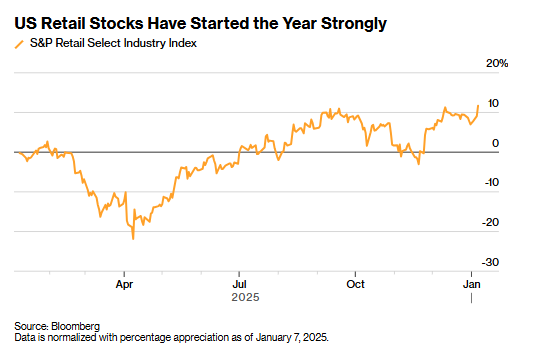
The S&P Retail Select Industry Index, which includes companies such as KMX.US (KMX.US), Etsy (ETSY.US), and Academy Sports & Outdoors (ASO.US), has accumulated a cumulative increase of 3.5% since the beginning of the year, and has risen 8.8% since the busy holiday shopping season began in November last year.
The Goldman Sachs team anticipates that multiple favorable factors will inject momentum into the consumer market. For example, the negative impact of tariffs imposed during the Trump administration is gradually fading, the labor market is stabilizing, and the tax refund dividends released after the implementation of major laws introduced by the US government last year will all boost consumption vitality.
Currently, investors are rushing to find an alternative direction for AI concept stocks that have led the market in the past three years. Previously, the AI sector led by the “Big Seven” had always been the absolute protagonist of the market.
Economists surveyed predict that the US economy will grow 2.1% this year, driven by consumer spending. This expectation has prompted investors to shift capital to sectors that have lagged behind in recent years.
Charlie McEligott, a cross-asset macro strategist at Nomura Securities International, said, “The market is raising expectations for US economic growth. If this trend continues, it will benefit the more traditional value stock sector.”
In an interview, he added, “The market showed a clear trend of fragmentation last year, and only 12 individual stocks supported the overall market's upward trend. Now, the rise in the market is spreading to a wider range of sectors.”
“Investors are beginning to move to sectors with higher beta coefficients in the market,” McEligott explained. These sectors tend to be highly volatile and are closely related to the economic conditions of ordinary American consumers.
Dick Sporting Goods (DKS.US) was an early beneficiary of this round of potential sector rotation. The company, headquartered in Coraopolis, Pennsylvania, specializes in sporting goods such as golf clubs, soccer shoes, and tennis rackets. The company's stock price plummeted 13% in 2025, but after entering 2026, the stock price rose 6.1% to $210.08 in just four trading days.
According to Chris Murphy, co-head of derivatives strategy at Susquehanna International Group, during the options trading on Tuesday, some investors were betting that the stock would return to an all-time high of $250 — a price the retailer set in early 2025. The premium cost for this option position is $84,000, and the potential maximum return is $3.5 million.
In addition to Dick's Sporting Goods, Goldman Sachs also listed five other retail chains benefiting from the growing wealth of the middle class, including Burlington Department Store (BURL.US), Best Buy (BBY.US), Five Below (FIVE.US), LEVI.US (LEVI.US), and Gap (GAP.US).
Admittedly, physical retailers have always faced fierce competition from e-commerce giants such as Amazon (AMZN.US). However, in the context of high valuations of large technology and AI-driven companies, investors seem to be looking more at other investment opportunities.
At least in early 2026, the value stock sector seemed to have become a “value depression” in the market. McEligott put it bluntly: “The valuation of growth stocks is already ridiculously expensive.”