
- PREMIUM
- LIVE QUOTES
- INSTITUTIONS
 Index Options


 State Street
 CME Group
 Nasdaq
 Cboe
Cboe TradingView
 Wall Street Journal
Is It Too Late To Consider Carvana (CVNA) After Its 3-Year Share Price Surge?
- If you are wondering whether Carvana's current share price reflects its true worth, you are not alone. This article will focus squarely on what the numbers say about value.
- Carvana's share price closed at US$440.44, with returns of 2.5% over the past 7 days, 10.2% over the past 30 days, 10.0% year to date, 122.1% over the last year, and a very large return over 3 years compared to 5 years.
- Recent coverage around Carvana has centered on its position in online used car retailing and how investors are weighing that business model against the broader auto and retail sector. This context has kept attention on how sensitive the stock may be to shifts in sentiment about used vehicle demand, financing conditions, and digital only car buying platforms.
- On Simply Wall St's 6 point valuation check, Carvana currently scores 0 out of 6. We will look at what traditional valuation tools such as multiples and cash flow models suggest about the stock, and then finish with a different way of thinking about value that can help tie all of these pieces together.
Carvana scores just 0/6 on our valuation checks. See what other red flags we found in the full valuation breakdown.
Approach 1: Carvana Discounted Cash Flow (DCF) Analysis
A Discounted Cash Flow, or DCF, model estimates what a company might be worth today by taking forecasts of its future cash flows and discounting them back to a single present value in today's dollars.
For Carvana, the model used is a 2 Stage Free Cash Flow to Equity approach, based on cash flows available to shareholders. The latest twelve month Free Cash Flow is US$520.3 million. Analysts have provided explicit forecasts out to 2028, with Simply Wall St extrapolating cash flows beyond that, including a projected Free Cash Flow of US$4.2b by 2030. The ten year projections range from US$1.3b in 2026 to US$7.3b in 2035, with each year discounted back to reflect the time value of money.
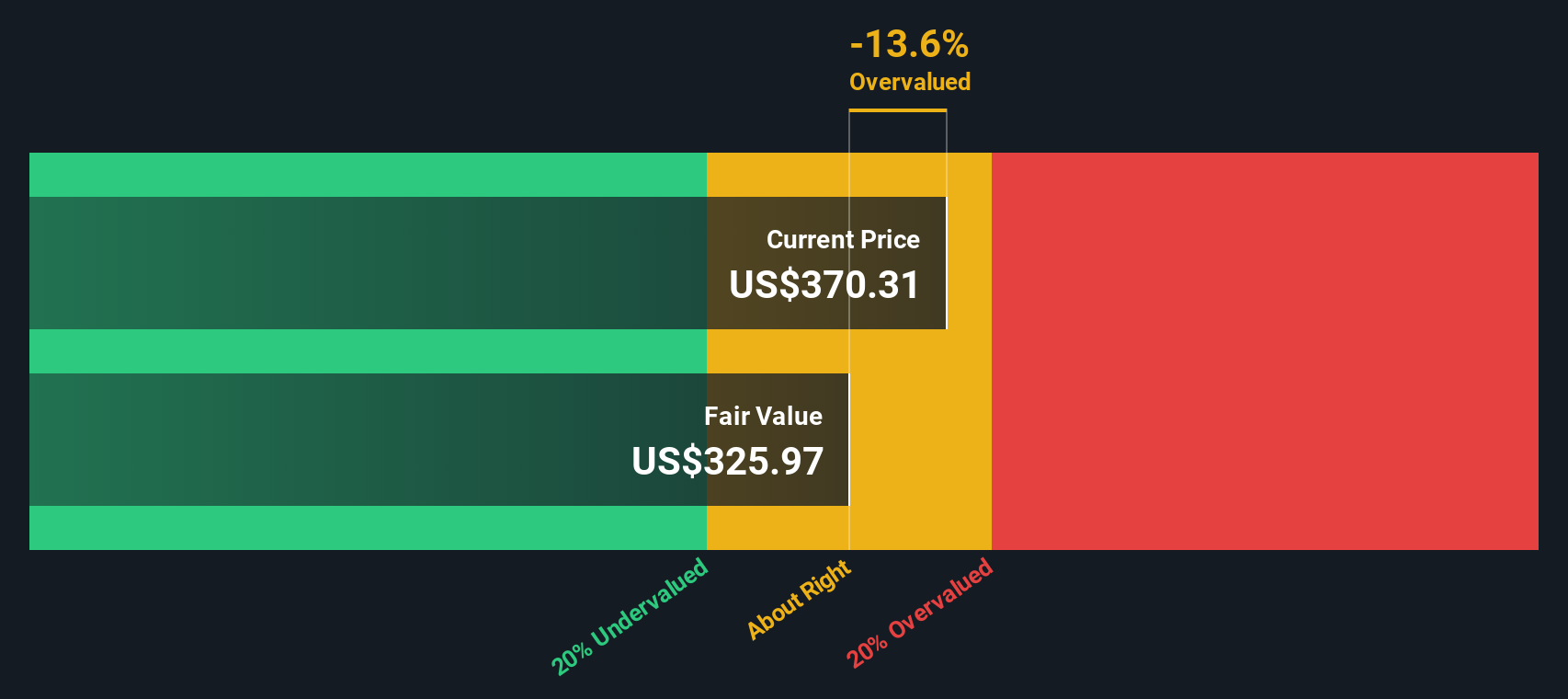
Adding up these discounted cash flows and adjusting for the share count gives an estimated intrinsic value of about US$404.44 per share. Compared with the recent share price of US$440.44, the model implies Carvana is about 8.9% overvalued, which sits within a reasonable margin of error for this kind of analysis.
Result: ABOUT RIGHT
Carvana is fairly valued according to our Discounted Cash Flow (DCF), but this can change at a moment's notice. Track the value in your watchlist or portfolio and be alerted on when to act.
Approach 2: Carvana Price vs Earnings
For profitable companies, the P/E ratio is a straightforward way to see how much investors are paying for each dollar of earnings. It links the share price directly to the bottom line, which is what ultimately supports long term returns.
What counts as a reasonable P/E depends on how the market views a company’s growth potential and risk. Higher expected growth or lower perceived risk can support a higher P/E, while slower growth or higher risk usually justifies a lower one.
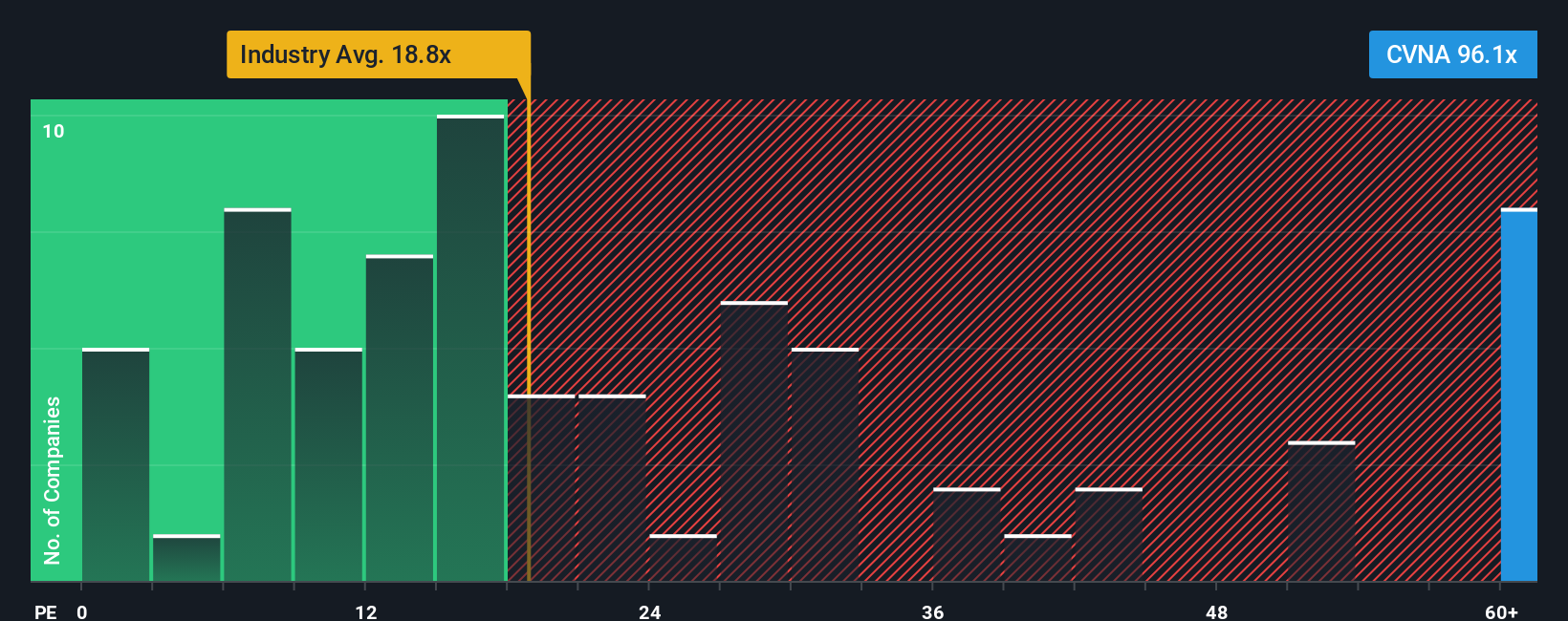
Carvana currently trades on a P/E of 99.0x. That is well above the Specialty Retail industry average of 20.7x and the broader peer average of 18.2x. To go a step further, Simply Wall St calculates a “Fair Ratio” of 38.1x for Carvana. This proprietary metric estimates the P/E that might be appropriate after accounting for factors such as earnings growth, profit margins, industry, market cap and specific risks.
Because the Fair Ratio builds these company specific inputs into one number, it can offer a more tailored reference point than simple peer or industry comparisons. Set against this 38.1x Fair Ratio, Carvana’s current 99.0x P/E points to the shares trading at a richer level.
Result: OVERVALUED
P/E ratios tell one story, but what if the real opportunity lies elsewhere? Discover 1448 companies where insiders are betting big on explosive growth.
Upgrade Your Decision Making: Choose your Carvana Narrative
Earlier we mentioned that there is an even better way to understand valuation. Let us introduce you to Narratives, where you tell a simple story about Carvana using your own assumptions for future revenue, earnings and margins. You then link that story to a forecast and a fair value, and compare that fair value with the current price, all inside Simply Wall St's Community page, which millions of investors use. Narratives update automatically when new news or earnings arrive and, in Carvana's case, allow one investor to build a bullish story that lines up closer to the US$500 analyst target while another builds a more cautious story near US$330. This way you can see clearly which version of the future you believe and what that implies for your next move.
Do you think there's more to the story for Carvana? Head over to our Community to see what others are saying!
This article by Simply Wall St is general in nature. We provide commentary based on historical data and analyst forecasts only using an unbiased methodology and our articles are not intended to be financial advice. It does not constitute a recommendation to buy or sell any stock, and does not take account of your objectives, or your financial situation. We aim to bring you long-term focused analysis driven by fundamental data. Note that our analysis may not factor in the latest price-sensitive company announcements or qualitative material. Simply Wall St has no position in any stocks mentioned.
Have feedback on this article? Concerned about the content? Get in touch with us directly. Alternatively, email editorial-team@simplywallst.com