
- PREMIUM
- LIVE QUOTES
- INSTITUTIONS
 Index Options


 State Street
 CME Group
 Nasdaq
 Cboe
Cboe TradingView
 Wall Street Journal
Is Seadrill (SDRL) Offering Opportunity After Recent Offshore Drilling Sector Attention?
- If you are wondering whether Seadrill at around US$34.80 is a value opportunity or a value trap, this article walks through the key checks that matter before you decide what to do next.
- The share price has been relatively steady over the last week with a 0.8% return, but the 8.8% return over the last 30 days sits against a year to date return of 0.4% decline and a 9.5% decline over the last year.
- Recent attention on offshore drilling and related energy names has kept Seadrill on more investors' watchlists, as the sector continues to be influenced by energy demand expectations and capital allocation trends across the industry. These themes help frame why a stock can show a 3.2% return over three years while still posting a decline over the most recent 12 months.
- Simply Wall St currently gives Seadrill a valuation score of 2 out of 6. This means it screens as undervalued on 2 of the 6 checks we will look at in more detail, and we will compare those standard valuation tools with a broader way of thinking about value at the end of the article.
Seadrill scores just 2/6 on our valuation checks. See what other red flags we found in the full valuation breakdown.
Approach 1: Seadrill Discounted Cash Flow (DCF) Analysis
A Discounted Cash Flow, or DCF, model estimates what a company might be worth today by projecting its future cash flows and then discounting those back to a present value.
For Seadrill, the latest twelve month free cash flow is a loss of $100.35 million. The current model uses a 2 Stage Free Cash Flow to Equity approach, with analyst inputs for the early years and then extrapolated figures after that. For example, Simply Wall St uses analyst estimates of $75 million in free cash flow for 2026 and $231.5 million for 2027, before extending that path out to 2035, where projected free cash flow is $1,554.81 million.
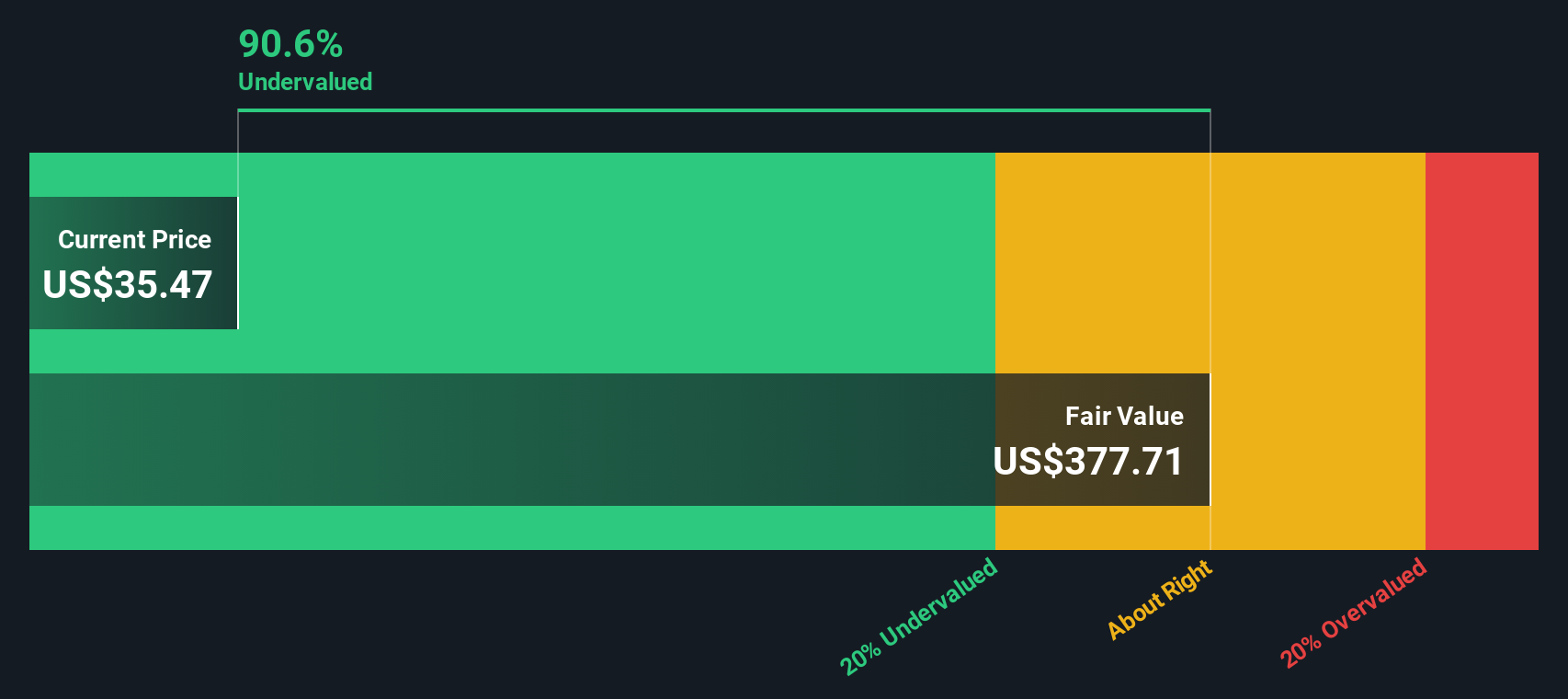
When all of those projected cash flows are discounted back to today, the model arrives at an intrinsic value of about $376.06 per share. Against a current share price around $34.80, this specific DCF output indicates the stock screens as around 90.7% undervalued on this set of assumptions.
Result: UNDERVALUED
Our Discounted Cash Flow (DCF) analysis suggests Seadrill is undervalued by 90.7%. Track this in your watchlist or portfolio, or discover 877 more undervalued stocks based on cash flows.
Approach 2: Seadrill Price vs Earnings
P/E is a common way to look at value for companies that are generating earnings, because it links what you pay per share to the profit that each share represents. In general, higher growth and lower risk can justify a higher P/E, while slower growth or higher risk usually lines up with a lower, more conservative P/E that investors might see as “normal” or “fair.”
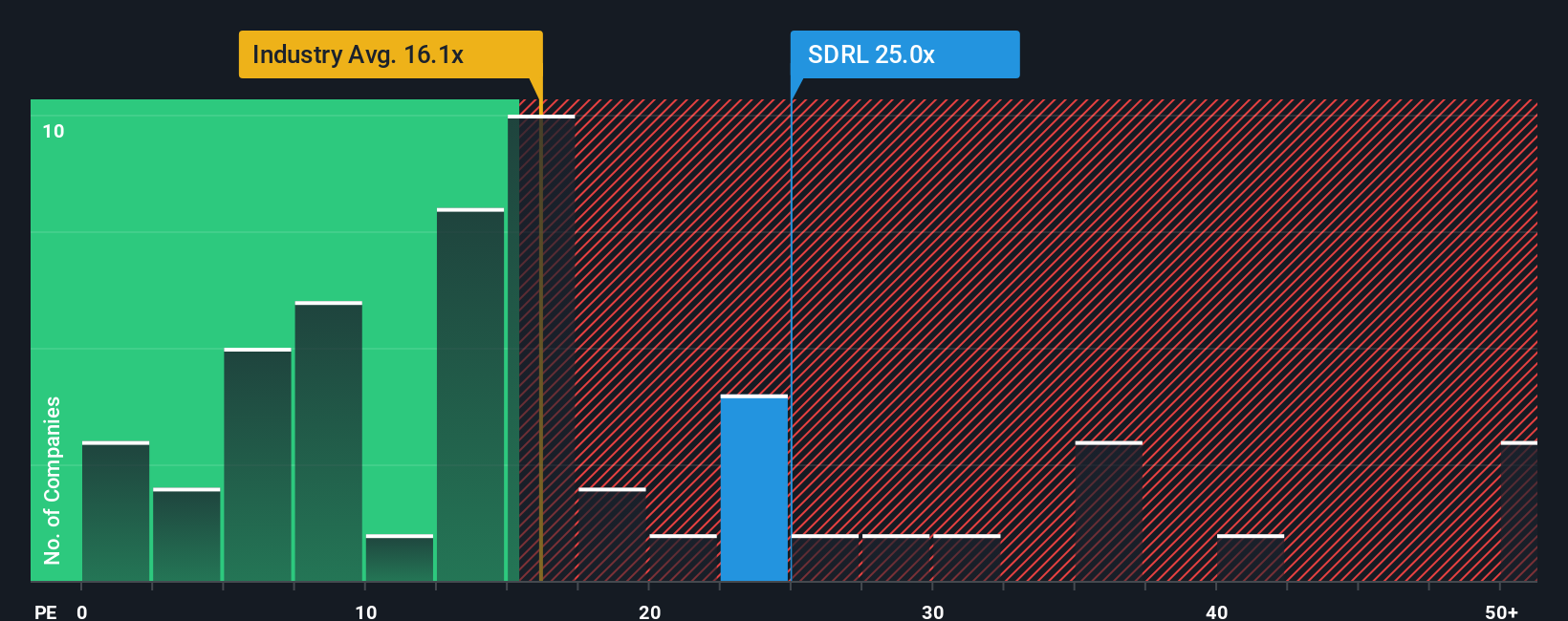
Seadrill is currently trading on a P/E of 63.84x. That sits above the Energy Services industry average of 19.88x and above the peer average of 13.13x, so on simple comparisons the shares look expensive relative to many similar companies.
Simply Wall St’s Fair Ratio for Seadrill is 53.39x. This is a proprietary estimate of what the P/E “should” be when you factor in the company’s earnings growth profile, profit margins, industry, market value and risk characteristics. Because it blends these elements into one number, the Fair Ratio can be more tailored than a basic check against peers or the industry, which treat all companies in the group as if they deserve the same multiple.
Compared with the Fair Ratio of 53.39x, Seadrill’s current P/E of 63.84x screens as overvalued on this metric.
Result: OVERVALUED
P/E ratios tell one story, but what if the real opportunity lies elsewhere? Discover 1449 companies where insiders are betting big on explosive growth.
Upgrade Your Decision Making: Choose your Seadrill Narrative
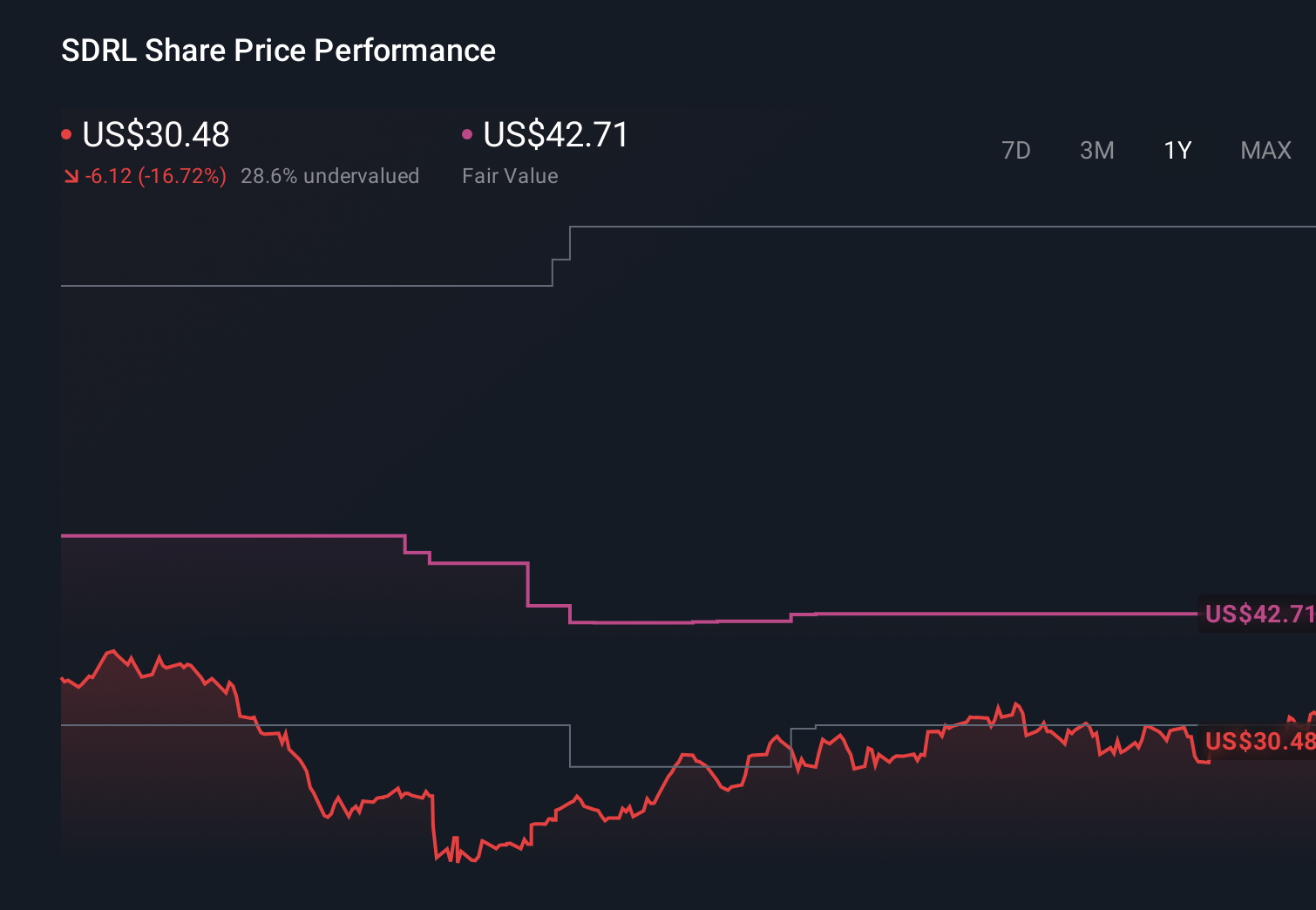
Earlier we mentioned that there is an even better way to understand valuation. Let us introduce you to Narratives, which are simple stories you create about a company that tie your view of its future revenue, earnings and margins to a forecast and fair value. You then compare that fair value with today’s price to help you decide when to buy or sell, all within an easy tool on Simply Wall St’s Community page that automatically refreshes as new news or earnings arrive. For Seadrill, one investor might build a bullish Narrative that leans on tight ultra deepwater rig supply, higher expected margins of 14.6% and a fair value near the US$43.50 analyst consensus. Another might focus on softer utilization, regulatory risks and cash preservation and land closer to the US$32.00 low analyst target. You can see both viewpoints side by side to decide which story you think is more realistic.
Do you think there's more to the story for Seadrill? Head over to our Community to see what others are saying!
This article by Simply Wall St is general in nature. We provide commentary based on historical data and analyst forecasts only using an unbiased methodology and our articles are not intended to be financial advice. It does not constitute a recommendation to buy or sell any stock, and does not take account of your objectives, or your financial situation. We aim to bring you long-term focused analysis driven by fundamental data. Note that our analysis may not factor in the latest price-sensitive company announcements or qualitative material. Simply Wall St has no position in any stocks mentioned.
Have feedback on this article? Concerned about the content? Get in touch with us directly. Alternatively, email editorial-team@simplywallst.com