
America's “copper hoarding wave” has sparked a rise in the market! Copper prices rose above $13,000 and then hit a new high
The Zhitong Finance App learned that copper prices continued to rise strongly after breaking through the $13,000 per ton mark for the first time because the new wave of copper shipments to the US has further stimulated bullish sentiment among bulls and investors. After rising more than 4% on Monday, as of press release, LME copper futures had risen nearly 4.5% to a record high of 13,235 US dollars/ton. Earlier in the day, they had risen to a record high of 13,259.75 US dollars/ton.
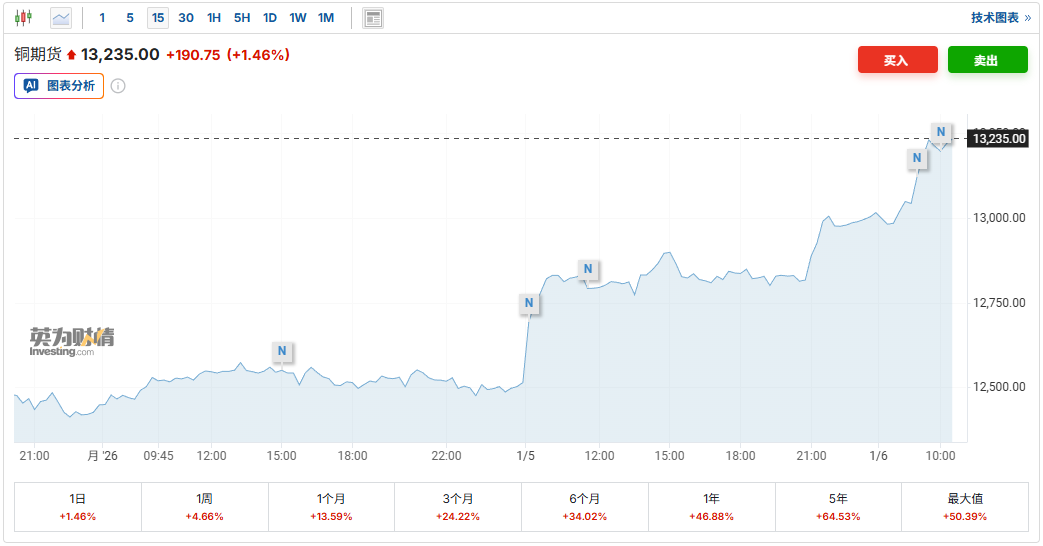
Since mid-November last year, copper prices have increased by more than 20% cumulatively. The support for this round of gains comes from a new wave of copper shipments to the US. As the threat of US President Trump imposing import tariffs on metals such as copper persists, large quantities of metals, including copper, are being shipped to the US in order to evade tariffs. Helen Amos (Helen Amos), commodity analyst at BMO Capital Markets, said: “The historic accumulation of US inventories remains the core driving force behind global copper prices.”
In the first half of last year, Trump's policy already triggered a boom in large-scale copper shipments to the US. Then, at the end of July, import tariffs on refined copper were suddenly exempted, stopping this rush of goods for a while. However, in recent months, as the Trump administration's plan to re-evaluate copper import tariffs was put on the agenda, US copper prices once again surged, and the campaign became active again. Trade data shows that US copper imports jumped to the highest level since July in December last year.
Al Munro (Al Munro), senior basic metals strategist at Marex, stated: “The reality is that this round of growth is driven by speculative capital because the market expects further price increases, especially in the first quarter of 2026. Many investors who previously watched and expected a price correction have entered the market one after another.”
At the same time, tight supply is also a core supporting factor for the continued rise in copper prices. The recent strike at Capstone Copper's Mantoverde copper and gold mine in northern Chile has further strengthened market concerns about supply shortages. Until then, some of the world's largest copper mines in 2025 were not flat. In late May 2025, a mine earthquake occurred at the Kamoa-Kakura copper mine, the fourth largest copper mine in the Democratic Republic of the Congo (DRC), which lowered its 2025 production guidelines from 520,000 to 520,000 tons. At the end of July, Chile's El Teniente mine, the world's largest underground copper mine, collapsed due to an earthquake. The Chilean State Copper Company, which operates the mine, said production will be reduced by 300,000 tons this year, which is about 11% lower than previously anticipated. US mining giant Freeport-Moc Moran temporarily suspended operations after a landslide occurred at Indonesia's Grasberg mine on September 8. The company has announced the initiation of force majeure clauses and expects its production to be significantly affected and continue until 2027. Freeport-Mockmoland has cut the 2026 Grasberg mine production guideline by 35%, which means a reduction in copper supply of around 270,000 tons.
As the US continues to siphon global copper stocks, the decline in copper inventories in other regions of the world has further heightened concerns about copper supply and attracted bulls that are already optimistic about the prospects for copper demand. Copper is widely used in various fields such as electric vehicle batteries and data centers. It is worth mentioning that under the wave of rapid advances in global AI computing power infrastructure, data centers are becoming veritable “new copper mines.” Copper, a traditional industrial metal, has become a core material supporting the development of the artificial intelligence industry due to its irreplaceable electrical and thermal conductivity. The Morgan Stanley report predicts that in 2025, global data center copper consumption will be about 500,000 tons, accounting for 1.5% of total global copper demand; in 2026, this figure will increase to 740,000 tons, contributing 0.6 percentage points to the increase in global copper demand. By 2027, data center copper consumption is expected to reach 1 million tons (2.8% of total demand), and further increase to 1.3 million tons (3.3%) in 2028, with a compound annual growth rate of 40%.
Copper is receiving more and more attention as government concerns about the supply of key metals increase. Copper is critical to the energy transition, yet miners and traders have long warned that investment in new mines has failed to keep up with the pace of new demand. Ewa Manthey (Ewa Manthey), commodity strategist at Dutch International Group, said: “Years of underinvestment and continued mine turbulence have left the market with little room to buffer. At the same time, uncertainty about tariff policies and hoarding practices are increasing the supply of usable metals.”
Kostas Bintas (Kostas Bintas), the head of Mercuria Energy Group's well-known metals business, warned in an interview in November last year that the rush of imported copper from the US would cause the rest of the world to run into copper shortages, and predicted that this “will be a decisive market” for copper bulls. Mantai also warned that “with the exception of the US, low inventory levels on major exchanges have little room to absorb any further supply shocks.”
According to UBS data, the US holds about half of the world's copper inventory, yet its demand accounts for less than 10% of the world's demand. This means that the rest of the world is at risk of reduced supply. The price difference between LME spot copper and three-month copper is still at a deep spot premium. This structure indicates a recent tight supply. UBS Group analysts, including Daniel Major (Daniel Major), wrote in Monday's report: “We estimate that the global refined copper market is oversupplied in 2025, but the US tariff policy distorted the flow of metals/stocks, leading to a sharp increase in US imports.”