
- PREMIUM
- LIVE QUOTES
- INSTITUTIONS
 Index Options


 State Street
 CME Group
 Nasdaq
 Cboe
Cboe TradingView
 Wall Street Journal
There Are Reasons To Feel Uneasy About Metropolis Healthcare's (NSE:METROPOLIS) Returns On Capital
If we want to find a potential multi-bagger, often there are underlying trends that can provide clues. Firstly, we'll want to see a proven return on capital employed (ROCE) that is increasing, and secondly, an expanding base of capital employed. If you see this, it typically means it's a company with a great business model and plenty of profitable reinvestment opportunities. In light of that, when we looked at Metropolis Healthcare (NSE:METROPOLIS) and its ROCE trend, we weren't exactly thrilled.
What Is Return On Capital Employed (ROCE)?
Just to clarify if you're unsure, ROCE is a metric for evaluating how much pre-tax income (in percentage terms) a company earns on the capital invested in its business. Analysts use this formula to calculate it for Metropolis Healthcare:
Return on Capital Employed = Earnings Before Interest and Tax (EBIT) ÷ (Total Assets - Current Liabilities)
0.13 = ₹2.1b ÷ (₹20b - ₹3.0b) (Based on the trailing twelve months to September 2025).
Thus, Metropolis Healthcare has an ROCE of 13%. That's a relatively normal return on capital, and it's around the 12% generated by the Healthcare industry.
View our latest analysis for Metropolis Healthcare
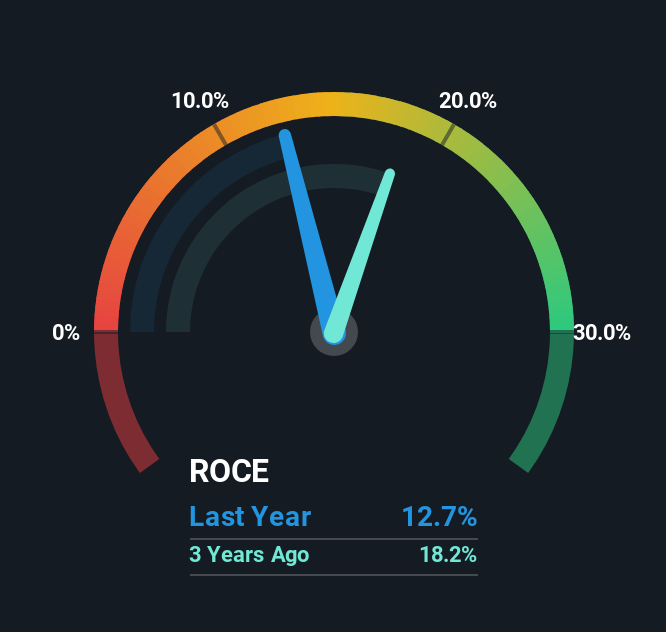
In the above chart we have measured Metropolis Healthcare's prior ROCE against its prior performance, but the future is arguably more important. If you're interested, you can view the analysts predictions in our free analyst report for Metropolis Healthcare .
What Does the ROCE Trend For Metropolis Healthcare Tell Us?
Unfortunately, the trend isn't great with ROCE falling from 27% five years ago, while capital employed has grown 155%. However, some of the increase in capital employed could be attributed to the recent capital raising that's been completed prior to their latest reporting period, so keep that in mind when looking at the ROCE decrease. Metropolis Healthcare probably hasn't received a full year of earnings yet from the new funds it raised, so these figures should be taken with a grain of salt. Also, we found that by looking at the company's latest EBIT, the figure is within 10% of the previous year's EBIT so you can basically assign the ROCE drop primarily to that capital raise.
In Conclusion...
Even though returns on capital have fallen in the short term, we find it promising that revenue and capital employed have both increased for Metropolis Healthcare. These trends don't appear to have influenced returns though, because the total return from the stock has been mostly flat over the last five years. As a result, we'd recommend researching this stock further to uncover what other fundamentals of the business can show us.
If you're still interested in Metropolis Healthcare it's worth checking out our FREE intrinsic value approximation for METROPOLIS to see if it's trading at an attractive price in other respects.
While Metropolis Healthcare isn't earning the highest return, check out this free list of companies that are earning high returns on equity with solid balance sheets.
Have feedback on this article? Concerned about the content? Get in touch with us directly. Alternatively, email editorial-team (at) simplywallst.com.
This article by Simply Wall St is general in nature. We provide commentary based on historical data and analyst forecasts only using an unbiased methodology and our articles are not intended to be financial advice. It does not constitute a recommendation to buy or sell any stock, and does not take account of your objectives, or your financial situation. We aim to bring you long-term focused analysis driven by fundamental data. Note that our analysis may not factor in the latest price-sensitive company announcements or qualitative material. Simply Wall St has no position in any stocks mentioned.