
- PREMIUM
- LIVE QUOTES
- INSTITUTIONS
 Index Options


 State Street
 CME Group
 Nasdaq
 Cboe
Cboe TradingView
 Wall Street Journal
Estimating The Intrinsic Value Of Takasago Thermal Engineering Co., Ltd. (TSE:1969)
Key Insights
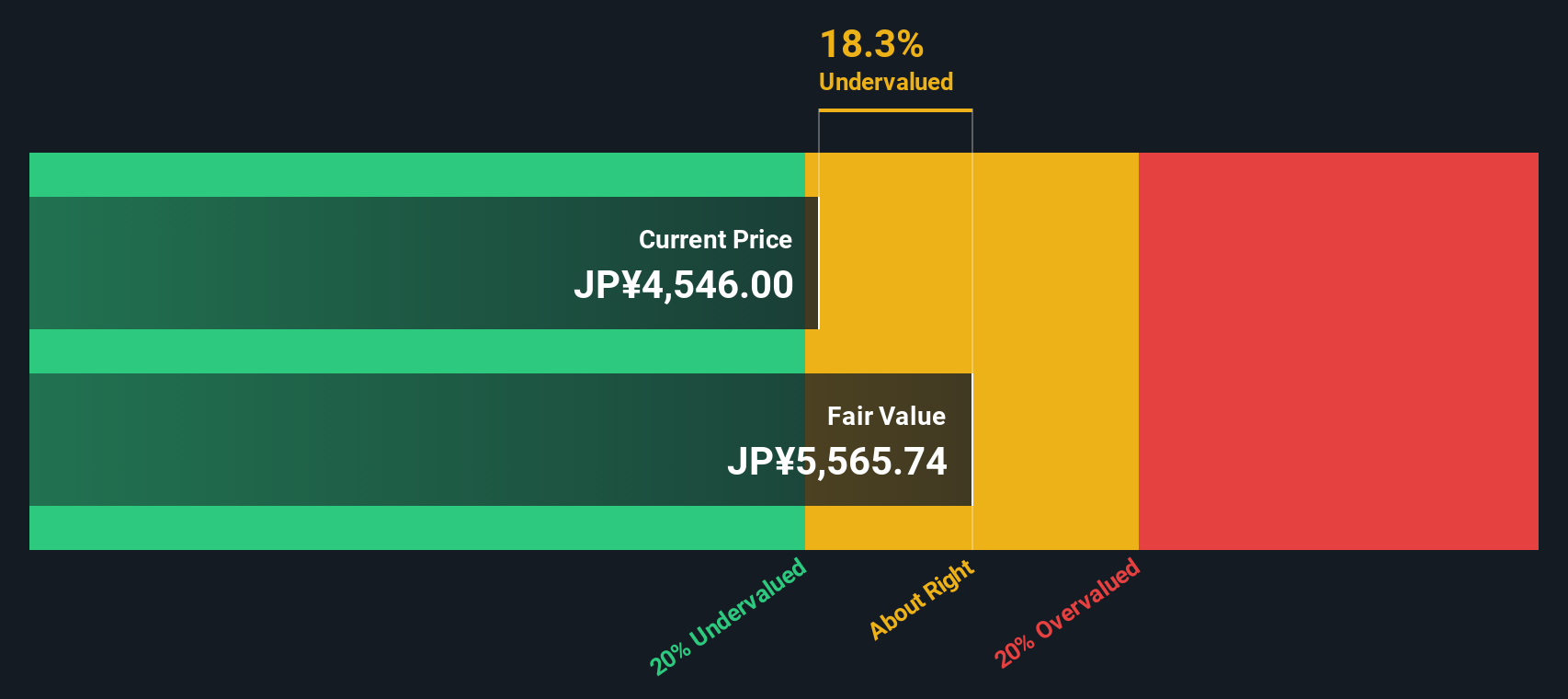
- The projected fair value for Takasago Thermal Engineering is JP¥5,566 based on 2 Stage Free Cash Flow to Equity
- Current share price of JP¥4,546 suggests Takasago Thermal Engineering is potentially trading close to its fair value
- The JP¥4,592 analyst price target for 1969 is 18% less than our estimate of fair value
Today we'll do a simple run through of a valuation method used to estimate the attractiveness of Takasago Thermal Engineering Co., Ltd. (TSE:1969) as an investment opportunity by taking the expected future cash flows and discounting them to their present value. We will use the Discounted Cash Flow (DCF) model on this occasion. There's really not all that much to it, even though it might appear quite complex.
We would caution that there are many ways of valuing a company and, like the DCF, each technique has advantages and disadvantages in certain scenarios. If you still have some burning questions about this type of valuation, take a look at the Simply Wall St analysis model.
Is Takasago Thermal Engineering Fairly Valued?
We're using the 2-stage growth model, which simply means we take in account two stages of company's growth. In the initial period the company may have a higher growth rate and the second stage is usually assumed to have a stable growth rate. In the first stage we need to estimate the cash flows to the business over the next ten years. Where possible we use analyst estimates, but when these aren't available we extrapolate the previous free cash flow (FCF) from the last estimate or reported value. We assume companies with shrinking free cash flow will slow their rate of shrinkage, and that companies with growing free cash flow will see their growth rate slow, over this period. We do this to reflect that growth tends to slow more in the early years than it does in later years.
Generally we assume that a dollar today is more valuable than a dollar in the future, so we need to discount the sum of these future cash flows to arrive at a present value estimate:
10-year free cash flow (FCF) estimate
| 2026 | 2027 | 2028 | 2029 | 2030 | 2031 | 2032 | 2033 | 2034 | 2035 | |
| Levered FCF (¥, Millions) | JP¥34.8b | JP¥33.1b | JP¥37.0b | JP¥39.7b | JP¥41.9b | JP¥43.5b | JP¥44.8b | JP¥45.8b | JP¥46.6b | JP¥47.2b |
| Growth Rate Estimate Source | Analyst x1 | Analyst x3 | Analyst x2 | Est @ 7.39% | Est @ 5.36% | Est @ 3.93% | Est @ 2.93% | Est @ 2.23% | Est @ 1.74% | Est @ 1.40% |
| Present Value (¥, Millions) Discounted @ 6.4% | JP¥32.7k | JP¥29.2k | JP¥30.7k | JP¥31.0k | JP¥30.6k | JP¥29.9k | JP¥28.9k | JP¥27.8k | JP¥26.6k | JP¥25.3k |
("Est" = FCF growth rate estimated by Simply Wall St)
Present Value of 10-year Cash Flow (PVCF) = JP¥293b
We now need to calculate the Terminal Value, which accounts for all the future cash flows after this ten year period. The Gordon Growth formula is used to calculate Terminal Value at a future annual growth rate equal to the 5-year average of the 10-year government bond yield of 0.6%. We discount the terminal cash flows to today's value at a cost of equity of 6.4%.
Terminal Value (TV)= FCF2035 × (1 + g) ÷ (r – g) = JP¥47b× (1 + 0.6%) ÷ (6.4%– 0.6%) = JP¥813b
Present Value of Terminal Value (PVTV)= TV / (1 + r)10= JP¥813b÷ ( 1 + 6.4%)10= JP¥436b
The total value is the sum of cash flows for the next ten years plus the discounted terminal value, which results in the Total Equity Value, which in this case is JP¥728b. The last step is to then divide the equity value by the number of shares outstanding. Compared to the current share price of JP¥4.5k, the company appears about fair value at a 18% discount to where the stock price trades currently. The assumptions in any calculation have a big impact on the valuation, so it is better to view this as a rough estimate, not precise down to the last cent.
Important Assumptions
The calculation above is very dependent on two assumptions. The first is the discount rate and the other is the cash flows. You don't have to agree with these inputs, I recommend redoing the calculations yourself and playing with them. The DCF also does not consider the possible cyclicality of an industry, or a company's future capital requirements, so it does not give a full picture of a company's potential performance. Given that we are looking at Takasago Thermal Engineering as potential shareholders, the cost of equity is used as the discount rate, rather than the cost of capital (or weighted average cost of capital, WACC) which accounts for debt. In this calculation we've used 6.4%, which is based on a levered beta of 1.113. Beta is a measure of a stock's volatility, compared to the market as a whole. We get our beta from the industry average beta of globally comparable companies, with an imposed limit between 0.8 and 2.0, which is a reasonable range for a stable business.
Check out our latest analysis for Takasago Thermal Engineering
SWOT Analysis for Takasago Thermal Engineering
- Earnings growth over the past year exceeded the industry.
- Debt is not viewed as a risk.
- Dividend is low compared to the top 25% of dividend payers in the Building market.
- Annual earnings are forecast to grow for the next 3 years.
- Good value based on P/E ratio and estimated fair value.
- Dividends are not covered by cash flow.
- Annual earnings are forecast to grow slower than the Japanese market.
Next Steps:
Although the valuation of a company is important, it shouldn't be the only metric you look at when researching a company. DCF models are not the be-all and end-all of investment valuation. Instead the best use for a DCF model is to test certain assumptions and theories to see if they would lead to the company being undervalued or overvalued. For example, changes in the company's cost of equity or the risk free rate can significantly impact the valuation. For Takasago Thermal Engineering, we've put together three relevant items you should further research:
- Risks: Every company has them, and we've spotted 3 warning signs for Takasago Thermal Engineering (of which 1 is potentially serious!) you should know about.
- Future Earnings: How does 1969's growth rate compare to its peers and the wider market? Dig deeper into the analyst consensus number for the upcoming years by interacting with our free analyst growth expectation chart.
- Other High Quality Alternatives: Do you like a good all-rounder? Explore our interactive list of high quality stocks to get an idea of what else is out there you may be missing!
PS. The Simply Wall St app conducts a discounted cash flow valuation for every stock on the TSE every day. If you want to find the calculation for other stocks just search here.
Have feedback on this article? Concerned about the content? Get in touch with us directly. Alternatively, email editorial-team (at) simplywallst.com.
This article by Simply Wall St is general in nature. We provide commentary based on historical data and analyst forecasts only using an unbiased methodology and our articles are not intended to be financial advice. It does not constitute a recommendation to buy or sell any stock, and does not take account of your objectives, or your financial situation. We aim to bring you long-term focused analysis driven by fundamental data. Note that our analysis may not factor in the latest price-sensitive company announcements or qualitative material. Simply Wall St has no position in any stocks mentioned.