
- PREMIUM
- LIVE QUOTES
- INSTITUTIONS
 Index Options


 State Street
 CME Group
 Nasdaq
 Cboe
Cboe TradingView
 Wall Street Journal
Institutional investors may overlook Frequency Electronics, Inc.'s (NASDAQ:FEIM) recent US$53m market cap drop as long-term gains remain positive
Key Insights
- Significantly high institutional ownership implies Frequency Electronics' stock price is sensitive to their trading actions
- A total of 8 investors have a majority stake in the company with 51% ownership
- Past performance of a company along with ownership data serve to give a strong idea about prospects for a business
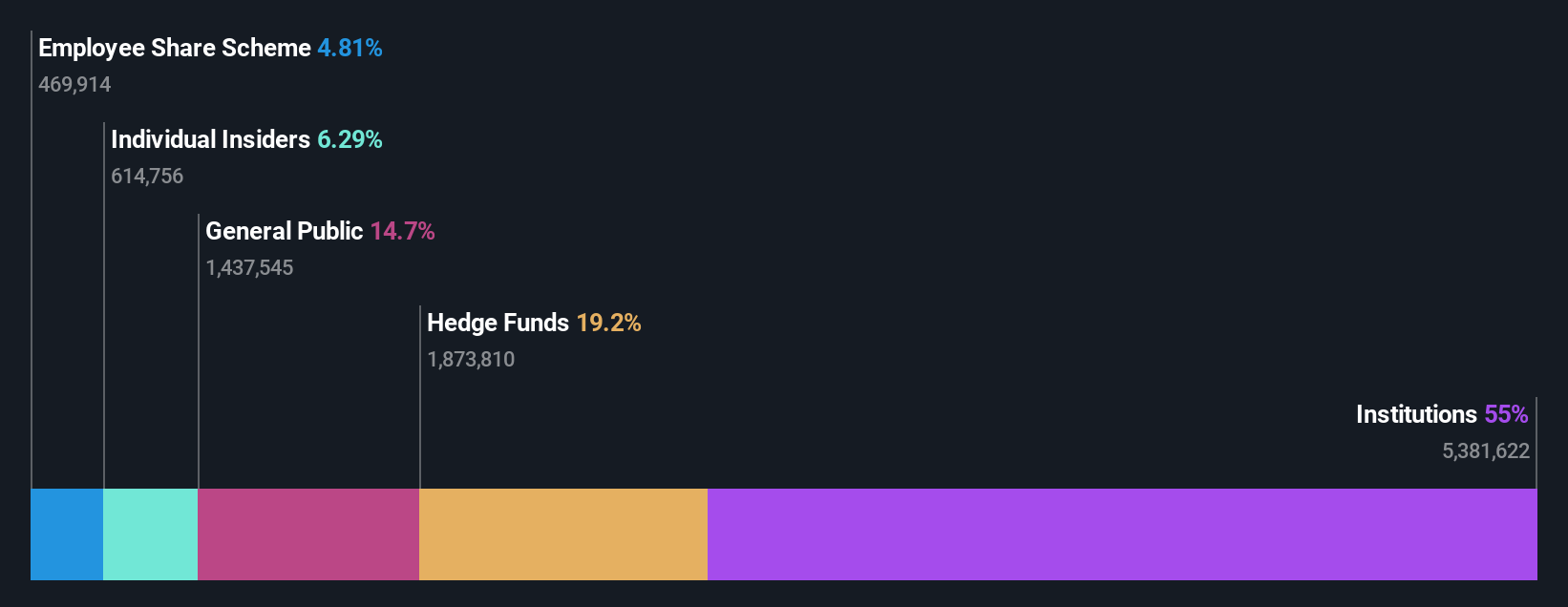
To get a sense of who is truly in control of Frequency Electronics, Inc. (NASDAQ:FEIM), it is important to understand the ownership structure of the business. With 55% stake, institutions possess the maximum shares in the company. That is, the group stands to benefit the most if the stock rises (or lose the most if there is a downturn).
Institutional investors was the group most impacted after the company's market cap fell to US$494m last week. Still, the 180% one-year gains may have helped mitigate their overall losses. We would assume however, that they would be on the lookout for weakness in the future.
Let's delve deeper into each type of owner of Frequency Electronics, beginning with the chart below.
See our latest analysis for Frequency Electronics
What Does The Institutional Ownership Tell Us About Frequency Electronics?
Institutions typically measure themselves against a benchmark when reporting to their own investors, so they often become more enthusiastic about a stock once it's included in a major index. We would expect most companies to have some institutions on the register, especially if they are growing.
Frequency Electronics already has institutions on the share registry. Indeed, they own a respectable stake in the company. This suggests some credibility amongst professional investors. But we can't rely on that fact alone since institutions make bad investments sometimes, just like everyone does. When multiple institutions own a stock, there's always a risk that they are in a 'crowded trade'. When such a trade goes wrong, multiple parties may compete to sell stock fast. This risk is higher in a company without a history of growth. You can see Frequency Electronics' historic earnings and revenue below, but keep in mind there's always more to the story.

Investors should note that institutions actually own more than half the company, so they can collectively wield significant power. Our data indicates that hedge funds own 19% of Frequency Electronics. That worth noting, since hedge funds are often quite active investors, who may try to influence management. Many want to see value creation (and a higher share price) in the short term or medium term. Looking at our data, we can see that the largest shareholder is Edenbrook Capital, Llc with 19% of shares outstanding. With 6.9% and 4.8% of the shares outstanding respectively, Wax Asset Management, LLC and The Vanguard Group, Inc. are the second and third largest shareholders. Additionally, the company's CEO Thomas McClelland directly holds 0.7% of the total shares outstanding.
We did some more digging and found that 8 of the top shareholders account for roughly 51% of the register, implying that along with larger shareholders, there are a few smaller shareholders, thereby balancing out each others interests somewhat.
Researching institutional ownership is a good way to gauge and filter a stock's expected performance. The same can be achieved by studying analyst sentiments. There is some analyst coverage of the stock, but it could still become more well known, with time.
Insider Ownership Of Frequency Electronics
While the precise definition of an insider can be subjective, almost everyone considers board members to be insiders. Management ultimately answers to the board. However, it is not uncommon for managers to be executive board members, especially if they are a founder or the CEO.
Insider ownership is positive when it signals leadership are thinking like the true owners of the company. However, high insider ownership can also give immense power to a small group within the company. This can be negative in some circumstances.
We can see that insiders own shares in Frequency Electronics, Inc.. It has a market capitalization of just US$494m, and insiders have US$31m worth of shares, in their own names. It is good to see some investment by insiders, but it might be worth checking if those insiders have been buying.
General Public Ownership
The general public-- including retail investors -- own 15% stake in the company, and hence can't easily be ignored. While this group can't necessarily call the shots, it can certainly have a real influence on how the company is run.
Next Steps:
I find it very interesting to look at who exactly owns a company. But to truly gain insight, we need to consider other information, too. Like risks, for instance. Every company has them, and we've spotted 2 warning signs for Frequency Electronics (of which 1 is a bit unpleasant!) you should know about.
Ultimately the future is most important. You can access this free report on analyst forecasts for the company.
NB: Figures in this article are calculated using data from the last twelve months, which refer to the 12-month period ending on the last date of the month the financial statement is dated. This may not be consistent with full year annual report figures.
Have feedback on this article? Concerned about the content? Get in touch with us directly. Alternatively, email editorial-team (at) simplywallst.com.
This article by Simply Wall St is general in nature. We provide commentary based on historical data and analyst forecasts only using an unbiased methodology and our articles are not intended to be financial advice. It does not constitute a recommendation to buy or sell any stock, and does not take account of your objectives, or your financial situation. We aim to bring you long-term focused analysis driven by fundamental data. Note that our analysis may not factor in the latest price-sensitive company announcements or qualitative material. Simply Wall St has no position in any stocks mentioned.