
- PREMIUM
- LIVE QUOTES
- INSTITUTIONS
 Index Options


 State Street
 CME Group
 Nasdaq
 Cboe
Cboe TradingView
 Wall Street Journal
Is Sinopharm Group (HKG:1099) A Risky Investment?
Legendary fund manager Li Lu (who Charlie Munger backed) once said, 'The biggest investment risk is not the volatility of prices, but whether you will suffer a permanent loss of capital.' So it might be obvious that you need to consider debt, when you think about how risky any given stock is, because too much debt can sink a company. We note that Sinopharm Group Co. Ltd. (HKG:1099) does have debt on its balance sheet. But is this debt a concern to shareholders?
What Risk Does Debt Bring?
Debt assists a business until the business has trouble paying it off, either with new capital or with free cash flow. Ultimately, if the company can't fulfill its legal obligations to repay debt, shareholders could walk away with nothing. However, a more frequent (but still costly) occurrence is where a company must issue shares at bargain-basement prices, permanently diluting shareholders, just to shore up its balance sheet. Of course, the upside of debt is that it often represents cheap capital, especially when it replaces dilution in a company with the ability to reinvest at high rates of return. When we think about a company's use of debt, we first look at cash and debt together.
What Is Sinopharm Group's Net Debt?
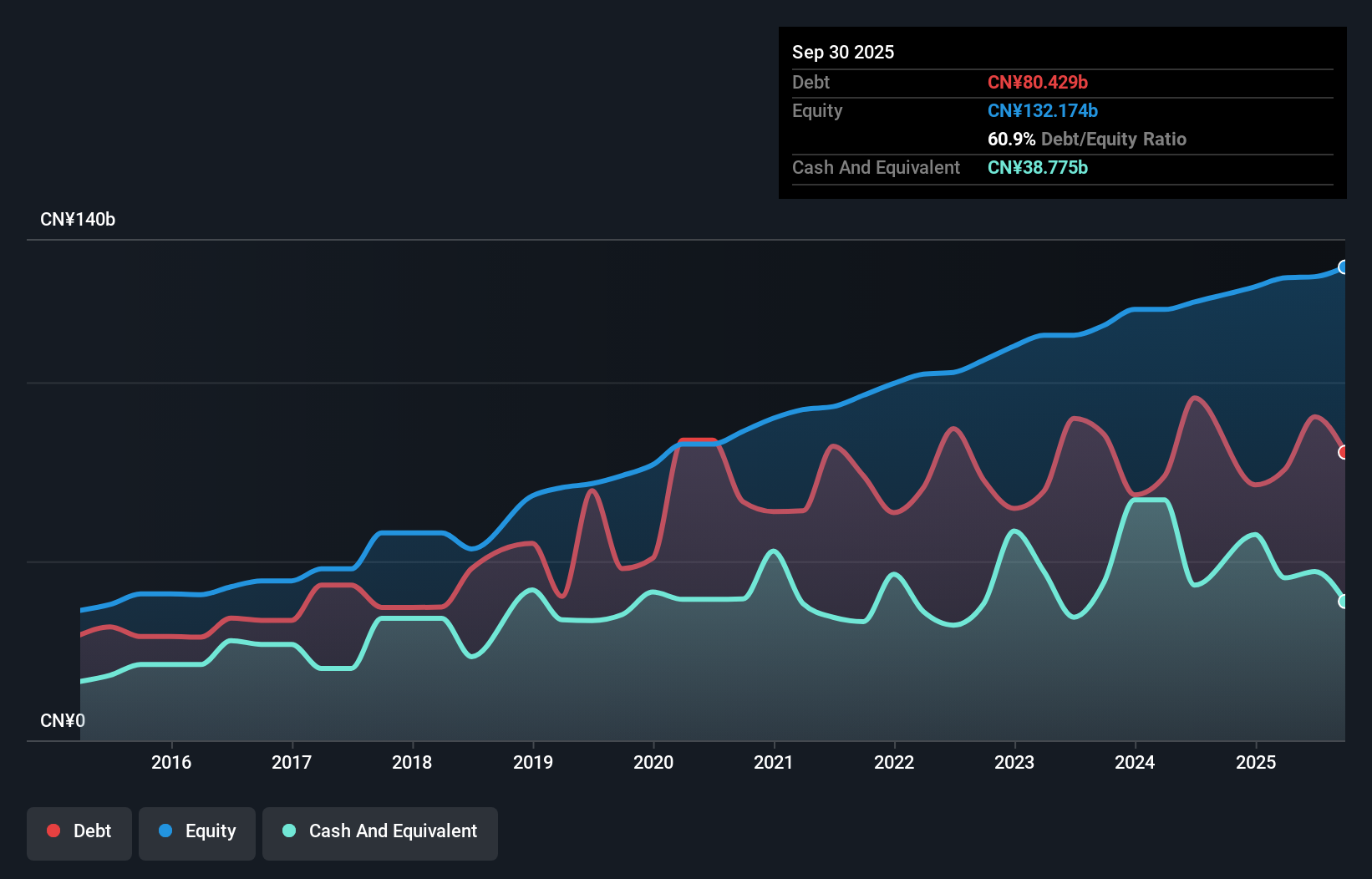
As you can see below, at the end of September 2025, Sinopharm Group had CN¥80.4b of debt, up from CN¥71.4b a year ago. Click the image for more detail. However, it does have CN¥38.8b in cash offsetting this, leading to net debt of about CN¥41.7b.
How Healthy Is Sinopharm Group's Balance Sheet?
According to the last reported balance sheet, Sinopharm Group had liabilities of CN¥276.2b due within 12 months, and liabilities of CN¥10.0b due beyond 12 months. On the other hand, it had cash of CN¥38.8b and CN¥257.9b worth of receivables due within a year. So it actually has CN¥10.5b more liquid assets than total liabilities.
It's good to see that Sinopharm Group has plenty of liquidity on its balance sheet, suggesting conservative management of liabilities. Because it has plenty of assets, it is unlikely to have trouble with its lenders.
Check out our latest analysis for Sinopharm Group
In order to size up a company's debt relative to its earnings, we calculate its net debt divided by its earnings before interest, tax, depreciation, and amortization (EBITDA) and its earnings before interest and tax (EBIT) divided by its interest expense (its interest cover). Thus we consider debt relative to earnings both with and without depreciation and amortization expenses.
Sinopharm Group's net debt to EBITDA ratio of about 2.1 suggests only moderate use of debt. And its commanding EBIT of 10.4 times its interest expense, implies the debt load is as light as a peacock feather. The bad news is that Sinopharm Group saw its EBIT decline by 13% over the last year. If earnings continue to decline at that rate then handling the debt will be more difficult than taking three children under 5 to a fancy pants restaurant. When analysing debt levels, the balance sheet is the obvious place to start. But ultimately the future profitability of the business will decide if Sinopharm Group can strengthen its balance sheet over time. So if you want to see what the professionals think, you might find this free report on analyst profit forecasts to be interesting.
But our final consideration is also important, because a company cannot pay debt with paper profits; it needs cold hard cash. So the logical step is to look at the proportion of that EBIT that is matched by actual free cash flow. In the last three years, Sinopharm Group created free cash flow amounting to 7.8% of its EBIT, an uninspiring performance. That limp level of cash conversion undermines its ability to manage and pay down debt.
Our View
Sinopharm Group's interest cover was a real positive on this analysis, as was its level of total liabilities. In contrast, our confidence was undermined by its apparent struggle to grow its EBIT. We would also note that Healthcare industry companies like Sinopharm Group commonly do use debt without problems. Looking at all this data makes us feel a little cautious about Sinopharm Group's debt levels. While we appreciate debt can enhance returns on equity, we'd suggest that shareholders keep close watch on its debt levels, lest they increase. There's no doubt that we learn most about debt from the balance sheet. However, not all investment risk resides within the balance sheet - far from it. Be aware that Sinopharm Group is showing 1 warning sign in our investment analysis , you should know about...
When all is said and done, sometimes its easier to focus on companies that don't even need debt. Readers can access a list of growth stocks with zero net debt 100% free, right now.
Have feedback on this article? Concerned about the content? Get in touch with us directly. Alternatively, email editorial-team (at) simplywallst.com.
This article by Simply Wall St is general in nature. We provide commentary based on historical data and analyst forecasts only using an unbiased methodology and our articles are not intended to be financial advice. It does not constitute a recommendation to buy or sell any stock, and does not take account of your objectives, or your financial situation. We aim to bring you long-term focused analysis driven by fundamental data. Note that our analysis may not factor in the latest price-sensitive company announcements or qualitative material. Simply Wall St has no position in any stocks mentioned.