
- PREMIUM
- LIVE QUOTES
- INSTITUTIONS
 Index Options


 State Street
 CME Group
 Nasdaq
 Cboe
Cboe TradingView
 Wall Street Journal
Dismantling the world's wildest stock market in 2025: AI, storage and military industry drive South Korea's Kospi index to soar more than 76%
The Zhitong Finance App learned that the unparalleled “revival” of the Korean stock market in 2025 can be called recorded in the annals of global financial markets, and the country's stock market is moving towards the strongest increase in 25 years. In 2025, from the “crushing” gains of memory chip giants to military exporters, to the astonishing surge in AI and K-beauty concept stocks, Korean investors and foreign forces focused on South Korea received an extremely strong return on investment in a stock market that continues to reach record highs.
Strong gains contributed by these popular sectors have driven the Korean stock market's benchmark stock index, the Kospi Korea Composite Index, up more than 76% so far this year, making it the best-performing major stock index in the global stock market/ that is, the most powerful benchmark stock index/major stock index in the global stock market for the whole year in 2025. Among them, the two major memory chip giants, Samsung Electronics and SK Hynix, which account for up to 30% of the benchmark stock index in the Korean stock market, contributed nearly half of the increase. At the same time, South Korea's defense and nuclear energy companies were also major contributors to the increase.
More importantly, Wall Street analysts believe that the Korean stock market still has strong upside in the future. Top Wall Street brokerage firms, including Citigroup, J.P. Morgan Chase, and Nomura, predict that South Korea's benchmark stock index will rise at least 20% next year. Analysts added that the South Korean government's increased stimulus measures, combined with strong profit growth, should continue to support the “upward trajectory” of the Korean stock market.
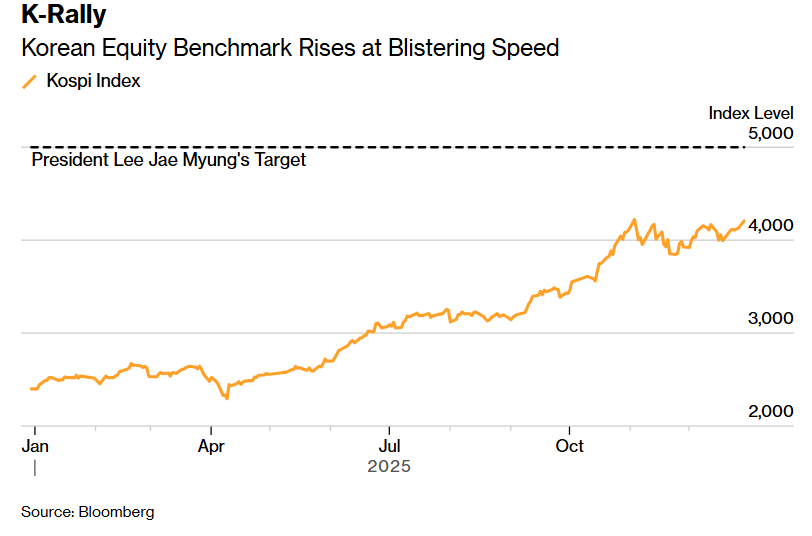
As shown in the chart above, this “K-Rally” of the Korean stock market can be described as sweeping the world — the Korean stock market benchmark Kospi Index continues to rise at an alarming rate. South Korean President Lee Jae-myung even recently predicted that the South Korean stock market would soon break through the 5,000 super mark. As of Monday's close, Korea's Kospi Index closed at 4,220 points. If the strong upward momentum of early Tuesday trading continues, the Korean stock market will reach another record high.
Here's a review of the winners and losers of the Korean stock market in 2025.
AI investment themes
In the Korean stock market, the biggest winners of AI investment-themed deals are not traditional chip makers or large memory chip stocks like Samsung, but those “industrial stock targets that cover the AI label.” These include South Korean power transformer manufacturer Hyosung Heavy Industries, and nuclear power supplier Doosan Enerbility. According to Korea Exchange price statistics, both stock prices have risen by more than 330% since this year.
Despite high valuations, the bulls in these two stocks generally believe that there are no fast and viable carbon-free alternatives to meet the electricity demand brought about by the surge in the number of AI data centers around the world. This trend makes these power companies even more indispensable.
The essence of the global AI competition is an AI computing power infrastructure competition, and the core foundation that drives AI computing power clusters is a stable and huge power supply system. Because of this, the demand for electricity in AI data centers is surging at an unprecedented rate, and AI seems to have become a “power devil.” The core foundation behind high-energy AI data centers, which are expanding exponentially in scale due to intense demand for computing power infrastructure such as AI chips, is inseparable from the core foundation of electricity supply. This is also the origin of the market view that “the end of AI is electricity.”
Wall Street financial giant Goldman Sachs recently revised in a research report the huge electricity demand forecast driven by global data centers to a 175% increase in electricity consumption compared to 2023 (Goldman Sachs's previous forecast was +165%), which is equivalent to increasing the power resource load of one of the “top ten power consumers in the world”. According to Goldman Sachs's team of strategy analysts, the end of the AI model is electricity — the agency emphasizes that AI, which can be called an “power-swallowing giant,” will bring an unprecedented global “super demand cycle” for electricity and a “super bull market” for electricity stocks.
In his first budget speech in November, South Korean President Lee Jae-myung placed artificial intelligence at the center of the South Korean government's economic vision, vowed to comprehensively transform the country's core industrial chain, public services, and even military defense through massive AI investment and South Korean policy support, and strive to fully integrate everything in the country with AI.
Lee Jae-myung stressed that the South Korean government will increase AI investment to more than 10.1 trillion won (about 7 billion US dollars) next year. As an important part of the overall budget proposal of 728 trillion won, the goal is to revive South Korea's economic growth, overcome the decline in South Korea's demographic structure, and fully prepare for the wave of drastic changes in global trade and technology.
A team of analysts from Morgan Stanley said that investors' interest in power grid and AI computing power infrastructure stocks should continue throughout 2026. Among them, they emphasized, HD Hyundai Electric is entering “a wave of revaluation that could last for decades at a time when power grid modernization, AI data centers, and decarbonization converge.”
Memory chip leader
Samsung Electronics and SK Hynix can be described as having experienced one of the most outstanding years, fully consolidating their absolute leading position as Kospi's two largest weighted stocks and the world's top memory chip manufacturers. Driven by global tech giants, including Microsoft, Google, and Meta, growing demand for special-grade, high-capacity, high-performance memory chips for AI training/inference systems, Samsung's stock price rose 125% this year and continued to rise to a record high. SK Hynix's stock price rose by about 268%, also repeatedly reaching record highs this year.
Memory chips — critical to South Korea's exports and the South Korean economy. Korea is home to two of the world's largest memory chip manufacturers, SK Hynix and Samsung. Among them, SK Hynix, the global HBM hegemon, has become the long-term and most core HBM supplier for Nvidia's AI GPU computing power cluster. Another South Korean storage giant, Samsung, is one of the world's largest technology companies and the world's largest supplier of consumer-grade DRAM and NAND memory chips, and enterprise-grade NAND storage components, and recently became the supplier of Nvidia's flagship AI computing power cluster products, the GB200/GB300 series of HBM storage systems that dominate AI chips.
As breakthrough AI application tools such as AI agents penetrate into various industries around the world, bringing about sky-level “AI inference terminal computing power requirements,” this means that the future prospects for AI computing power infrastructure construction such as AI chips, HBM storage systems, enterprise-grade SSDs, and high-performance networks and power equipment will still be a sea of stars. Furthermore, the end-side AI boom will also bring demand for consumer electronics-grade DRAM and NAND storage to a new round of growth curve.
According to a recent memory chip industry tracking research report released by Nomura Securities (Nomura), this round of the “storage supercycle” that began in the second half of this year will continue until at least 2027, and a truly meaningful new supply will not appear until early 2028 at the earliest. Nomura also further raised the investment institution's target share prices for these two “Korean memory chip giants” within 12 months, stressing that the two giants, which have repeatedly reached new highs, will have more than 40% room for future stock price increases.
In recent months, the world's top three memory chip giants — Samsung Electronics, SK Hynix and Micron, as well as Western Digital and Seagate — have recently announced extremely strong results, causing financial giants such as Nomura, J.P. Morgan, and Morgan Stanley to chant that the “storage supercycle” has arrived, highlighting the continued blowout expansion of the world's AI training/inference computing power demand and the consumer electronics demand recovery cycle driven by the AI boom on the end side have all driven the expansion of the DRAM/NAND series storage product demand The one that has the highest share in the storage business with Micron HBM storage and server-level high-performance DDR5 in the DRAM segment; in addition, demand for enterprise-grade SSDs in the NAND sector has also recently surged.
In the Korean market, momentum about the strong rise in memory chips has also spilled over to related companies, such as SK Square, the parent company of SK Hynix, and Korea Circuit, which regards Broadcom, the leader in AI ASIC from the US as a customer. Both stocks are also up more than 330% this year.
“The shortage of memory chips is unquestionably accelerating, so I expect Korean semiconductor stocks to continue to have an extremely strong year,” said Kang Dae-kyun, chief investment officer from Seoul Life Asset Management.
Defense and military industry star
US President Donald Trump's reshaping of traditional security alliances has spawned significant new defense and military spending this year from allies in Europe and Asia, driving investors to refocus on South Korean contractors known for faster delivery and lower deployment costs.
Since this year, the military stock investment frenzy has taken the world by storm. Wall Street financial giant Citi recently released a research report saying that the “international rearming” trend (International Rearmed) will soon become the main structural and multi-year global military and defense demand line, and it is predicted that the military sector of the international stock market will continue to rank among the popular investment sectors in the global stock market for the next 2-3 years, which is expected to become a core contributor to the rise of the stock market.
According to the latest statistics, the frenzy of defense and military investment can be described as sweeping the stock market. For example, American aerospace and defense stocks have recorded a 36% increase so far in 2025, while the same military stock sector in the European stock market has risen sharply by 55% so far this year, even significantly outperforming the semiconductor sector, which is the core driving sector of the US stock market, by about 45%, mainly because Germany and the entire European continent wanted to rearm Europe after Trump announced that they would fully concentrate on defense construction in the US.
In the Korean stock market, K9 self-propelled artillery manufacturer Hanwha Aerospace became one of the biggest winners in the Korean military sector, and its stock price rose nearly 200% this year. Hanwha Marine, a major shipbuilder whose business is biased towards the military industry, rose 210%.
Must Asset Management said that given the recent large-scale order breakthroughs made by Korean companies in Europe, these companies are likely to obtain more and deeper partnerships with NATO member states in the next few years.
K-Beauty's Next Generation Leader
In less than two years since its IPO in the Korean stock market, APR Corp.'s market capitalization has surpassed that of established Korean beauty giants Amorepacific Corp. and LG H&H. APR Corp, a manufacturer of the MediCube brand and a leader in household beauty devices, with a 369% increase, led all sector gains in the MSCI Korea Index and led the overall benchmark index. It can be called a super dark horse in the K-beauty sector in Korea.
“In my opinion, APR's excess performance is not just better execution, but playing a very different game,” said Jung In Yun, CEO of Fibonacci Asset Management Global in Singapore. “It sells actual results and user experience through social-first channels, not just skincare products through traditional retail channels.”
LG H&H, which owns the “The Whoo” skincare brand, is on its way to falling for five consecutive years, while beauty giant Amorepacific Corp's stock price rose 14% this year. Investors generally said that the market expects APR to continue to outperform the benchmark beauty sector and the benchmark stock index of the Korean stock market as a whole, but its high valuation also makes the stock more likely to fluctuate sharply in the event of a setback.
A losing game
Despite the general rise in the Korean market, Korean game developers' stock prices are rarely clearly left behind the market. Krafton's market capitalization shrunk by about one-fifth, while Com2uS fell by more than one-third. Concerns about its limited overall appeal in the Asian market and its inability to compete fiercely with its Chinese rivals have forced investors to look elsewhere.
Investment managers from Life Asset said that as demand for Korean role-playing games in Asia is limited, there is still limited room for stock prices to rise in the future.
Other notable losers to the Korean stock market in 2025 include many Korean electric vehicle industry chain companies that were severely impacted by a sharp decline in global demand for electric vehicles. One of the biggest losers is South Korea's Enchem, whose stock price has fallen by about 50% during the year. The stock price of SK Innovation, one of Korea's top three battery suppliers, is also expected to end with a slight decline throughout the year.