
- PREMIUM
- LIVE QUOTES
- INSTITUTIONS
 Index Options


 State Street
 CME Group
 Nasdaq
 Cboe
Cboe TradingView
 Wall Street Journal
Easy Control Smart Driving updates Hong Kong stock prospectus: asset-light models account for more than half of revenue, and results doubled in the first three quarters of 2025
The Zhitong Finance App learned that recently, due to the expiration of the audit report, Easy Control Smart Driving, which is sprinting to the Hong Kong stock market, updated its prospectus and also revealed the latest trends in driverless racing tracks in domestic mining areas.
According to the latest data, Easy Control Smart Driving's performance in the first three quarters of 2025 was quite impressive, achieving revenue of 921 million yuan, an increase of 103.76% over the previous year. It is close to the level of the full year of 2024, further consolidating its leading position in the industry.
More importantly, the “car-free” asset-light model laid out by this technology company in the driverless mining area has completely surpassed the traditional “car-owning” model in terms of revenue and number of active mining cards, accounting for more than half of total revenue. It has not only received strategic investment and in-depth cooperation from industrial giants such as Zijin Mining, Ningde Era, Yankuang Capital, and Desai Xiwei, but has also continued to break through at the level of commercialization and technological innovation, showing strong development potential.
Fleet size and revenue both increased, continuing to lead the industry
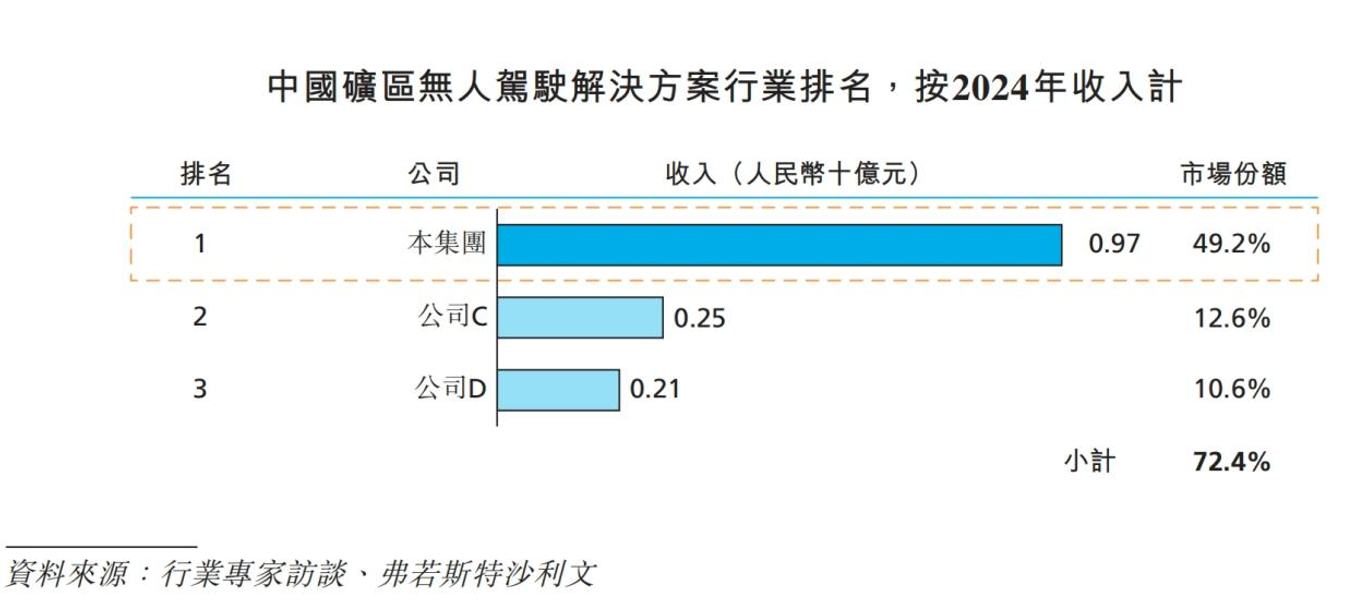
According to the prospectus, the size of the driverless mining truck fleet operated by Easy Control Smart Driving increased from more than 1,400 units in June to more than 2,000 units, and the company already accounts for nearly half of the driverless solution market in L4 mining areas in China.
In 2024, the company achieved total revenue of 986 million yuan, ranking first among all L4 driverless companies in China; at the same time, the company is the largest provider of driverless solutions for mining areas in China, with a market share of about 49.2%; in terms of revenue for the same period, China, as the world's largest L4 mine driverless solution market, has a global market share of over 40.5%.
Entering 2025, the fundamentals of easy-to-control and intelligent driving continue to be optimized, and growth momentum is abundant. In the first three quarters of 2025, gross profit reached 65.328 million yuan, and revenue was more than double that of the same period in 2024.
As of the end of September 2025, solutions for easy control and intelligent driving have been deployed in 7 of the 12 largest open pit coal mines in China with annual approved production capacity. As of the last practical date, the company has deployed 509 and 488 unmanned mining trucks in two open pit mine transportation projects in northwest China, setting the record for the largest unmanned mine truck fleet in the industry. Nationwide, there are 9 unmanned mining projects with more than 100 unmanned mining cards in a single mine, and 8 of them have deployed their solutions.
More than half of ATaaS revenue, asset-light model verifies technology core
Behind the rise in performance is a successful transformation of the business model. The commercialization transformation of easy-to-control intelligent driving from a car-owning model to a non-car-owning model is leading the driverless industry in mining areas to a profound shift from “asset operation” to “technological empowerment.”
Generally speaking, currently there are two main types of driverless solutions in mining areas: TaaS (car-holding) mode and ATaaS (unmanned vehicle) model. The TaaS (vehicle ownership) model means that the enterprise owns and operates driverless mining cards. Under this asset-heavy model, enterprises often face greater financial pressure; in the ATaaS (no vehicle ownership) model, downstream customers buy or rent mining cards. The enterprise only needs to provide driverless technology, software support and auxiliary services in the mining area, which can also test the technical strength and commercial implementation ability of the enterprise.
In the early days, Easy Control and Intelligent Driving, as an industry leader, also adopted the TaaS (vehicle ownership) heavy asset model, but starting in 2023, the company gradually transitioned to an ATAaS (no vehicle ownership) asset-light model.
According to the latest financial data, after the ATAaS (no vehicle ownership) model achieved revenue of 450 million yuan in 2024, accounting for more than 46% of total revenue, in the first three quarters of 2025, the share of revenue contributed by the Easy Control Smart Driving ATaaS (no vehicle ownership) model further increased to 50%, reaching 461 million yuan, an increase of 267% over the previous year.
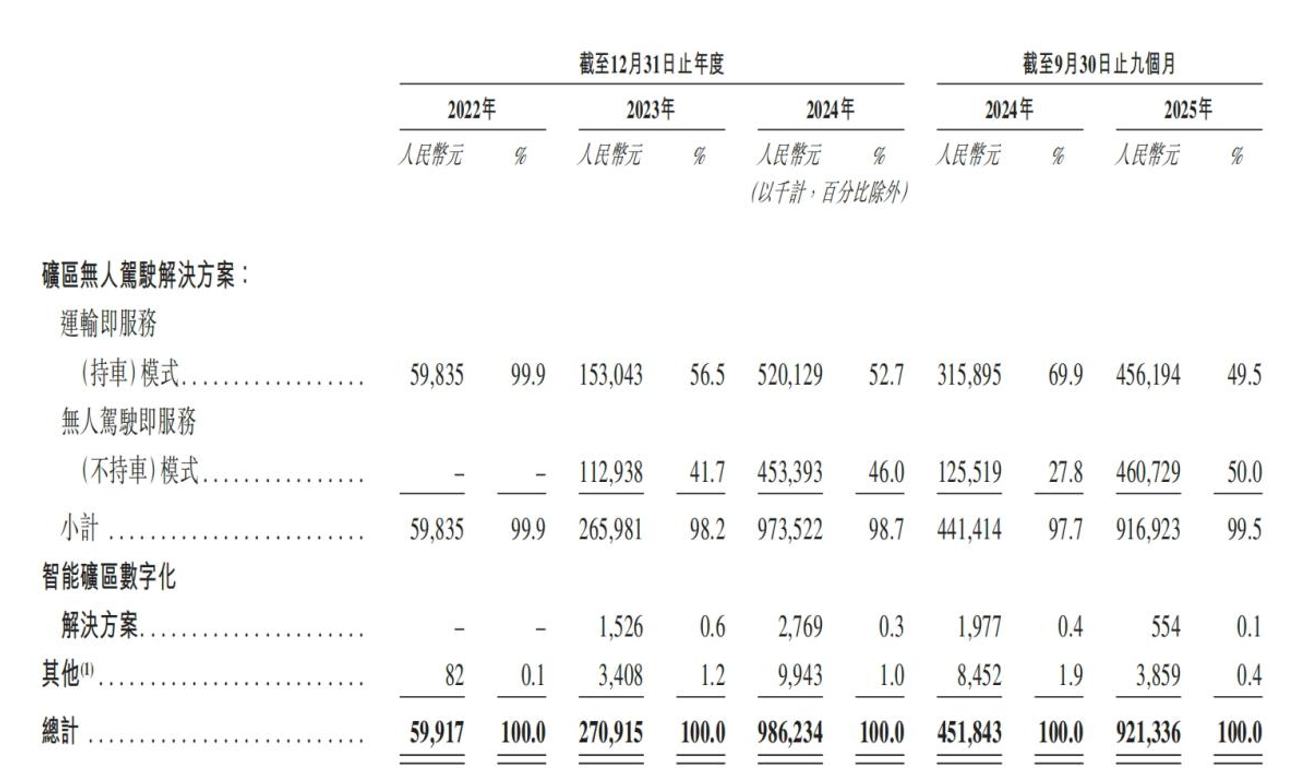
Screenshot of the Easy Control Smart Driving prospectus
From the end of 2024 to September of this year, the number of TaaS (car-holding) vehicles with easy control and smart driving increased by only 165, while the number of vehicles increased by 852 under the ATaaS (no vehicle ownership) model, which not only shows that the strategic goal of changing the business model from heavy to light has basically been achieved, but also highlights the commercial nature of autonomous driving technology companies with algorithms, software, and systems as the core.
“Going from owning a car to not owning a car means customers are shifting from paying for 'vehicle capacity' to paying for 'technical reliability' and 'operational efficiency'.” An analyst focused on the autonomous driving industry pointed out and emphasized, “This proves that the company's solution has gone beyond the 'usable' phase and has entered a 'easy to use and necessary' stage where customers are willing to pay ongoing fees for stability and efficiency improvements.”
In fact, in recent years, as driverless technology in mining areas has become more mature, the willingness of miners to directly buy and hold unmanned mining cards has increased markedly, and the asset-light model is becoming an important trend in the development of the industry. The practice of easy control and intelligent driving shows that in the mining scene, the path of value realization for autonomous driving technology companies is already clear. The asset-light model of not owning a car is more in line with the characteristics of technology companies. By providing customers with integrated software and hardware technology subscription services, it firmly locks its core competitiveness in R&D and system iteration. This not only greatly optimizes cash flow, but also frees the company from the cyclical constraints of the manufacturing industry and strengthens the characteristics of a pure technology company with high gross profit and high scalability.
Going deep into the sea, the top of the global mining industry completed the “Safety Officer Getting Off” test
If financial data confirms the superiority of its business model, then technological breakthroughs from overseas during the same period provided a hard-core footnote to its position as a global technology company.
On December 18, 2025, Australia's Norton Jintian project, a joint collaboration between Easy Control and Smart Driving, Zijin Mining, and Thiess, the world's top mining service provider, achieved a landmark breakthrough — successfully completing the first “safety officer getting off the bus” normalization test.
“Safety officer getting out of the car” means that the driverless system has the ability to operate completely autonomously and on a regular basis without monitoring by a safety officer in the vehicle under specific operating scenarios.
This is not only one of the ultimate tests of system reliability and safety, but also marks the first time that China's driverless mining technology has achieved complete capability verification in key scenarios in Australia, a major traditional mining country with strict regulations and extremely high requirements, and has achieved “reverse output” of advanced technology solutions, which is of great significance for the company's continued deepening global layout.
Currently, the global mining industry is facing the double pressure of rising labor costs and tightening production safety regulations.
According to Sullivan's report, in major global mining regions outside of China (including Australia, Canada, Chile, etc.), the market size of driverless solutions in terms of revenue is expected to increase from US$700 million in 2024 to US$8.1 billion in 2030, with a compound annual growth rate of 51.0%. Among them, the market size of driverless mining solutions in the Australian market in terms of revenue is expected to exceed 2.7 billion US dollars in 2030. Over the long term, the total potential market for driverless solutions in mining areas is over $110 billion worldwide.
This breakthrough in easy control and intelligent driving has undoubtedly obtained a key “admission card” for it to enter this rapidly growing global circuit. And this achievement stems from the accumulation of hard-core technology.
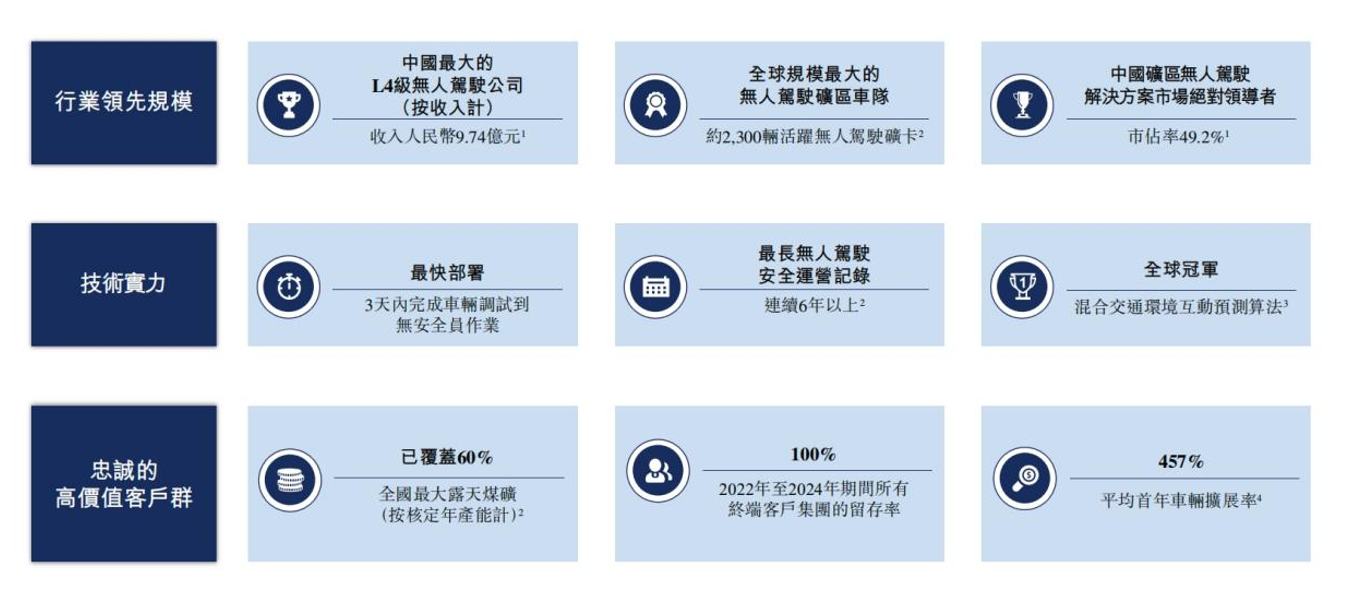
Screenshot of the Easy Control Smart Driving prospectus
As the only driverless technology enterprise in China that can achieve completely unmanned, mixed loading, and mixing and unloading operations, the BEV multi-modal fusion sensing algorithm adopted by the company can accurately identify obstacles and adapt to complex working conditions such as snowy and rainy days. Its dynamic obstacle interactive deduction trajectory prediction technology also solves the industry problem of mixed driving between manned vehicles and unmanned vehicles. At the core technical level, the “multi-modal fusion perception of the visual center” ability of easy to control and intelligent driving has been tested for a long time. Relying on the “Mountain” scheme, a safety record of 0 accident rate in 6 years has been achieved, and the customer retention rate has remained 100%.
At present, technical solutions for easy control and intelligent driving have been verified in multiple mining and complex operating conditions scenarios at home and abroad. From an open pit coal mine in Inner Mongolia to a gold mine in Australia, unmanned mining cards have passed not only geographical distance, but also a gap between technical verification and commercial trust.
In recent years, demand for intelligent transformation in the global mining industry has continued to be unleashed, and the market space for driverless mining has gradually expanded as a key path to improving efficiency and reducing safety risks. Predictably, as Chinese mining driverless enterprises, represented by easy control and intelligent driving, continue to make efforts in core technology, system integration, and localized services, compounding the growing demand for intelligent solutions in the global mining industry, Chinese mining enterprises will gradually break the traditional pattern of overseas markets and help the collaborative development of the global intelligent mining ecosystem.