
- PREMIUM
- LIVE QUOTES
- INSTITUTIONS
 Index Options


 State Street
 CME Group
 Nasdaq
 Cboe
Cboe TradingView
 Wall Street Journal
Don't be biased by Wall Street's “rotating bull market” noise Mag7's “leading rise myth” is still the main line for US stocks
At a time when top Wall Street analysts are shouting that 2026 will be a “rotating bull market,” some institutional investors say that this kind of revolving panic will definitely not last. Investors should continue to bet on the “seven tech giants” of the highly weighted US stock market to outperform other sectors in 2026 and strongly lead the S&P 500 Index and the Nasdaq 100 Index to new highs over and over again.
The S&P 500 index is expected to end strongly at an all-time high in 2025, which will surely pave the way for a new record high in 2026. Judging from the rise and fall of the US stock market sector, market leadership has indeed rotated from “technology and growth stocks closely related to AI” to other investment sectors that have been undervalued for a long time, such as value, healthcare, and materials.
In terms of the percentage increase contribution, the S&P 500 index's growth contribution since the “AI bubble theory” swept the market in November was not focused on the top seven tech giants with 35% weight and closely related to AI, but spread from the AI investment theme to various segments. Wall Street analysts said that this kind of “rotating bull market” will be the main theme in 2026.
Although market rotation is becoming more obvious, according to JR Research, an institutional investor that successfully predicts that Nvidia's market value will surpass Apple at the end of 2022, the rotation will not last long. “The AI investment theme surrounding the AI computing power infrastructure construction process and Mag 7 (the seven major tech giants) will also be the strongest main line of the stock market throughout 2026, just like 2024 2025,” the institutional investor said in a report.
JR Research emphasized that AI computing power infrastructure and Mag 7 themes are still at the core, and “pick and shovel” companies in the technology sector are still driving the long-term value expansion of the market.
If Trump nominates an extremely dovish person as chairman of the Federal Reserve, and the seven tech giants whose profits are still extremely strong and the profit growth rate in 2026 will be stronger than the overall profit growth rate of the remaining 493 S&P 500 companies in the previous two years, it is bound to continue to provide core fuel for the overall profit growth of the S&P 500 index and lead the entire market to rise in 2026. Under such circumstances, investors should indeed maintain their exposure to them, and even more support is needed since the bottom of the 2022 bear market The AI technology theme of this amazing round of years of bull market.
The “super bull market” where the S&P 500 index has accumulated a cumulative increase of about 30 trillion US dollars over the past three years is largely driven by the world's largest tech giants (such as the seven major US tech giants), and also by companies that promote large-scale investment in AI computing power infrastructure (such as Micron, TSMC, Broadcom, etc.) and power system suppliers (such as Constellation Energy).
The so-called “seven tech giants” (Mag 7), which account for the high weight of the S&P 500 Index and the Nasdaq 100 Index (about 35%), include Apple, Microsoft, Google, Tesla, Nvidia, Amazon, and Facebook's parent company Meta Platforms. They are the core driving force behind the S&P 500 Index's many new highs, and are also regarded by top Wall Street investment institutions as the most capable of bringing huge sums to investors in the context of the biggest technological transformation since the Internet era A combination of rewards.
The “Santa” market has arrived as scheduled. How will the 2026 market be interpreted?
With the last week left for us to remember, many investors see 2025 as yet another highly successful year — the S&P 500, the benchmark index for the US stock market, has risen close to 19% year to date. The Santa rally (Santa rally) received a solid boost: the S&P 500 index closed at a record high before Christmas, creating an excellent time to welcome Santa's arrival. The explanation is that it will drive the last wave of gains at the end of the year and begin 2026 with a strong and positive momentum.
Looking back on the past, the year was probably full of anticipation, then quickly turned uneasy (marked by “Liberation Day” in April), then we had the “least popular V-shaped rebound” in recent years. Since then, the S&P 500 index has maintained an upward path and has hardly looked back. Since April, downside fluctuations have tried to overwhelm buying from time to time, but bears have always lacked conviction and endurance to carry out their arguments to the end, because the “AI bull market narrative” driven by the AI investment frenzy and the expansion of market risk appetite continues to be alarmingly popular under the AI data center construction process in full swing and extremely strong AI capital expenditure co-catalyzed.
Looking ahead to 2026, market trading logic is changing in several significant dimensions as the rotating theme is recognized by more Wall Street analysts. The AI investment market has recently faltered, with the exception of a few technology leaders. For example, the stock price of US memory chip leader Micron (MU.US) has repeatedly reached new highs after the release of its most recent earnings report. AI chip leaders such as NVDA.US (NVDA.US), AMD (AMD.US), and Broadcom (AVGO.US) are still significantly below their highest point in 2025. At this time, the market is clearly speeding up capital reallocation, shifting the narrative from growth to value and from technology to non-technology; in the “window dressing” (window dressing) that will be carried out at the end of this year for 2026, these undercurrents are beginning to accelerate.
Furthermore, the stock price performance of software companies in the US stock market since this year has not been ideal. This is undoubtedly a major negative sign for the “AI bull market logic.” After all, the real AI revenue generation and AI monetization path will largely depend on these SaaS-type software companies. With the exception of Palantir (PLTR.US), the stock price trends of software peers such as Salesforce (CRM.US), Adobe (ADBE.US), and even ServiceNow (NOW.US) are suffering from heavy pessimism and bearishness. Cautious buyers continue to stand still and are reluctant to increase their positions.
The market is keen to reinforce its bullish arguments about AI infrastructure targets, but this has not been implemented in the SaaS value chain. By 2026, as the market weighs down software companies that are still showing steady operating performance, solid long-term profit margins, and monetization opportunities for AI and non-AI workloads that are still in the early stages, can we finally usher in a much-needed rise in software stocks — whether it's a fundamental reversal or a rotation towards these snubbed software targets?
Although AI has been at the center of driving market momentum and sentiment since the bottom of the bear market in 2022, we must be careful and not be too quick to assert that these SaaS companies will be disrupted by the speed of adoption shown by AI Big Language Model (LLM) companies. Their economic principles have clearly not been proven (they are still unprofitable and continue to burn money for AI computing power infrastructure, although gross margins have improved), and the “agentic AI” (Agentic AI) revolution may also be overhyped at this stage. Instead, these “stumbling blocks” provide bargain opportunities for the SaaS value chain: first slow down, regroup, and then make necessary adjustments to transform the company's AI monetization strategy and deal with the impetus needed to secure a foothold, thus maintaining its important place in this unprecedented AI industrial revolution, which is likely far from entering the post-cycle stage.
Despite this, it's still good to see that the S&P 500 is experiencing a healthy rotation from leading technology and growth to sectors that were less popular before. The strong rebound in defensive cyclical sectors such as healthcare and materials began to provide important support for the S&P 500 index's upward trend since November. Furthermore, risk appetite cyclical sectors such as optional consumption, finance, and industry have also continued to rebound recently, helping the US stock market maintain its rise amidst current “AI bubble” concerns surrounding technology and growth peers.
In 2026, Mag 7 may continue to interpret what is the “leading rise myth”
However, according to JR Research, although current market leadership seems to have begun to shift beyond technology, the technology-focused S&P 500 Index and Nasdaq 100 Index are still unable to decouple from the core of AI-themed trading. “Although we can still find second-level or “second-order derivative” investment opportunities to support AI infrastructure construction in the fields of utilities, real estate, and even energy infrastructure, I think the main line of the “AI bull market narrative” will still be firmly based on “pick-and-shovel” companies in the technology sector.
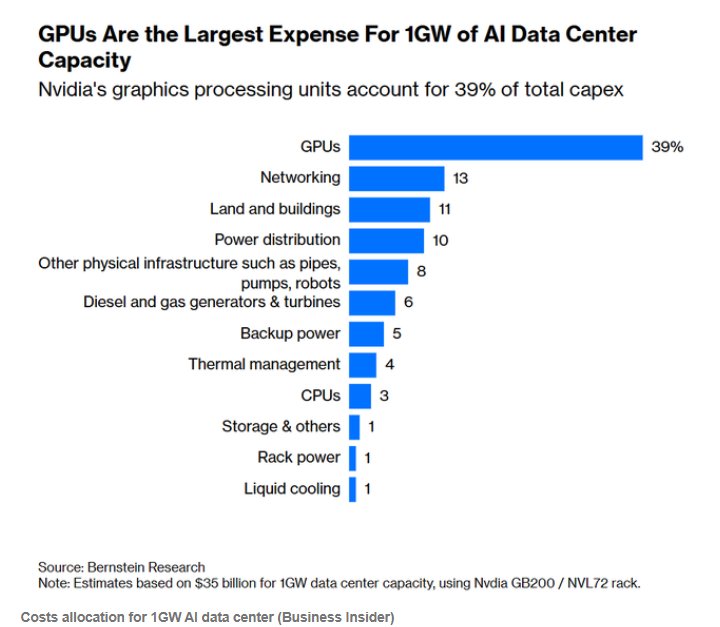
As shown above, most of the actual value goes to large technology companies involved in implementing the development and completion of AI data centers, such as Nvidia, Broadcom, Google, AMD, and Micron. As a result, JR Research said, “It's hard for me to imagine a new leader in this kind of value capture — we're still in the early stages of a trillion-dollar AI investment race,” so the market is still pricing who actually owns the AI crown.
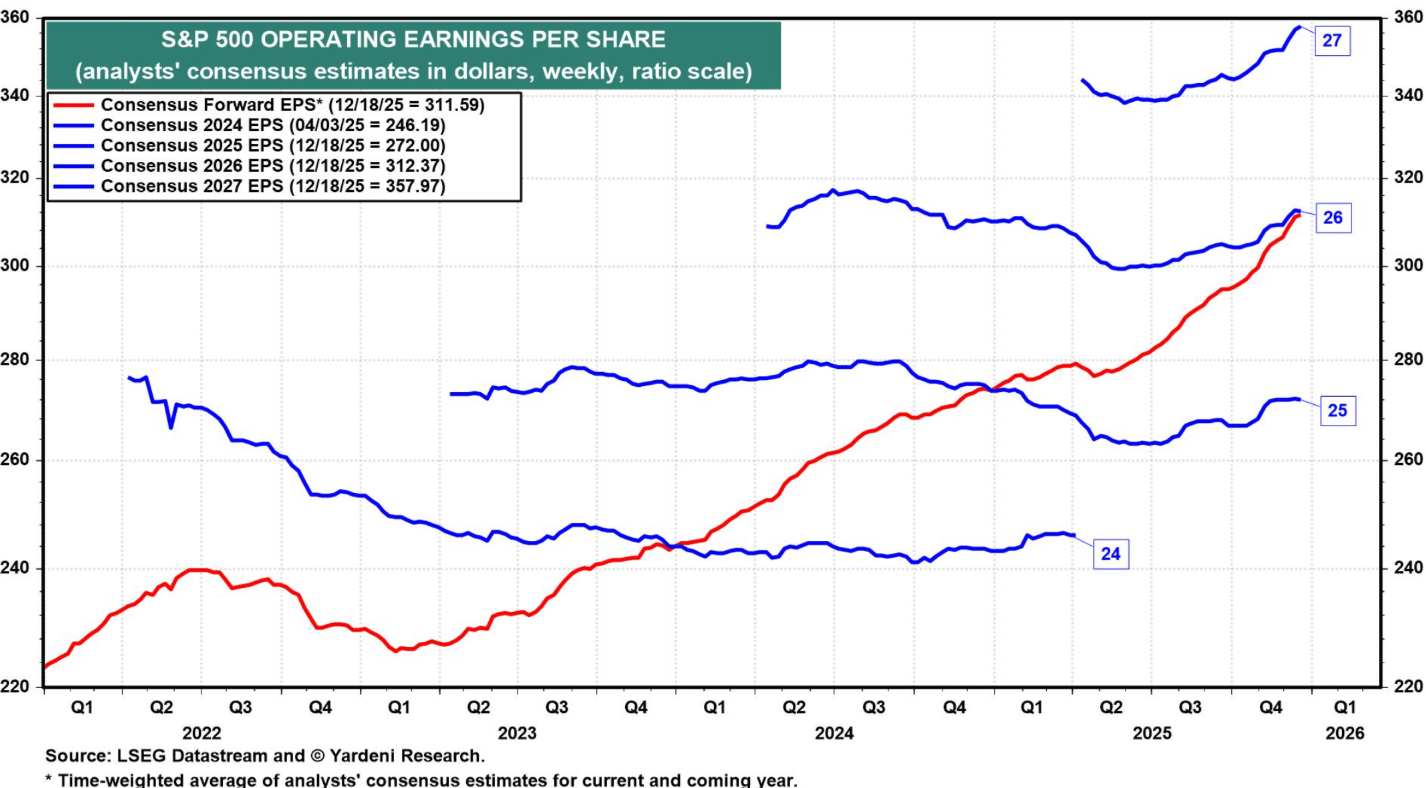
The overall profit forecast for the S&P 500 index has continued to be revised and extended to 2026. Although market concerns about the intermittent reduction of valuation multiples have arisen from time to time, the market did not seem to be bothered in the second half of the year. Some analysts still don't anticipate a significant risk of a sharp decline, as the Federal Reserve is expected to be dovish, especially as consumer sentiment is weak throughout December and labor market conditions may remain weak next year. Since the current popular candidates for the Federal Reserve Chairman are all seriously biased, the market will not rush to find exports due to concerns about the uncertainty of the Fed's policy.
At the same time, the possibility of a “melt-up” (melt-up) phase cannot be ruled out; it may also trigger a pattern leading to a larger market peak — or the ultimate bull market top, as some people call it — and echo the AI bubble bursting narrative that people are most concerned about. Under such circumstances, the US Federal Reserve, which favors monetary conditions, may further ease monetary conditions, thereby attracting investors who are still on the market to return to the stock market, especially when the ROI they receive from fixed income investments is likely to decline.
Furthermore, the strong profit shown by the Seven Magnificent Seven (Magnificent Seven) is expected to provide the market with the “most important ballast stone” needed to maintain a valuation multiple above average.
According to Wall Street analysts' forecast data compiled by FactSet (based on calendar year caliber), Wall Street expects the profit of the “Magnificent Seven” to increase sharply by about 22.7% in 2026; while the overall profit of the remaining 493 companies in the S&P 500 index will increase by about 12.5%. The FactSet research report shows that the Big Seven generally have stronger pricing power, operating scale advantages, high free cash flow, and combined capital operations such as buybacks to support EPS, making it easier for their profit growth rate to outperform the market average.
Current Wall Street estimates show that forward operating earnings per share in 2026 will be about 312.4 US dollars, and in 2027 it will be as high as about 358 US dollars. EPS expectations continued to be raised during 2025, mainly because analysts underestimated the intrinsic intensity of data center construction behind the AI investment boom, while also actively evaluating the higher-than-expected risks brought about by Trump's tariffs and trade uncertainty.
At the beginning of 2025 — before the world-famous DeepSeek AI chatbot launched by a Chinese AI startup with extremely low AI training costs once ignited market concerns about valuations of tech stocks benefiting from AI and heightened competitive fears about Chinese rivals, legendary investor Howard Marks (Howard Marks) warned that he was in a “bubble watching” state. The reason this opinion is remarkable is that the co-founder of Oak Capital Management was one of those investors who accurately predicted the moment the internet bubble burst in 2000.
However, this is clearly not a Wall Street consensus view. A recent report released by Bank of America Global Research (BofA Global Research) strategists showed that they “haven't seen an AI bubble to any extent.” According to data compiled by Jefferies (Jefferies), another Wall Street financial giant, Wall Street analysts generally expect the overall profit growth of S&P 500 companies to accelerate year by year, and is expected to continue until 2027.
According to a recent research report released by Bank of America, the global AI arms race is still in the “early to medium stages”; Pioneer Leader, one of the world's largest asset management giants, recently pointed out in a research report that the AI investment cycle may have only completed 30% to 40% of the final peak. However, the asset management giant said that the risk of a pullback in large technology stocks is indeed increasing.
Although tech giants are overvalued, they have not reached the “extreme” bursting of the bubble compared to past market frenzy. The market often compares it to the Internet bubble in the 2000s, but the scale of the increase brought about by AI is not the same as during the development of the Internet. For example, BI statistics show that the Nasdaq 100 index, which is dominated by technology stocks, is currently about 26 times the expected profit; at the peak of the internet bubble, this ratio was over an astonishing 80 times.
The reason why valuations in the Internet bubble era were far higher than they are now is not only because stock price increases were more exaggerated, but also because technology companies at the time were “younger”, less profitable, or even unprofitable.
Tony DeSpirito, BlackRock's global chief investment officer and fundamental stock portfolio manager, believes that now is not an “internet bubble valuation multiple.” However, the veteran asset manager said that this does not mean that there are no sporadic speculativism or irrational excitement, but he doesn't think this excitement is focused on the “seven big tech giants” targets related to AI.
In its annual outlook, J.P. Morgan Chase said that the 2026 market transaction pattern will not be much different from 2025, and the stocks that dominate the market will show extreme congestion and a record concentration of AI giants (that is, the Big Seven US stocks will continue to hold a high weight). J.P. Morgan believes that the current AI-driven super-investment cycle is at the core of its optimistic outlook. This cycle has driven record capital expenditure, rapid expansion of profits, and created an “unprecedented” market concentration for AI beneficiary stocks and high-quality growth companies. The report defines these high-quality companies as those with strong profit margins, steady cash flow growth, strict return on capital, and low credit risk, and emphasizes that this technology-driven structural transformation is reshaping the market pattern.