
Goldman Sachs: Optimistic about “disruptive” opportunities in the space sector, Rocket Lab (RKLB.US) sets a new government order record, and the target price is $47
The Zhitong Finance App learned that Goldman Sachs has released an in-depth research report on the space sector. The report focuses on the “Dispersive Combatant Space Architecture” (PWSA) project promoted by the US Department of Defense Space Development Administration (SDA). In particular, it thoroughly analyzed the award of contracts for the third batch of tracking layer satellites.
According to the report, the SDA announced the contract for the third batch of tracking layer satellites for the PWSA project on December 19, 2025, with a total value of up to 3.5 billion US dollars, covering the construction and launch missions of 72 satellites, which is expected to be gradually deployed from 2029. This major contract was shared by four companies, L3Harris (LHX.US), Lockheed Martin (LMT.US), Northrop Grumman (NOC.US), and Rocket Lab (RKLB.US). Each company received hundreds of millions of dollars in orders. Among them, Rocket Lab won its largest government order to date with this contract, marking the rise of innovative disruptors in key national security contracts.
According to information, the PWSA project aims to build a low Earth orbit (LEO) constellation composed of military satellites to provide end-to-end missile warning, missile tracking, and missile defense services. The project is implemented in stages to continuously iteratively upgrade satellite performance to meet increasingly complex space security challenges. From the initial proof of concept to today's enhanced sustainability, the PWSA project has gradually become an important part of the US space defense system.
Goldman Sachs analyzed in detail the award status and contract value of each batch of satellites in the report. Since the start of the project, SDA has awarded a total of US$13.6 billion worth of contracts for the construction of 518 tracking and communication satellites. Among them, the award of the third batch of tracking layer satellites not only maintained an increasing trend in quantity, but also achieved significant technical upgrades, including better missile tracking sensitivity and accuracy, stronger target positioning capabilities, and advanced tactical data links and radio frequency communication functions.
Specifically, the US Space Development Administration (SDA) divided its satellite iteration plan into multiple “batches”. Specifically, 28 satellites were deployed in batches 0, 1 batch was expanded to 154, and 2 batches were further increased to 264, while the 3 batches currently under construction include 72 satellites.
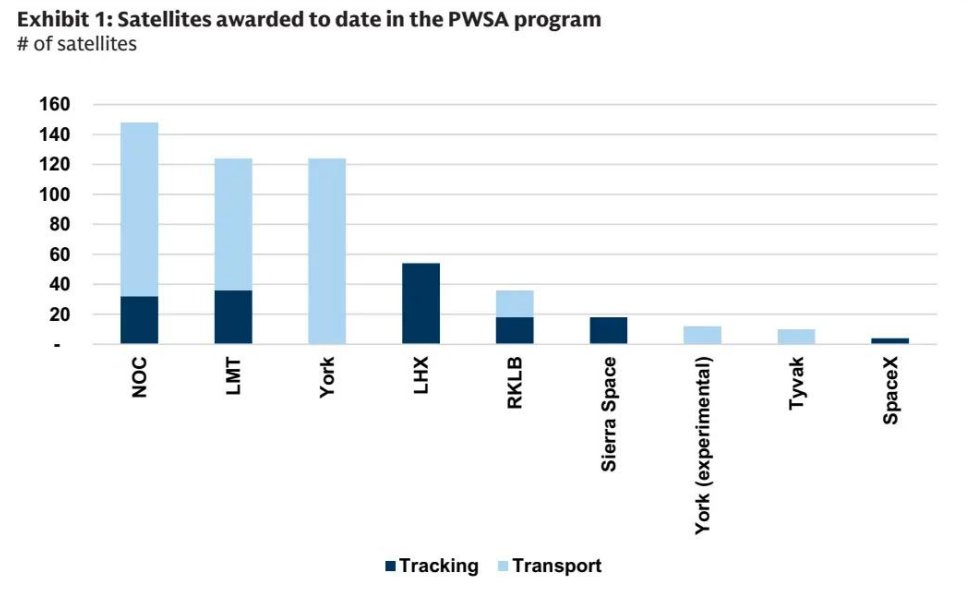
So far, the SDA has allocated a total of 13.6 billion US dollars to build a total of 518 tracking and transportation satellite networks. Although the SDA has previously indicated that the number of satellites will increase with each new batch, it did not include special funding for 3 batches of transport layer satellites in its 2026 budget application.
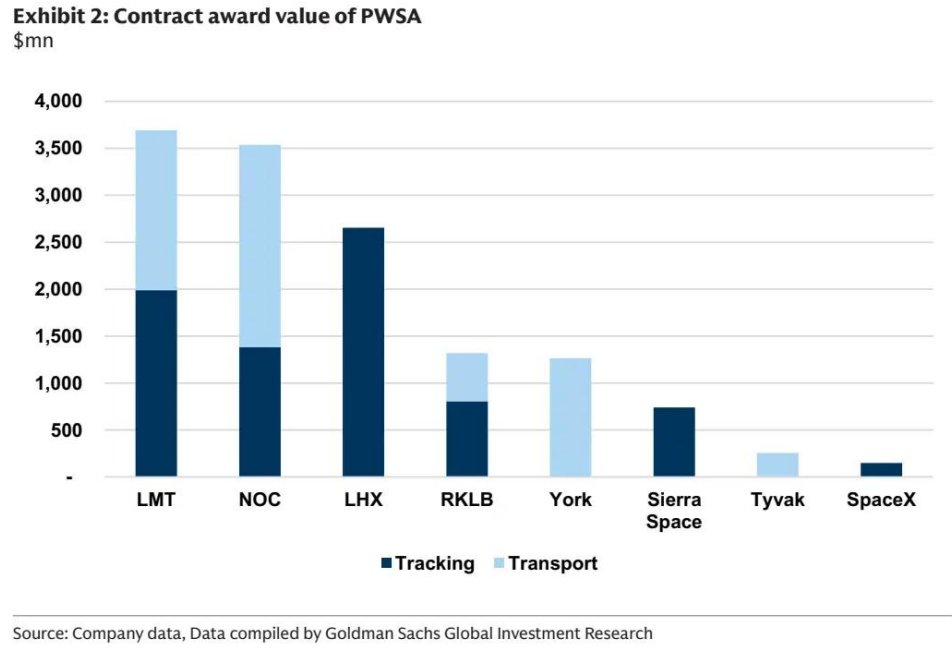
For the companies involved in the project, these contracts not only brought significant revenue growth, but are also strategically aligned with the fastest-growing areas of the US defense budget, and are expected to surpass their peers in the medium term. Goldman Sachs analysts pointed out that the contract amount for L3Harris is basically in line with the goals it has set, and Rocket Lab has successfully seized a larger market opportunity than before. Lockheed Martin and Northrop Grumman also continued to play an important role in the project as traditional defense contractors.
Specifically, for L3 Harris, Goldman Sachs gave a buying rating and set a 12-month target price of $351. This price is estimated based on the 4.75% free cash flow yield expected in 2026. However, the risks faced by L3Harris cannot be ignored, including increased spending by the Department of Defense and changes in priorities, uncertainty in profit margins and project implementation, and potential capital allocation issues.
Next, let's take a look at Northrop Grumman. Goldman Sachs gave a neutral rating and set a 12-month target price of $533. This price is calculated based on 0.99 times the expected price-earnings ratio (excluding pensions) for the 2026 calendar year compared to the S&P 500 index. Northrop Grumman's main risks include the impact of geopolitical factors, adjustments to the Department of Defense's spending priorities, rationality of capital allocation, and changes in profit margins.
Turning its attention to Rocket Lab, Goldman Sachs gave a neutral rating and determined a 12-month target price of $47. The price was calculated based on 23.0 times the expected corporate value/sales for the 2027 fiscal year and converted back to one year at a 10% discount rate. The main risks faced by Rocket Labs include the difficulty of product expansion, the pressure of incremental capital investment, and the risks that may arise from aggressive contract underwriting.
Finally, Lockheed Martin, and Goldman Sachs gave a sales rating and set a 12-month target price of $430. This was determined based on 0.81 times the expected price-earnings ratio (excluding pensions) for the 2026 calendar year compared to the Standard & Poor's 500 Index. Lockheed Martin mainly faces risks such as geopolitical factors, Department of Defense spending priorities, and capital allocation.
In addition, Goldman Sachs also emphasized the profound impact of the PWSA project on the field of satellite communications and navigation. With the continuous improvement of the low-orbit satellite constellation, global low-latency communication access will become a reality, providing strong support for emerging applications such as telemedicine, autonomous driving, and augmented reality. At the same time, advances in satellite technology will also drive the development of 6G networks and achieve seamless mobile network services.
However, the development of the space sector is also facing many challenges. High launch costs, bandwidth and delay issues, and space debris are all key factors limiting the further development of the industry. Goldman Sachs believes that only through technological innovation and capital investment can these barriers be effectively overcome and the space sector can achieve sustainable development.