
- PREMIUM
- LIVE QUOTES
- INSTITUTIONS
 Index Options


 State Street
 CME Group
 Nasdaq
 Cboe
Cboe TradingView
 Wall Street Journal
The 2025 financial edition of “Guns, Germs, and Steel”: Guns and Precious Metals are amazing! Other “traditional havens” collectively failed
Needless to say, gold, as a precious metal, is the clearest commodity and the biggest winner among “safe haven assets” in 2025, and with the exception of gold, almost all other traditional “safe haven” assets have completely outperformed the US stock market benchmark, the S&P 500 index, let alone compare with the spot price of gold, which has skyrocketed by more than 70% since this year.
In a year full of trade frictions, geopolitical turbulence and conflict, and vague concerns about the “bursting of the artificial intelligence bubble,” trading prices in the defense and military sector and precious metals, including gold, silver, and platinum, jumped across the board, while “traditional safe-haven assets” other than gold collectively failed. This is an extreme pricing situation unprecedented in the century-old history of the capital market.
The global economy unexpectedly remained hot (not falling into stagflation or even recession as economists predicted at the end of 2024), politicians actively promoted monetary easing, and concerns about recession and inflation began to subside. After AI fanaticism swept through the market, it was hit by an “AI bubble” storm. The level of geopolitical tension continued to rise, and together shaped this year's market landscape where safe-haven assets other than precious metals have collectively failed.
Precious metals have outperformed almost everything since 2025. Both silver and platinum have more than doubled, and the spot price of gold has risen by more than 70%, the biggest increase since the 1979 global oil crisis. This performance crushed the MSCI Global Stock Market Benchmark Index by about 20%.
Whether gold, silver, and platinum have also fallen into their own speculative bubble is still an unanswered question. The question requires answers from commodity traders in 2026. However, their strength is supported by strong demand from central banks for capital purchases and their role as a key input for broader technology construction (such as the important role of silver in electrification transformation and AI data center construction).
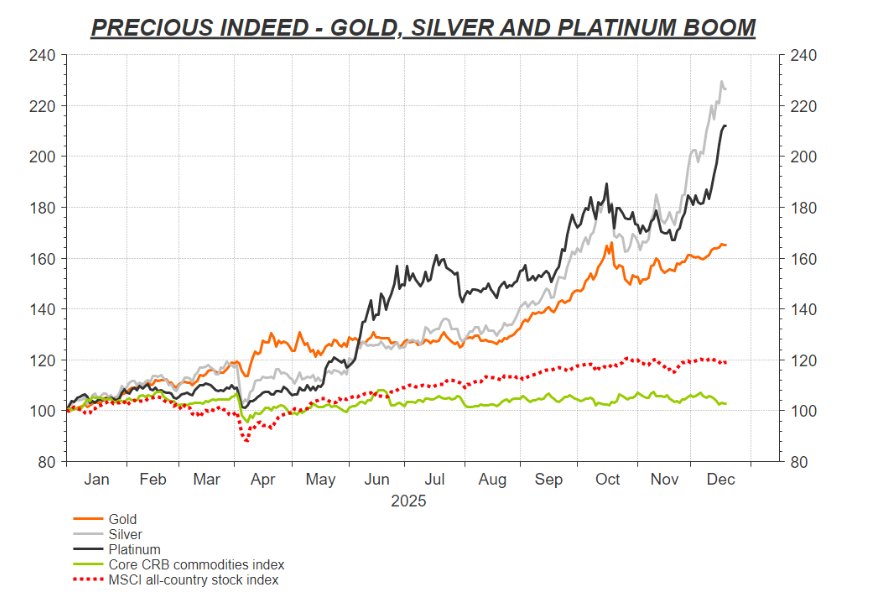
The above chart shows that precious metal assets won overall — gold, silver, and platinum collectively surged in 2025, outperforming the MSCI global stock index across the board.
However, the broader commodity index has performed extremely poorly this year, completely overwhelmed by expanding expectations of crude oil surpluses. Despite several times of extreme supply pressure in the Middle East in 2025, and concerns that crude oil might jump to $100 per barrel, the international crude oil price benchmark, Brent crude oil futures prices actually fell 20% year on year. The current level is almost half of the level of concern at the time. “Oversupply expectations” about crude oil continue to disrupt the commodity market.
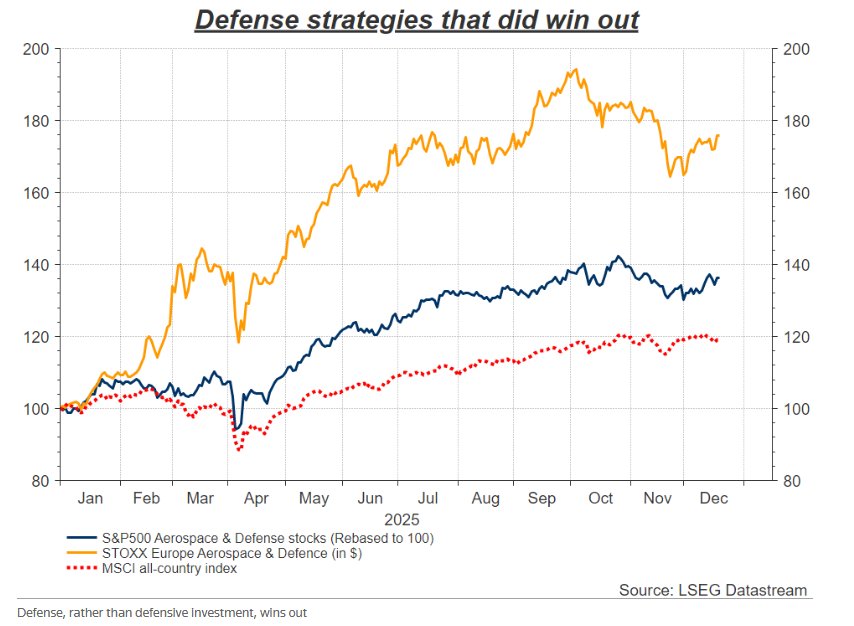
If you are concerned about the intensification of global geopolitical conflicts, investing your money in traditional defensive stock market sectors (such as utilities and essential consumer goods, the most typical “traditional safe haven”) is not the best choice. Instead, the real benefit is the defense and military sector, which has the title of “alternative safe haven” itself, which is closely related to geopolitics. According to the latest statistics, US aerospace and defense stocks recorded a 36% increase in 2025, while similar European military stock sectors rose sharply by 55%, mainly because Germany and mainland Europe wanted to rearm Europe after Trump announced that they would fully concentrate defense construction in the US.
Generally speaking, the defense and military sector is not a “traditional safe haven” that traders have focused on for a long time, but rather an “alternative safe-haven asset”, mainly because it may show relative strength as a “safe-haven” during the conflict escalation and rearmed cycle, but it is still essentially a stock risk asset, which is affected by valuation, interest rates, market beta, policy and order cycles, so the military logic is more “financial budget and military spending-driven profit improvement”; it is not entirely equivalent to “traditional safe-haven assets” such as gold/US bonds, which are also quite different Avoid the traditional “stock market” where demand is more stable during periods of economic downturn or fluctuation “Insurance sector” (such as utilities, essential consumption, medical care).
Guns, germs, and steel
The popular global science and humanities book “Guns, Germs, and Steel”, written by American evolutionary biologist Jared Diamond, tells the world that the gap in wealth, technology, and power in human society is mainly determined by geographical and ecological conditions (domesticable animals and plants, agricultural diffusion paths, resources and transmission conditions), not “racial talent”; “Guns, germs, and steel” are proximate carriers (military technology, pathogen immunity, metals, and immunization) in the expansion of European and other societies after these underlying conditions have been accumulated over a long period of time ability).
Putting the logic of “Guns, Germs, and Steel” author Diamond into the current capital market, the vast majority of traditional safe-haven investment strategies (government bonds, some defensive sectors, some currencies, volatility hedging, etc.) that “seem safer” over a long period of time did not have any protective effect in 2025. Instead, “guns” (military/defense industry chain chain) and “gold/precious metals” (hard currency safe-haven assets), which can be called alternative safe-haven assets, won out.
Guns and precious metals are king, and the “traditional safe-haven investment strategy” has collectively failed. It can be said that it is similar to Diamond's evolutionary biology paradigm: what determines the outcome is not a superficial racist label (the word “safe haven”), but rather the underlying, sustainable structural forces — that is, huge geosecurity requirements and rearming needs (guns), the central bank's extremely strong demand for capital purchases and safe-hide+physical input attributes (precious metals — can be understood as “steel” industrial chain hard restrictions) completely overcame traditional market pricing The “long term The rule of thumb for safe-haven since then”.
Guns (Guns) = the “hard power premium” brought about by geography and remilitarization
In years of rising conflict and uncertainty, what really outperforms is not the “traditional defense sector” such as utility/essential consumption, but the defense and military industry sector itself, which corresponds to “guns” as a direct carrier of power and budget tendencies: when national security becomes the main macroeconomic line, the capital market will directly price the “military spending - order - profit” chain.
Steel (Steel) = “hard asset restraint” of the central bank and consumers' unparalleled demand for capital purchases and industrial investment
Precious metals (gold, silver, platinum) outperformed the global stock market in 2025. One of the key supports comes from the growing demand for reserves/de-dollarization/safe-haven investments from central banks and retail investors and their input attributes in broader “technological construction/expansion”. In the “steel” paradigm, this is not a simple “risk aversion,” but rather the structural forces of “hard restraints on the industrial chain+strong reserve demand at the central bank level” are driving — this is the “Guns, Germs, and Steel” narrative where “underlying conditions determine upper level outcomes.”
Germs (Germs) = the “transmission mechanism” of risk is not spreading according to the traditional script
Traditional hedging (government debt, yen/dollar, volatility hedging tools) essentially bet on “panic contagion” — once the impact spreads, capital will flock to these assets in a panic. However, the conclusion of the 2025 market review was accurate: despite all kinds of turbulence throughout the year, most traditional safe-haven transactions did not achieve protective effects or significant risk hedging functions, and volatility indicators did not rise at the end of the year. In the language of “Guns, Germs, and Steel,” this is “germs have not formed a pandemic”: there is a lot of conflict and noise, but risk is not continuously transmitted into a systemic financial panic, so “traditional safe-haven assets” are naturally mediocre or even dragged down.
A deeper “Diamondian explanation”: In “Guns, Germs, and Steel,” guns/germs/steel are “proximate causes,” while the deeper drive comes from geography and resource endowments, systems, and technology diffusion conditions. Corresponding to the 2025 market, the reason why precious metals and the military won was also driven by structural factors: central banks' propensity to buy money and de-dollarize, physical demand from AI and energy/hardware investment, European rearmed trends and fiscal stimulus policy shifts, and macroeconomic “concerns about economic heating/recession subside,” which discounted the protective properties of the bond and defense sector.
In 2025, bonds, traditional safe-haven defense sectors, and sovereign currencies unexpectedly lagged behind the stock market benchmark index
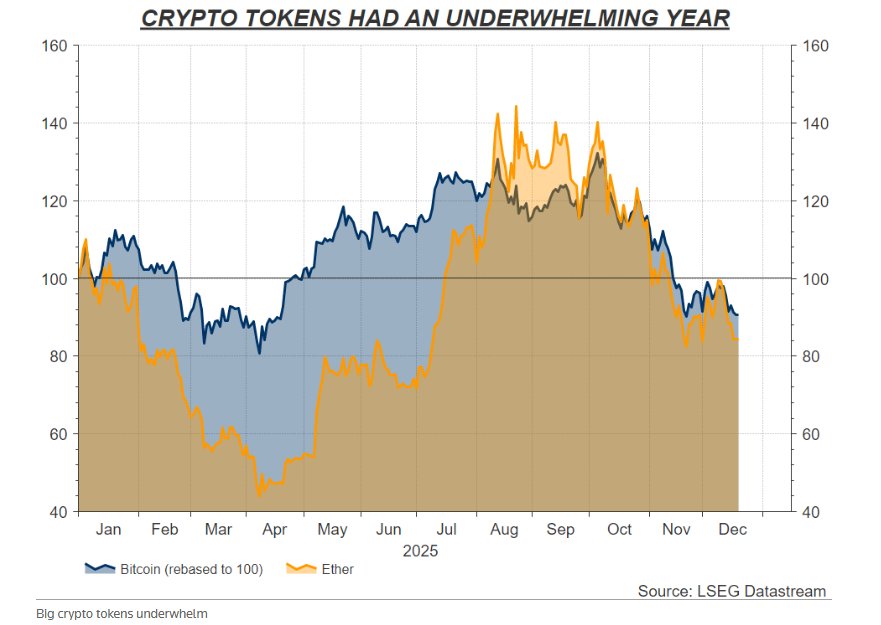
Since this year, most other types of traditional buffer and safety configurations have been more of a drag on portfolios than protection. Even cryptocurrency tokens such as Bitcoin, which some investors touted as “digital gold,” recorded a sharp decline during the year-end period.
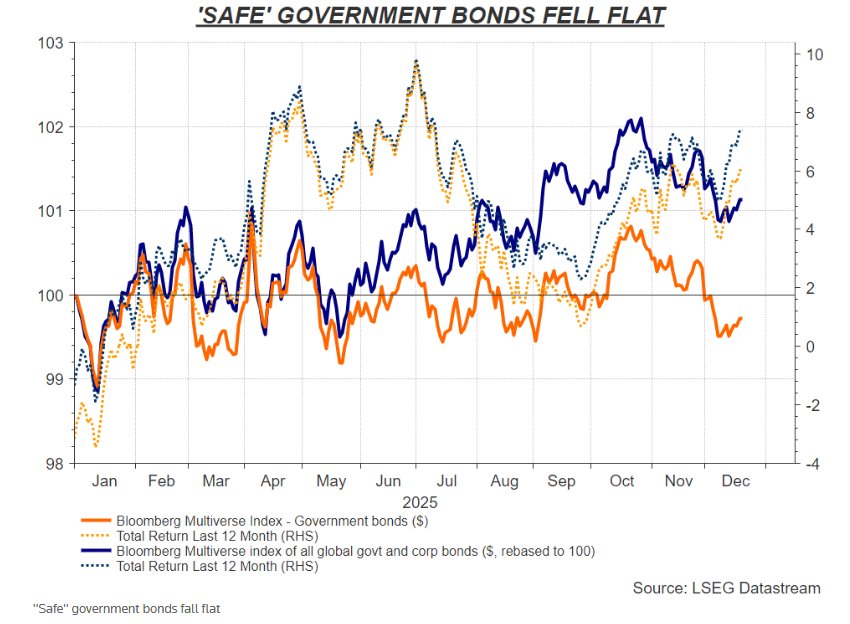
Bond-like assets also had an incredibly bad year. In US dollars, the global “risk-free government bond price index” unexpectedly fell by about 1% — rarely outperforming the MSCI global stock index and most likely ending the year with a negative value, but it rose slightly more than 6% when calculated by adding the total return of yield. Broader global consolidated bond benchmarks (such as the Bloomberg Multiverse Index, which covers government, supra-national debt, institutional bonds, and corporate bonds) did not improve much, with prices rising by only about 1%, and total returns close to 7%.
The price-level returns on these bond assets are less than half of the increase in the MSCI Global Market Stock Benchmark Index — the index is expected to record its best annual performance since 2019 before the pandemic.
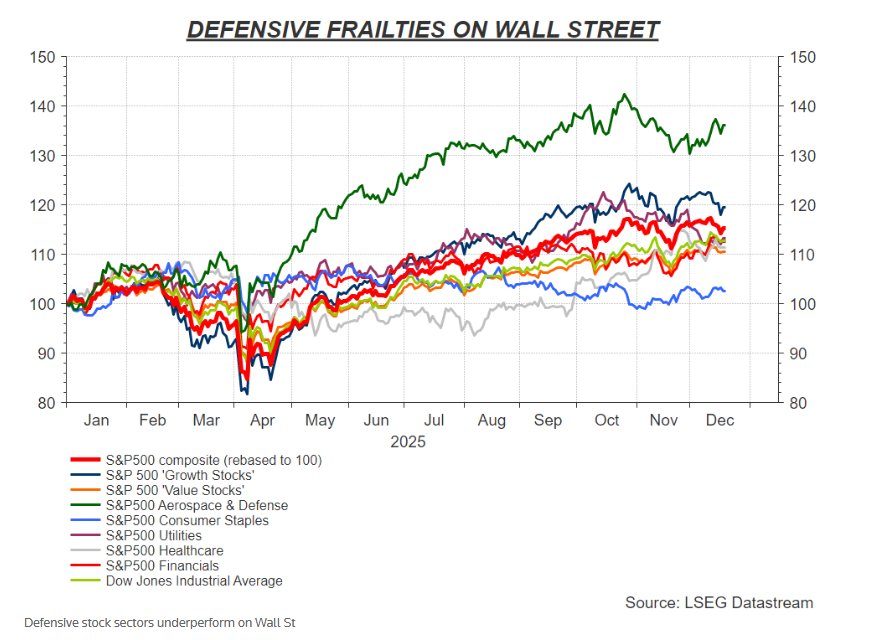
Within the global stock market, adopting a traditional defensive strategy will definitely not be the big winner in 2025.
The S&P 500 index has performed well with the joint support of tech giants and AI investment themes. The annual benchmark has risen 15%; the strong rebound in the US economy in the second half of 2025 and the downward trend in interest rates driven by the Federal Reserve's interest rate cut expectations, and the AI fanatical investment wave led by AI computing power leaders such as Nvidia, Oracle, and Broadcom have jointly boosted most of Wall Street's assets.
Statistics show that the S&P 500 “growth stock benchmark index” rose sharply by 20%, more than double the increase in the “value stock” benchmark index, which is enough to show that during a year full of turbulence, the safe-haven strategy completely failed, and completely outperformed the general market benchmark and growth stock benchmark.
Since 2025, the total return of the S&P 500 index has also been surprisingly 5 percentage points higher than the equal-weighted version of the index, exceeding the expectations of almost all Wall Street analysts at the end of 2024 — at the time, they generally believed that as market gains spread from technology to various sectors, the weighted version of the S&P 500 index would perform even stronger.
Although the utilities, healthcare, and finance sectors performed well, with gains of more than 10%, they all lagged far behind major indices such as the S&P 500 index and the NASDAQ and MSCI global stock indexes. The essential consumer goods sector rose by only about 2%. This traditional safe-haven sector has been the bottom sector in the entire US stock market since 2025.
Finally, in terms of stock market benchmark index performance around traditional safe-haven assets, the Dow Jones Industrial Index (the traditional safe-haven sector of the stock market), which is compiled around blue-chip stocks with large market capitalization, also outperformed the S&P 500 and NASDAQ 100 indices.
Among sovereign currencies, the yen and the Swiss franc are generally regarded as traditional safe-haven assets — but one of them has also been disappointing since 2025.
The weakening of the US dollar in the first half of 2025 initially pushed the yen and the Swiss franc higher at the same time, but the yen then threw back almost all of its gains. Further interest rate hikes by the Bank of Japan also failed to provide any help, as investors feared additional fiscal stimulus and were uneasy about the domestic bond market due to the arrival of the new Prime Minister Takaichi and then sold the yen — Japan's domestic bond market yield was disrupted by interest rate hikes due to the arrival of the new Prime Minister Takaichi Sanae, and continued to reach new highs.
Based on the actual effective exchange rate caliber for Japan's major trading partners, the yen fell by about 4% for the whole year.
However, the Swiss franc maintained its early gains and, along with gold and silver, became one of the few assets that actually “realized safe-haven properties” in 2025. However, compared to precious metals, the Swiss franc did not look good enough.
But if you saw the US dollar as a safe haven during a period of geopolitical stress at the beginning of the year, then you have to rethink — that is, neither the dollar nor the yen is “safe” or “safe haven” in 2025.
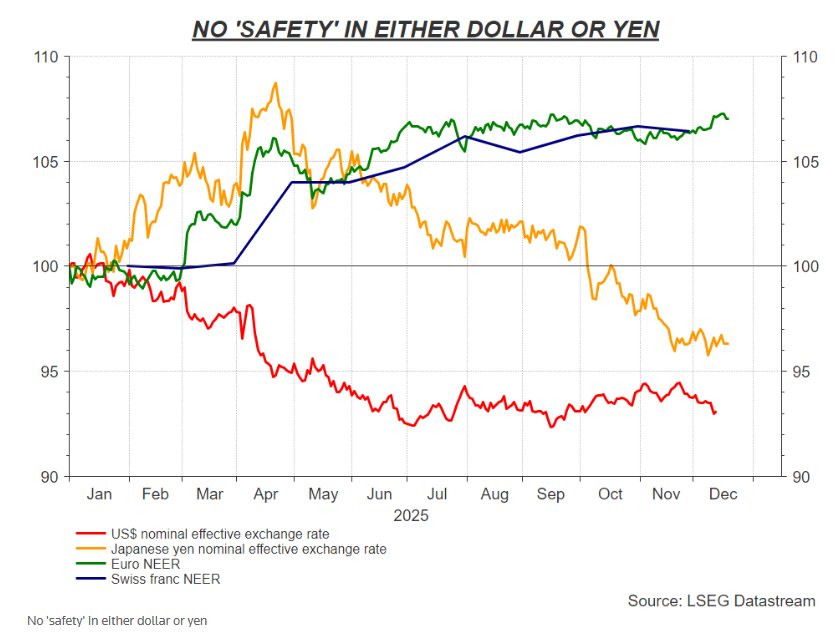
The DXY, or US dollar index, once fell sharply by 12% during the most turbulent months of global geopolitical and trade events in 2025, and continued to weaken during many hot events in the Middle East, Eastern Europe, and even the Caribbean.
In 2025, the volatility strategy favored by derivatives traders also failed
For investors who are concerned about market turbulence, another strategy could be to buy a volatility index closely related to options to achieve significant profits from the sharp fluctuations in stocks and bonds. This is also an “options-style” safe-haven tool commonly used by some derivatives traders.
However, in 2025, these “parachutes” that focus on volatility also did not actually open. In other words, with the exception of defense, military industry, and precious metal assets, excessive prudence this year did not really bring any kind of return.
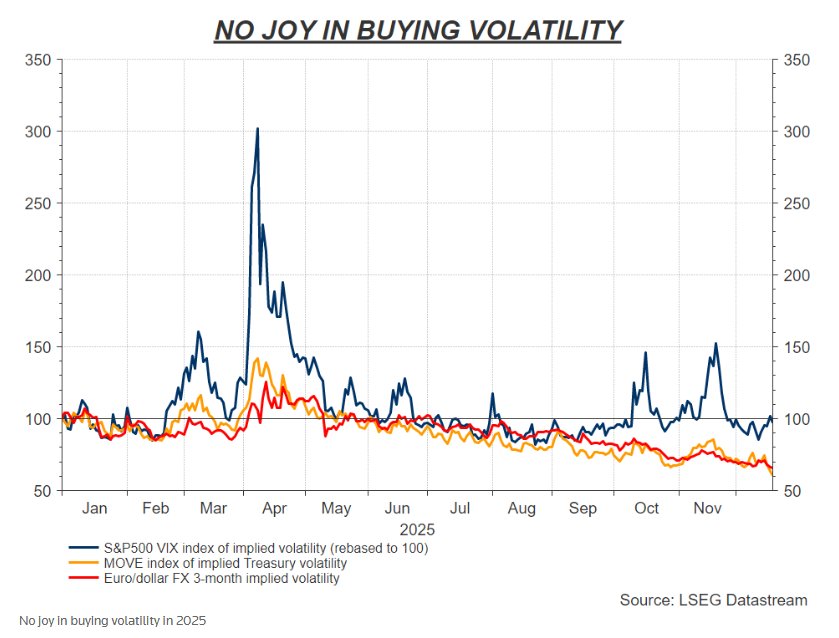
Despite sharp “roller coaster” fluctuations in the financial market in spring, the VIX Panic Index, which closely tracks fluctuations in the S&P 500 index — the “VIX Panic Index,” which reflects the implied volatility of one-month S&P 500 index options — was about 2 points lower at the end of the year than at the beginning of the year. The Bank of America MOVE Index, a bond market fluctuation indicator corresponding to the VIX Panic Index in the US bond market, has fallen to less than two-thirds of the level at the beginning of the year, and less than half of the peak in April. Volatility indicators for major foreign exchange markets are also lower.