
The rise of retail investors in US stocks: capital broke records in 2025, and Wall Street institutions are being forced to “dance with retail investors”
The Zhitong Finance App learned that retail capital inflows into the US stock market in 2025 will reach a record high. Driven by expectations of interest rate cuts, individual investors have become the main force behind this wave of stock market rebound that may continue until next year.
According to J.P. Morgan's data, since 2025, the amount of capital invested by retail investors in the US stock market has increased by 53% compared to the same period last year of US$1970 billion, and is 14% higher than the record of US$270 billion set during the peak of retail trade frenzy in 2021.
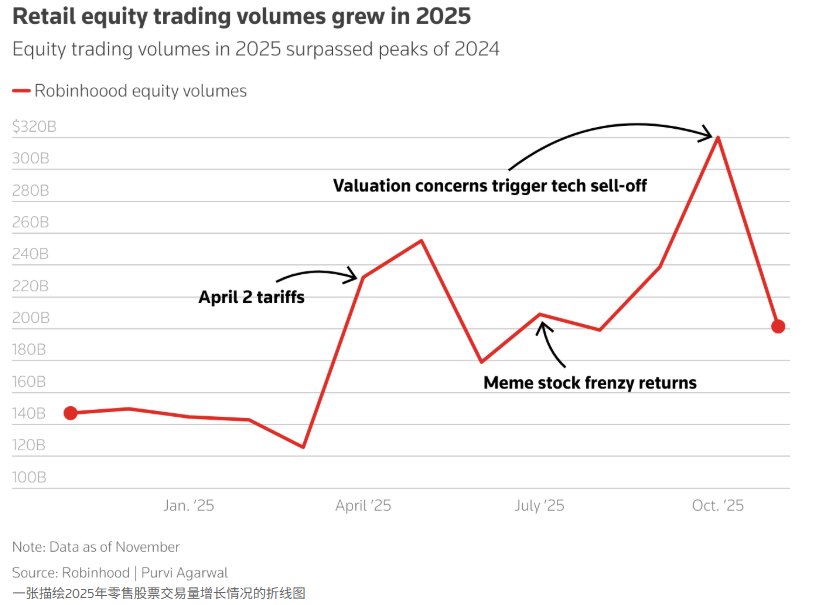
Meanwhile, according to J.P. Morgan Chase's special transaction data, retail transactions accounted for about 20% to 25% of this year's total trading activity, and hit a record high of about 35% in April.
Individual investors absorbed high-quality stocks at low prices during the market sell-off. Most notably, after US President Donald Trump's “Liberation Day” tariff policy triggered a sharp decline in global markets in April, the intervention of retail investors helped push the S&P 500 index to a new high. The benchmark index has risen about 16% this year.
Steven DeSanctis, a small and medium cap strategist at Jefferies, said, “Retail investors will be around for a long time, especially in 2026. They made money this year, love to trade stocks, and have an app to do the trades. We'll continue to see them maintain a good presence.”
Over the years, with the rise of low-cost, zero-commission brokers such as Robinhood and Yingtou Securities, the entry threshold for ordinary Americans is lower and the cost is lower, and retail participation in the stock market has grown steadily.
This trend received widespread attention in 2021. At the time, many Americans who were home and well-funded due to the COVID-19 pandemic used mobile trading platforms to gamble on everything from game stations to big tech stocks.
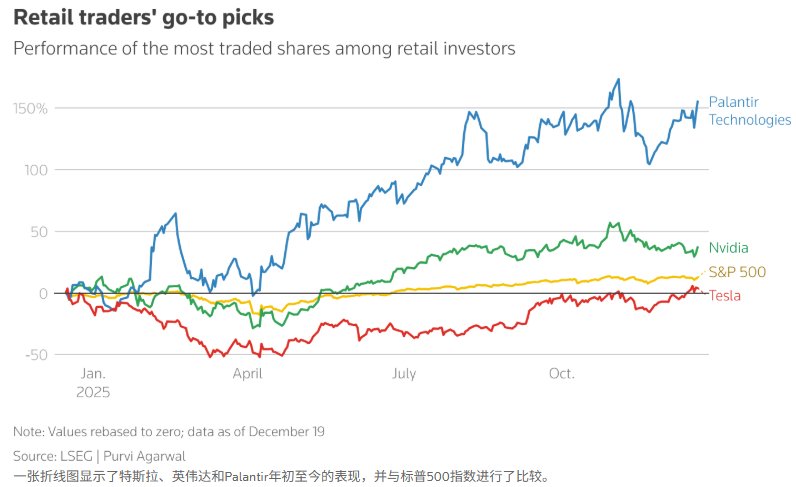
According to retail broker data and executives, AI concept stocks such as Nvidia (NVDA.US) and Palantir are the number one darlings this year. The latter more than doubled its value as retail investors “bought on dips” when institutional investors withdrew due to valuation concerns.
Another retail favorite — Tesla (TSLA.US) shares hit a record high on December 17, the first time since the end of 2024.
Steve Sosnick, chief strategist at Yingtou Securities, said, “The two most actively traded stocks on our platform are usually Nvidia and Tesla. These two examples show that individual investors are grasping market narratives and, in many cases, forcing institutional investors to follow suit.”
As investors' investment methods become more “thematic,” quantum computing companies, uranium miners, metal miners, and rare earth companies have also attracted the interest of large numbers of retail investors.
Retail traders increasingly prefer ETFs
Executives from major trading platforms said that a key characteristic of retail trading in 2025 is their growing preference for exchange-traded funds (ETFs) that track stock indices, cryptocurrencies, and commodity trades.
Brian Lake, global co-head of third-party wealth at Goldman Sachs Asset Management, said, “Investors continue to be drawn to ETF technology. It trades around the clock, is tax-efficient, and transparent.”
eToro US investment analyst Brett Kenwell said that Direxion's three-times longer semiconductor and three-times shorter ranked in the platform's dollar turnover rankings.
Joe Mazzola, head of trading and derivatives at Carson Wealth Management, said that retail investors are now trading more sane, as reflected in the reduction in the number and duration of so-called “meme frenzies (meme frenzies)”.
He added, “Retail investors have gained a bit more insight into market dynamics this year.”
Potential interest rate cuts are seen as a key catalyst
Analysts and brokers expect the Federal Reserve's potential interest rate cuts will continue to boost the market next year, allowing retail investors to continue their momentum in 2026.
Increased stock market volatility may trigger a pullback, which may also attract individual investors willing to bet on a rebound, although recent evidence suggests they are less enthusiastic about such opportunities.
Nasdaq plans to file an application with the US Securities and Exchange Commission (SEC) to launch 24-hour stock trading, a move that analysts believe will further accelerate retail investor growth.
“We are in a golden age of retail investment, where people can more easily access knowledge, enter the market itself, and use advanced trading platforms,” said David Russell, global head of market strategy at TradeStation.
Still, analysts said that as AI stocks dominating the market this year remain uncertain, they don't expect the next year to surpass the 2025 record as investors may consider diversifying their portfolios more.
eToro's Kenwell said financial, communications, optional consumption, energy, mining, and gold mining ETFs are likely to perform well. “But at the end of the day, retail investors love tech stocks, so if there is any kind of fluctuation in 2026, it will be an area they will continue to return to.”