
- PREMIUM
- LIVE QUOTES
- INSTITUTIONS
 Index Options


 State Street
 CME Group
 Nasdaq
 Cboe
Cboe TradingView
 Wall Street Journal
A 3,000x overpurchase was exchanged for a sharp drop of nearly 50% on the first day. Why did Hansi Tai-B (03378) become a new “trap”?
On December 22 and December 23, two consecutive “18A Big Meat” sales broke out on the first day, causing many investors to feel a hint of market chill at the end of the year. After the stock price of Huayu Bio-B (02396) closed down nearly 30% on the day of the first listing on December 22, Hansatek-B (03378), which was first listed on December 23, was also “severely hit” by the market.
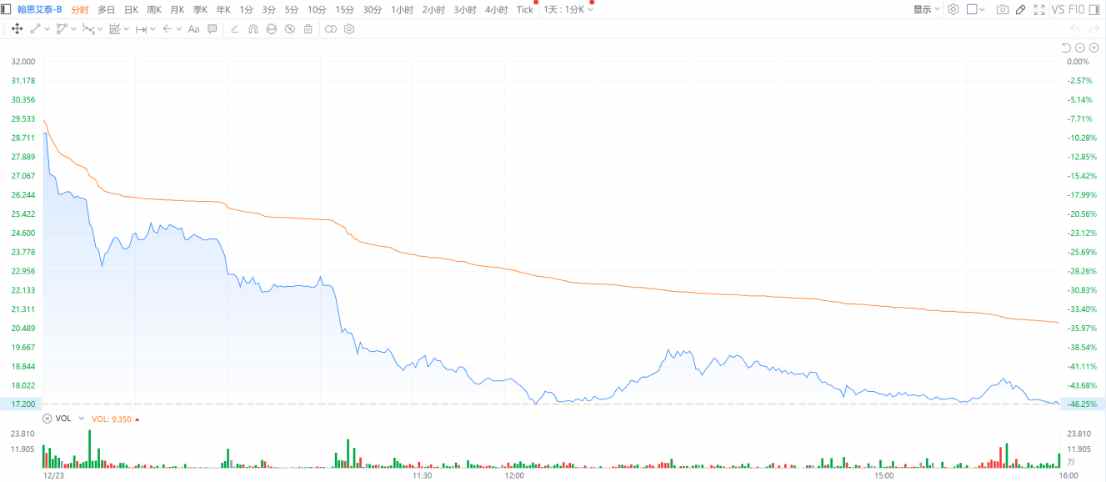
The Zhitong Finance App observed that on the first day, Hansi Aitai opened at HK$28.9, 9.69% lower than the issue price of HK$32. Since then, the company's stock price has dropped all the way down to HK$17.20, with the biggest drop of 46.25% throughout the day. Furthermore, its stock price bottomed out in the afternoon and was unable to narrow the decline to less than 40%. In the end, the company closed HK$17.20 at the lowest price of the day, locking in the first day's decline at 46.25%.
It is worth mentioning that both Huayi Biotech and Hansai have their own aura. Among them, Huayi Biotech is the “first Hong Kong stock PDGF stock”, while Hansatec has a differentiated “PD-1 plus” innovative treatment and the world's first and only dual-link anti-cancer variety.
Furthermore, due to their outstanding distribution results, these two companies were previously regarded by the market as “innovative drugs” nearing the end of the year. However, the performance of these two companies, which closed sharply on the first day of listing, clearly fell short of market expectations.
Has “Mechanism B+ Unprofitable 18A” become a new trap?
In fact, comparing the distribution results of Huayu Biotech and Hansi Aitai's 18A, we can actually see the market's new enthusiasm for innovative pharmaceutical companies.
According to the issuance plan, Hansi Aitai will now sell 18.321 million H shares globally. In terms of the Hong Kong public offering, Hansaltech was subscribed 3074.09 times. The final number of shares offered was 1,832,100 shares, accounting for about 10% of the total number of shares offered. Approximately 139,700 valid applications were received, and the number of applications accepted was 17,689, with a first-hand signing rate of about 1%; during the state allocation phase, Hansai received 5.78 times the subscription. The final number of shares offered internationally was 16.488,900 shares, which is equivalent to 90% of the total number of shares offered, in addition to 15% over-allotment rights.
The final issue price of the company was limited to HK$32 in the offering range, and raised a net capital of HK$531 million.
Since the Hong Kong Stock Exchange issued new IPO regulations in August of this year, many companies have pushed open placements to the lower limit of 10%, “artificially created” extremely shrinking circulation markets, and formed an issuance pattern dominated by institutions, cornerstones, and anchored investors. Regardless of whether it is Huayi Biotech or Hansi Aitai, they all seem to have enjoyed the “strategic dividend” from Mechanism B. The Zhitong Finance App observed that the Hong Kong public sale portion of Huayi Biotech was oversubscribed by 791.95 times, while Hansai received a huge overpurchase of 3074.09 times as much as the company that was distributed under Selection Mechanism B.
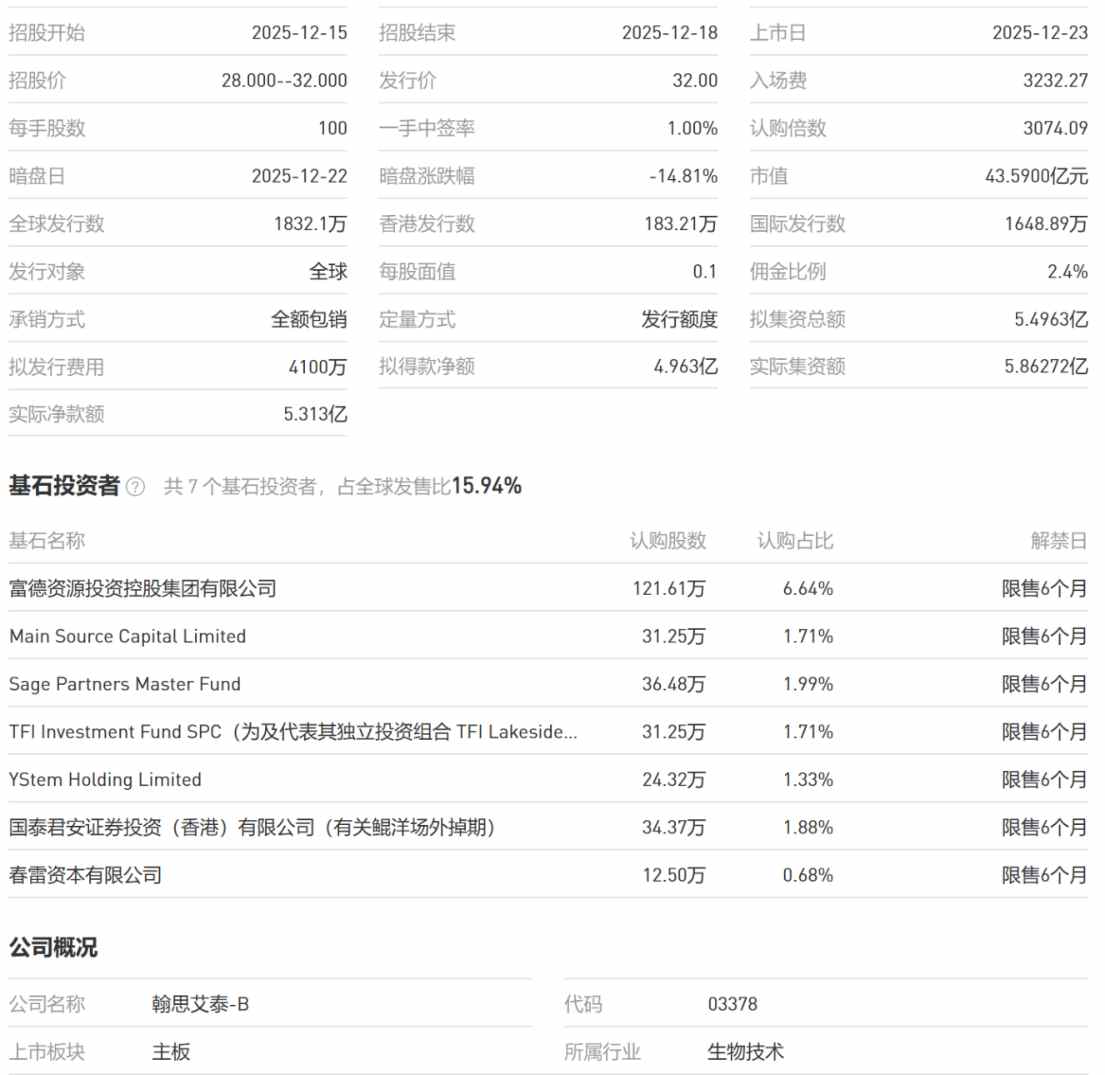
This time, Hansaitai's “Mechanism B” distribution strategy chose a more typical distribution pattern with institutions, cornerstones, and anchor investors as the main focus, and a “green shoe” mechanism.
In this listing, Hansai introduced 7 cornerstone investors, Fude Resources, Sage Partners Master Fund, Guotai Junan Securities Investment (Hong Kong) Limited (relating to Kunyang OTC swap), TFI Investment Fund SPC (acting for and on behalf of its independent portfolio TFI Lakeside SP), Main Source Capital Limited, iSystem Capital, and Chunlei Capital Co., Ltd., with a total investment amount of 9337 At HK$10,000, a total of 2,917,800 shares were subscribed, accounting for 15.93% of global sales.
As can be seen from the share of the current cornerstone placement, under the hard liquidity restrictions of the new Hong Kong stock IPO regulations, both Hansai Tech and Huayi Biotech abandoned the previous operation of imposing a high proportion of the cornerstone and instead chose to leave as much space as possible without locking in the placement requirements.
Judging from the core strategy comparison, Huayu Biotech chose the more aggressive “All in Anchored Investors” strategy and chose a “no foundation” approach to build a 100% unlocked institutional placement lineup; while Hansai Tech chose a more balanced “few but fine cornerstones+long-term anchoring+transactional anchoring” strategy.
However, judging from the dark market performance now, the above strategy does not seem to have had a positive effect of “price stabilization” for the two companies. Taking Phillip's dark market data as an example, Huayi Biotech's stock price even fell to 9.95% underwater at one point, eventually closing slightly higher by 0.58%; while Hansi Aitai closed at HK$27.26 in Phillip's undercover market, a decline of 14.81%. However, as the stock prices of both target cards plummeted on the first day of listing, it basically meant that there was no hope of getting through the end of the year for the two target cards.
In fact, looking back at when the Hong Kong market introduced new IPO regulations in August of this year, the market generally believed that mechanism B was more beneficial to institutions. After all, as long as the public sale ratio was reduced to 10%, then “patient capital” represented by cornerstones and institutions could obtain the vast majority of chips, bringing stable stock prices and long-term support to the company.
However, with both companies using Mechanism B to construct a typical distribution pattern to give 90% of the chips to the institution or cornerstone, the performance on the first day still fell short of expectations. Another common label between the two companies, “unprofitable 18A,” is probably an important reason why institutions chose to vote with their feet in the market.
Unprofitable combined with a limited price or the reason for “stepping on a hole”
Like Huayi Biotech, Hansai is also an “unprofitable 18A” company.
According to the Zhitong Finance App, Hansi Aitai is an innovative biotechnology company with independent expertise in structural biology, translational medicine, and clinical development. It is committed to exploring next-generation immunotherapy through the discovery, development and commercialization of first-in-class and/or best-in-class products for precise treatment of cancer and autoimmune diseases.
The company mainly innovates by improving methods for existing target inhibitors, and uses the company's proprietary VersatiBody platform (an antibody engineering platform) to create bifunctional or multifunctional molecules. Relying on this proprietary antibody engineering platform, the company successfully created a series of innovative molecules such as “PD-1 plus” and “CTLA-4 plus”, which have the advantages of high efficacy and low toxicity.
According to the prospectus, Hansi Aitai has a rich R&D pipeline, and the most notable product is Hx009 — a self-developed PD-1/SIRPα bifunctional antibody fusion protein, which aims to break through the limitations of traditional immunotherapy in certain tumors. In addition, the company also has two main clinical-stage products, HX044 and HX301, and seven pre-clinical drug candidates, covering ADC, BSaB, and mAb, covering the fields of tumors and autoimmune diseases.
Among them, the company's core product, Hx009, for its self-developed anti-PD-1/SIRPα bifunctional antibody fusion protein, has completed phase I clinical trials between China and Australia. Currently, multiple phase Ib to IIa clinical studies such as melanoma and non-Hodgkin lymphoma are being promoted in China. In 2025, it was approved by the State Drug Administration to treat advanced triple-negative breast cancer in combination with trastuzumab. It is expected that the first patient recruitment will be completed in 2026.
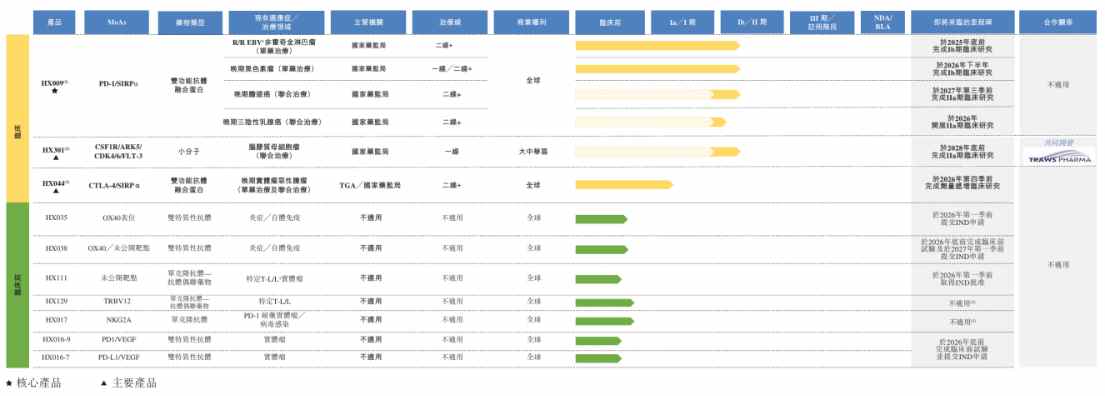
It is easy to see that all of the company's pipeline varieties are currently under development, and there are no major BD transactions yet. At a time when the market's value judgment on unprofitable 18A is returning to the cash red line index, this performance may affect the direction in which the market evaluates and judges it. Judging from financial performance, in the first eight months of 2023, 2024, and 2025, Hansi Aitai lost 85.16 million yuan, 117 million yuan, and 87.438 million yuan respectively. As of October 31, 2025, cash and equivalent amounts to $133 million, and total current liabilities amounted to $220 million.
Under these circumstances, Hansatec's final IPO price was even capped at HK$32, which is probably one of the important reasons that ignited negative market sentiment.
It is worth mentioning that before the IPO, the company completed a total of three rounds of financing. After the B+ round of financing in June 2024, the company was valued at about 1,615 billion yuan. However, the valuation after the IPO was as high as 4.352 billion yuan according to the pricing limit. After Hansaitai's first listing closed at a daily low price of HK$17.20, the total market value was still HK$2,343 billion. The corresponding net market ratio was still as high as 21.77 times, far higher than the industry average of 4.81 times, and surpassed the company's historical PB valuation in the past three months by 83%.