
- PREMIUM
- LIVE QUOTES
- INSTITUTIONS
 Index Options


 State Street
 CME Group
 Nasdaq
 Cboe
Cboe TradingView
 Wall Street Journal
Is Tan Chong Motor Holdings Berhad (KLSE:TCHONG) A Risky Investment?
Legendary fund manager Li Lu (who Charlie Munger backed) once said, 'The biggest investment risk is not the volatility of prices, but whether you will suffer a permanent loss of capital.' It's only natural to consider a company's balance sheet when you examine how risky it is, since debt is often involved when a business collapses. We can see that Tan Chong Motor Holdings Berhad (KLSE:TCHONG) does use debt in its business. But should shareholders be worried about its use of debt?
When Is Debt Dangerous?
Debt is a tool to help businesses grow, but if a business is incapable of paying off its lenders, then it exists at their mercy. If things get really bad, the lenders can take control of the business. However, a more common (but still painful) scenario is that it has to raise new equity capital at a low price, thus permanently diluting shareholders. By replacing dilution, though, debt can be an extremely good tool for businesses that need capital to invest in growth at high rates of return. When we think about a company's use of debt, we first look at cash and debt together.
What Is Tan Chong Motor Holdings Berhad's Debt?
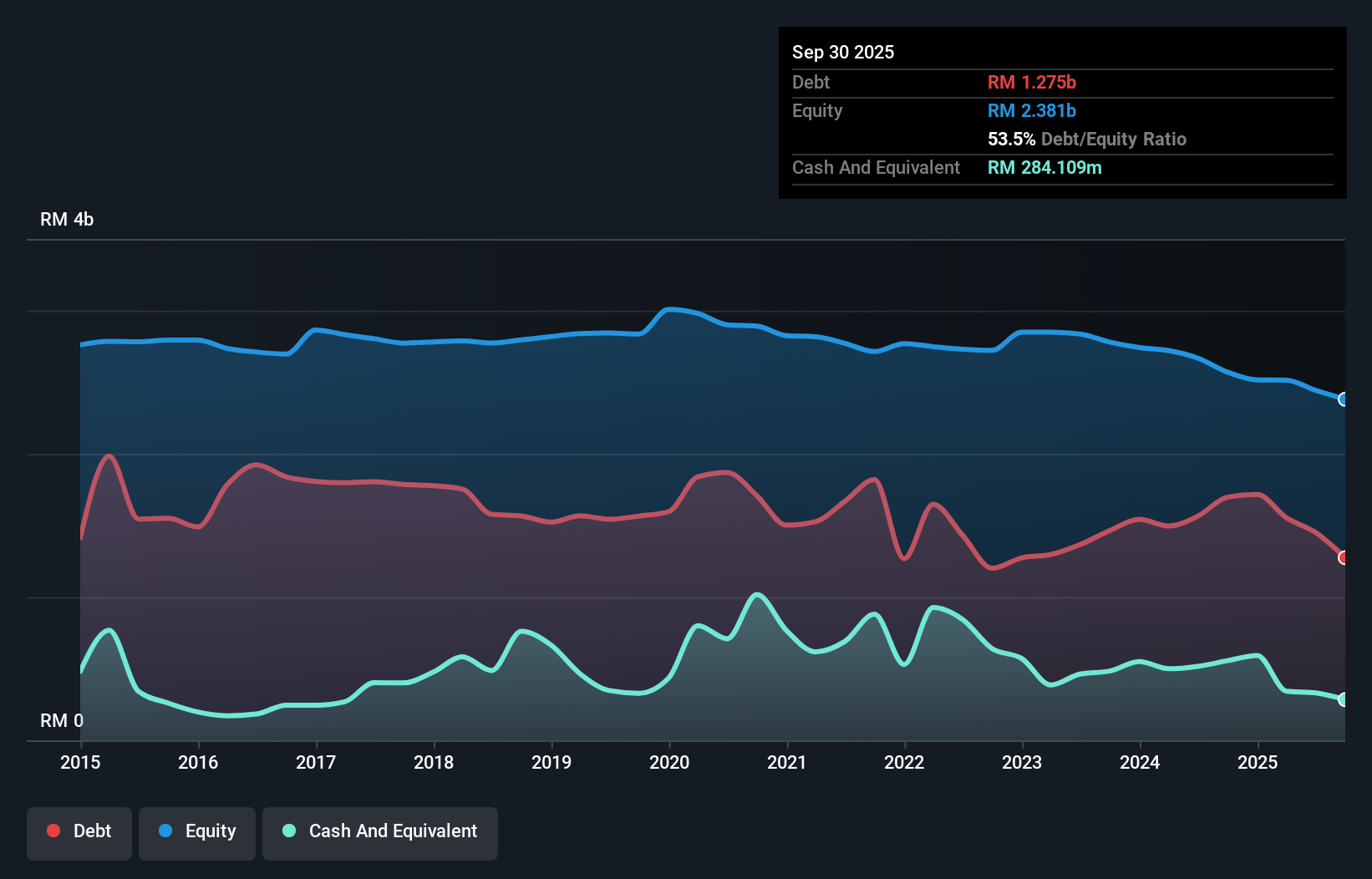
You can click the graphic below for the historical numbers, but it shows that Tan Chong Motor Holdings Berhad had RM1.27b of debt in September 2025, down from RM1.70b, one year before. On the flip side, it has RM284.1m in cash leading to net debt of about RM990.8m.
How Healthy Is Tan Chong Motor Holdings Berhad's Balance Sheet?
Zooming in on the latest balance sheet data, we can see that Tan Chong Motor Holdings Berhad had liabilities of RM1.56b due within 12 months and liabilities of RM612.7m due beyond that. Offsetting these obligations, it had cash of RM284.1m as well as receivables valued at RM532.3m due within 12 months. So its liabilities total RM1.35b more than the combination of its cash and short-term receivables.
The deficiency here weighs heavily on the RM413.8m company itself, as if a child were struggling under the weight of an enormous back-pack full of books, his sports gear, and a trumpet. So we'd watch its balance sheet closely, without a doubt. At the end of the day, Tan Chong Motor Holdings Berhad would probably need a major re-capitalization if its creditors were to demand repayment. When analysing debt levels, the balance sheet is the obvious place to start. But ultimately the future profitability of the business will decide if Tan Chong Motor Holdings Berhad can strengthen its balance sheet over time. So if you're focused on the future you can check out this free report showing analyst profit forecasts.
See our latest analysis for Tan Chong Motor Holdings Berhad
In the last year Tan Chong Motor Holdings Berhad had a loss before interest and tax, and actually shrunk its revenue by 3.7%, to RM2.1b. We would much prefer see growth.
Caveat Emptor
Over the last twelve months Tan Chong Motor Holdings Berhad produced an earnings before interest and tax (EBIT) loss. Indeed, it lost a very considerable RM191m at the EBIT level. If you consider the significant liabilities mentioned above, we are extremely wary of this investment. That said, it is possible that the company will turn its fortunes around. But we think that is unlikely since it is low on liquid assets, and made a loss of RM182m in the last year. So while it's not wise to assume the company will fail, we do think it's risky. There's no doubt that we learn most about debt from the balance sheet. But ultimately, every company can contain risks that exist outside of the balance sheet. Case in point: We've spotted 2 warning signs for Tan Chong Motor Holdings Berhad you should be aware of, and 1 of them shouldn't be ignored.
If, after all that, you're more interested in a fast growing company with a rock-solid balance sheet, then check out our list of net cash growth stocks without delay.
Have feedback on this article? Concerned about the content? Get in touch with us directly. Alternatively, email editorial-team (at) simplywallst.com.
This article by Simply Wall St is general in nature. We provide commentary based on historical data and analyst forecasts only using an unbiased methodology and our articles are not intended to be financial advice. It does not constitute a recommendation to buy or sell any stock, and does not take account of your objectives, or your financial situation. We aim to bring you long-term focused analysis driven by fundamental data. Note that our analysis may not factor in the latest price-sensitive company announcements or qualitative material. Simply Wall St has no position in any stocks mentioned.