
- PREMIUM
- LIVE QUOTES
- INSTITUTIONS
 Index Options


 State Street
 CME Group
 Nasdaq
 Cboe
Cboe TradingView
 Wall Street Journal
Goodwill B (02256): Pimitinib was successfully approved, and the accelerated realization of the value of the “billion dollar molecule” became the key to allocation
Since this year, the Hang Seng Healthcare Index (800804) has been rising from 2331.02 points at the beginning of the year to an annual high of 4726.41 points in September, driven by a bullish market in Hong Kong stocks, with a cumulative increase of 102.76%. Subsequently, driven by technology and the influence of multiple external factors, the index began a round of downward fluctuations. As of December 22, it had fallen 19.06% from the previous high.
During this period, many early stock price increases were remarkable, and corporate targets with hard core innovation capabilities and sound fundamentals were also affected to a certain extent. Peace B (02256) was one of them.
The Zhitong Finance App observed that in this year's Hong Kong stock innovative drug bull market, Heyi was the first echelon of rising stock prices in the Hong Kong stock innovative drug sector. The biggest increase in stock prices during the year was as high as 370.95%. Although the company's stock price declined to a certain extent due to the phased fluctuation and decline in the sector, with the successful approval for the domestic listing of the core product Pimicotinib (Pimicotinib), Heyuan recently ushered in a major value catalyst.
Successful commercialization of major “billion-dollar molecules”
On December 22, Heyu issued a major announcement: Based on positive data from the global Phase III ALVER study, China's National Drug Administration (NMPA) approved the world's first new drug marketing application for Bejemer® (pimitinib hydrochloride capsules).
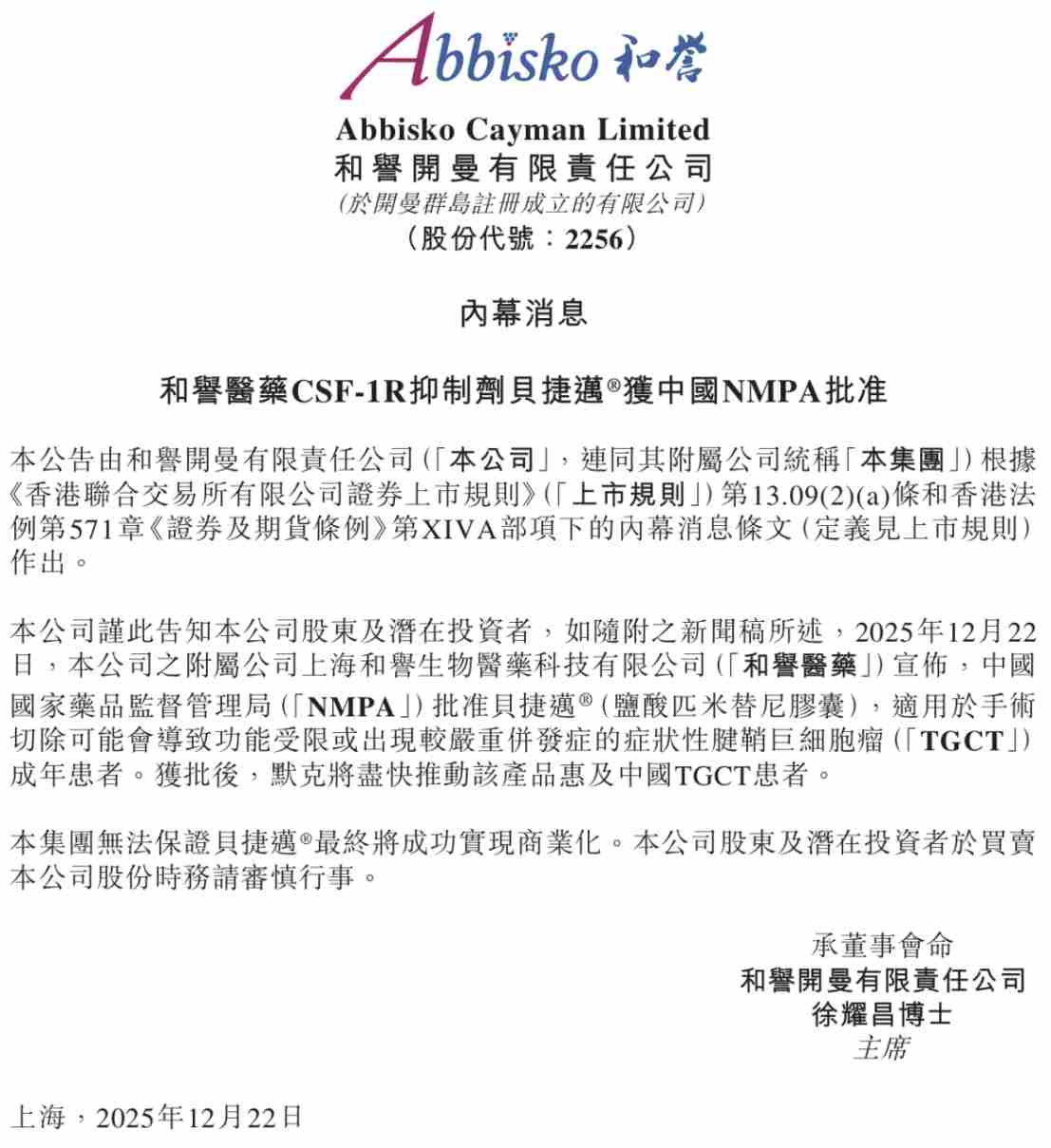
The Zhitong Finance App learned that Beijemer® is a Class 1 new drug independently developed by Heyu, and is also the first self-developed systemic treatment for tenosynovial giant cell tumor (TGCT) in China. As a core product within Heyu's differentiated innovation R&D pipeline, Bergemei® has been approved for listing in China, which means that this major “billion dollar molecule” with FIC/BIC potential has officially taken the first step in global commercialization, while also filling the gap in drug treatment for giant tendon sheath tumor in China.
Looking back on the approval and marketing process of Begemini®, after receiving approval from the Chinese NMPA in May of this year for priority review, its NDA application for the treatment of tenosynovial giant cell tumor (TGCT) was accepted by the NMPA again in June of this year, and zero supplements were approved about 6 months after the NDA was accepted.
It is worth mentioning that during the period, Heyu and Bellemare® also successfully passed the first on-site inspection carried out by the National Drug Evaluation and Inspection Center (CFDI) at an overseas clinical center, which not only reflects the strict standards of Heyu Pharmaceutical's R&D system, but also highlights the regulatory authorities' high recognition of the clinical value and data quality of Beijemer®.
In fact, behind the efficient approval of Begemei®, it is also inseparable from the release of key clinical data of the drug and the high recognition of its innovative value by the international academic community.
At the European Society of Medical Oncology Annual Meeting (ESMO 2025) held in October this year, Kazuyo presented the long-term efficacy and safety data of the global Phase III EVER study of pimitinib (pimicotinib/absk021) in the treatment of TGCT patients in the form of an oral report.
The results showed that according to the RECIST v1.1 standard, pimitinib showed strong and long-lasting tumor relief effects in TGCT patients. The clinical outcome evaluation showed continuous improvement with clinical significance. The safety was consistent with previous analyses, and its feasibility for long-term TGCT treatment was further verified.
The results of this STUDY not only once again confirmed its remarkable efficacy, but also provided strong evidence of the safety and reliability of long-term application, and also provided a key basis for approval decisions by domestic regulatory authorities.
The Zhitong Finance App learned that as the first CSF-1R inhibitor independently developed by China and approved for marketing, pimitinib has previously been recognized as a breakthrough treatment by regulators in China, the US, and Europe. Furthermore, as a potential global BIC drug on the CSF-1R inhibitor circuit, pimitinib not only has outstanding TGCT indications, but also has more room for imagination in various indications such as cGVHD.
Precisely because the drug's “billion-dollar molecule” potential is outstanding, the company reached a “high down payment, high milestone, and high share” BD deal with Merck, a well-known multinational pharmaceutical company, at the end of 2023, and received a down payment of 70 million US dollars in early 2024. On April 1 of this year, Merck once again announced that it would exercise its global commercialization option and pay 85 million US dollars to secure global rights in pimitinib. Coupled with subsequent potential R&D milestone payments and sales milestone payments, the total transaction amount could reach US$606 million, showing that multinational pharmaceutical companies are highly appreciative of Heyu's hard-core innovation capabilities.
Now that pimitinib has been approved for marketing in China, it means that this “billion-dollar molecule” has taken a critical step in global commercialization, and it also marks a key milestone from pioneering innovative research to commercialization of the first product.
From a market perspective, pimitinib is mainly used to treat TGCT which is not suitable for surgery. According to the National Organization for Rare Diseases (National Organization for Rare Diseases) report, the incidence of TGCT is about 43.1 million. Currently, the main competitor on the market is Daiichi Sankyo's FIC product pexidartinib (pesidatinib). It was approved for marketing in the US in 2019 as a systematic treatment for severe TGCT that cannot be improved through surgery, but the drug has severe liver toxicity and was “black box warned” by the FDA. Even so, pesidatinib's revenue in 2023 still reached 5.3 billion yen.
In contrast, pimitinib has been continuously proven to achieve the best curative effect for giant cell tumors of the tendon sheath while also greatly improving safety. Therefore, after approval for marketing, as treatment space for various indications continues to be explored, its global commercial hematopoietic potential is expected to be realized at an accelerated pace.
China Merchants Securities International published a report stating that pimitinib developed by Heyu is the CSF-1R small molecule with the best curative effect in the world. The bank believes that Merck has high expectations for this group and is expected to reach a peak of nearly 1.5 billion US dollars in global sales revenue.
Improve the closed loop of innovation and consolidate the foundation for development
After pimitinib was approved for marketing, the steady increase in revenue and cash flow brought about by it is expected to continue to feed back the reputation of the innovative R&D side, providing strong support for the accelerated implementation of major varieties in the company's precise tumor treatment and immunotherapy innovation pipeline, further improving the company's closed loop of innovation and consolidating its development base.
The Zhitong Finance App learned that in recent years, Heyu Pharmaceutical has focused on precise tumor treatment and immunotherapy, covering popular targets such as EGFR, FGFR, CSF-1R, and PMRT5, and has established 22 differentiated innovative R&D pipelines with global competitiveness. Many of the innovative drugs under development have the potential to be “best-in-class” or “global first”. For example, the second “billion-dollar molecule” in the Heyu pipeline, epagotinib (ABSK011), a global FIC drug similar to the FGFR4 inhibitor, deserves close attention in the industry market.
In addition to the two core products with “billion dollar molecule” potential mentioned above, there are also a number of potential FIC/BIC products within the Heyu Innovation Pipeline. The Zhitong Finance App observed that since December of this year, innovative products within the company's various pipelines have set new R&D milestones one after another. Heyu has successively disclosed the latest research and development progress of its oral small molecule PD-L1 inhibitor ABSK043, the oral small molecule KRAS G12D inhibitor ABSK141, and the FGFR2/3 inhibitor ABSK061. Continued R&D benefits are accelerating the release of the company's subsequent intrinsic value and saving strong potential.
Intrinsic value continues to be released, and allocation potential has increased significantly
It is worth mentioning that Heyu is one of the few innovative pharmaceutical companies in the 18A Hong Kong stock market that enhances investors' return on investment through stock prices while also giving back to investors through continuous cancellation stock buybacks. In March of this year, Heyu's board of directors once again approved the company's use of HK$200 million to repurchase shares in the market. According to statistics from the Zhitong Finance App, since the beginning of this year, Heyu has repurchased 39 times, and the number of repurchases has reached 10.229 million shares, totaling HK$84.6671 million.
From a valuation perspective, compared to many biopharmas that have already been commercialized in Hong Kong stocks, such as Kangfang Biotech and Yasheng Pharmaceuticals, etc., which are also affected by the sector pullback this time, their corresponding PS valuations are still 39.07 times and 49.16 times, respectively. In contrast, as a company with hard core innovation capabilities, stable fundamentals, and the ability to continuously return shareholders through stock repurchases, Peace Reputation is only 13.38 times the PS valuation, and there is clear room for valuation growth.
At present, the core product pimitinib has been successfully approved for marketing, indicating that Heyu has entered a new stage of commercial hematopoiesis. In the future, with abundant cash flow support from the company's “billion-dollar molecule”, it is expected to accelerate the construction of a closed loop of its own differentiated innovation, accelerate the transition to international leader Biopharma in systematic competition in various fields such as global R&D, overseas registration, and international commercialization, and continuously release its intrinsic value.