
Will the 2026 global stock market carnival continue? Beware of these “undercurrents”
The Zhitong Finance App learned that in 2025, the global stock market showed strong performance. This optimistic trend is making investors enter 2026 with a bullish mood.
Currently, the share allocation ratio continues to rise, and the amount of cash held by fund managers is at an all-time low. Investors' expectations that the market will continue to rise have outweighed concerns about overvalued stocks, huge capital expenditure in the field of artificial intelligence (AI), and overly optimistic profit expectations.
However, with the undercurrent surging, optimism about the economy is facing challenges, especially given the recent weakening of the US job market. Interest rate prospects are likely to once again become the focus of investors' concerns. Currently, the market has only absorbed the expectation that the Federal Reserve will cut interest rates twice next year.
“Entering 2026, global growth is likely to remain stable, but uncertainty has increased,” said Seema Shah, chief global strategist at Principal Asset Management. “Although the US economy continues to benefit from AI-driven investments, a sound consumer balance sheet, and targeted financial support, structural risks are rising. Inflation is showing stickiness, labor market dynamics are changing, and the Federal Reserve is facing a severe test of policy balance.”
High valuation levels
Driven by technology stocks, the forward valuation ratio of the S&P 500 index has reached an all-time peak. Not only did this indicator break through previous key highs, but historically, these highs are often harbingers of large-scale pullbacks — such as the summer season on the eve of the bursting of the internet bubble in 2000, and the point where market interest rates began to rise sharply in January 2022.
“The current bull market has entered its fourth year, and market fluctuations may become the norm, and against the backdrop of high growth expectations, the fluctuation may further intensify,” said the team led by Scott Chronert, Citigroup's chief strategist. “It is important to be clear that the starting point of overvaluation is indeed a major obstacle to the market, but it is not insurmountable. However, this will put more pressure on corporate fundamentals, and continued fundamentals will be needed to support current stock prices.”
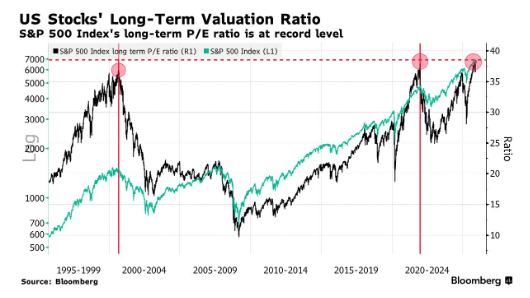
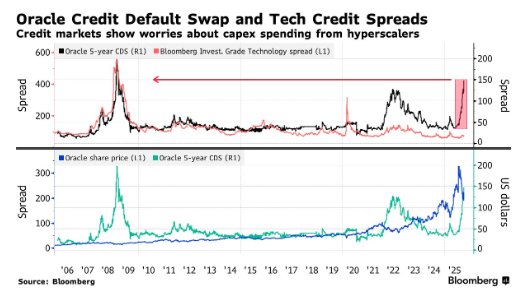
As valuations soar, market discussions about a “bubble” are heating up. Among them, the technology sector and AI concept stocks have become the focus of this concern. Leading cloud service providers continue to increase capital expenses, and their scale is approaching the upper limit of their balance sheets. Although the current problem has not spread to the entire market, the “supervisors” of the bond market are ready to go. The most direct example is that previous Oracle (ORCL.US) performance fell short of expectations, causing the stock price to plummet, and its credit default swap price simultaneously soared to a record high.
Pressure to fulfill profit expectations
Companies must deliver on profit promises if they want to maintain positive market sentiment — and this time, the threshold set by the market has been raised drastically.
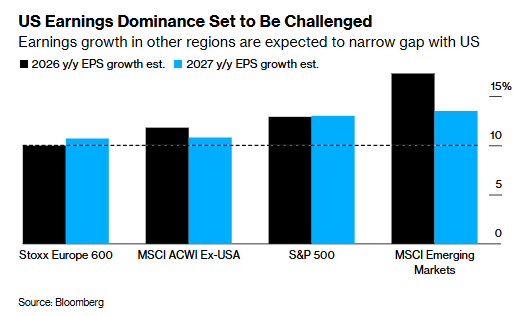
The market generally expects that corporate profits in all major regions of the world will achieve double-digit growth. Among them, high expectations are placed on emerging markets, which will become the core engine of growth.
However, this expectation is probably too optimistic. The Asian region needs to achieve established economic growth targets, and Europe's fiscal stimulus policies need to be effectively transformed into corporate profits, while America's growth prospects depend entirely on the continued advancement of the AI revolution and the resilience of the job market.
Continuation of sector rotation
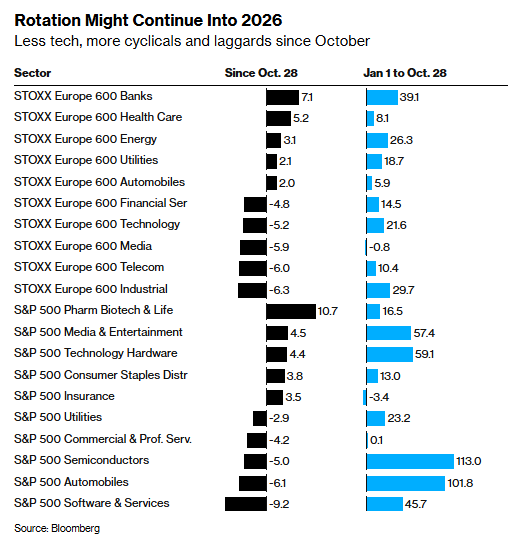
Over the past two months, as the AI and semiconductor sectors have been adjusted, more attractive investment opportunities have emerged in other fields, and investors have begun the process of position adjustment and stock exchange.
This sector rotation phenomenon is occurring simultaneously in the European and American markets; however, there are regional differences in the specific rotation path. Sector rotation helps broaden the basis for market growth and pushes capital to be diverted to procyclical sectors, defensive assets, and previously stagnant sectors.
Given that the return on investment and the sustainability of the business model in the AI sector continue to be questioned, investors are likely to continue this rotation of position themes in 2026. In the next two to three earnings seasons, capital switching between sectors is likely to intensify as investors gradually ascertain the fundamentals of various industries.
Seasonal effects of the new year
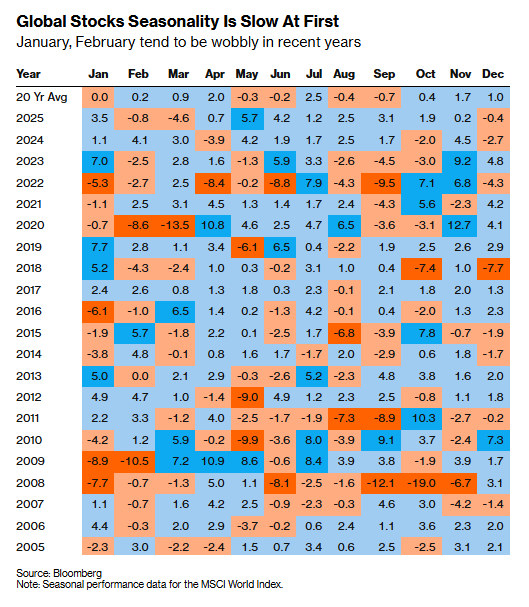
At the beginning of each year, a seasonal rebound in market risk appetite usually provides an upward boost to the stock market. The reset of the risk budget for the new year, the change in the performance assessment cycle, and the regular injection of funds into pensions are all typical factors driving the strengthening of the market.
Judging from historical rules, the overall stock market improved from the first quarter to April 2026, but January and February were not a “sharp rise window” in the traditional sense. Recent data also confirms this characteristic. The market performance in these two months was both good and bad, with both sharp rises and falls.
The golden window period for individual stock mining
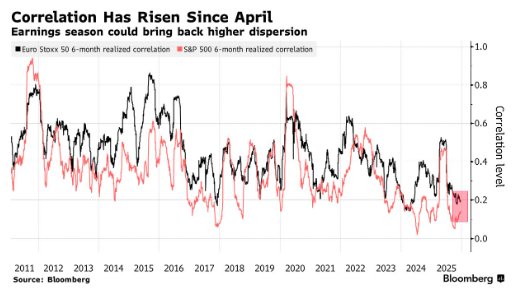
In 2025, due to the excessive weight of large technology stocks in major indices, market earnings were highly concentrated, while the correlation between index constituent stocks fell to a low level, which created an excellent operating environment for stock selection investors. Although the market pattern may change in 2026, with the expansion of rising sectors and changes in industry leaders, actively managed fund managers are expected to outperform the corresponding benchmark index.
The team led by Jean Boivin, BlackRock Group's chief investment strategist, said, “We still maintain our risk appetite and believe that the AI theme is still the core engine driving the trend of US stocks. However, in the current environment, active investment is entering a golden period — we judge that with the gradual spread of AI dividends, selecting individual stocks in the industrial chain that benefit targets and avoid potential risks will become the key to victory, both now and in the future.”
Overcrowded holding structure
Finally, what you need to be wary of is that currently market positions are already relatively crowded. According to the Bank of America fund manager survey, investors are generally optimistic about the outlook for 2026, and high expectations are placed on all types of assets, from economic growth to the stock market, commodities, etc.
Total exposure to two types of assets, stocks and commodities, which generally perform well during economic growth, has reached the highest level since February 2022. Meanwhile, cash levels have plummeted to a record low of only 3.3% of the assets under management.
Goldman Sachs Group strategist Kamakshya Trivedi's team pointed out, “The biggest downside risk in the current market is that the US job market has deteriorated more than expected, causing the risk of a recession to return.”
The Goldman Sachs team believes that the current market is underpricing the risk of recession, and the biggest micro-level threat facing US stocks is that the AI investment theme has faced substantial challenges. Based on this, they suggested that investors broaden the geographical and industry coverage of stock allocations, and add some traditional procyclical sectors, as well as defensive sectors with relatively low valuations, such as healthcare.