
- PREMIUM
- LIVE QUOTES
- INSTITUTIONS
 Index Options


 State Street
 CME Group
 Nasdaq
 Cboe
Cboe TradingView
 Wall Street Journal
Where Will Tesla Be in 1 Year?
Key Points
Tesla's production ramp, including Cybercabs, must be supported by regulatory approvals.
The company is likely to have a stronger second half in 2026 than its first.
This could be the year that Tesla finally delivers on its unsupervised full self-driving and robotaxi aims.
Tesla's (NASDAQ: TSLA) management described 2025 as the "year of the Y," but what will define 2026?
One way to describe it could be a year when the chips went all in. The roadmap was set during the third-quarter earnings call, and Tesla is betting big on full self-driving (FSD) and robotaxis. That said, it's likely to be a second-half-weighted year for the company, so investors need to be patient through the year. Here's why.
Where to invest $1,000 right now? Our analyst team just revealed what they believe are the 10 best stocks to buy right now, when you join Stock Advisor. See the stocks »
A tale of two halves
Tesla will release its fourth-quarter earnings in early 2026, and they are likely to show a sequential decline in electric vehicle (EV) deliveries, which could extend into the second quarter. The reason comes down to the pull-forward in deliveries in the U.S. third quarter, driven by the expiration of the federal EV tax credit at the end of September. That will undoubtedly lead to slowing sales in the fourth quarter.
As such, don't be surprised if Tesla's overall sales decline sequentially in the fourth quarter of 2025 and the first quarter of 2026. Indeed, the Wall Street analyst consensus is just such an event, before returning to sequential and year-on-year growth from the second quarter onwards.
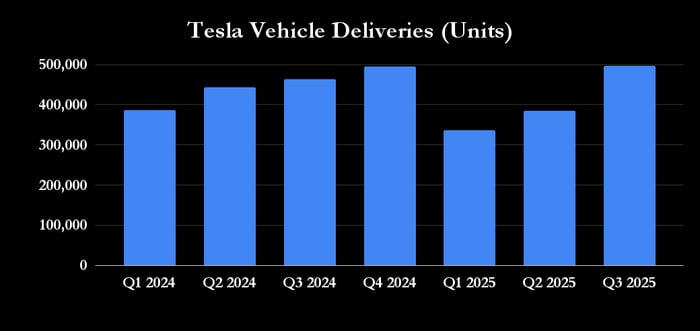
Data source: Tesla presentations. Chart by author.
Furthermore, CFO Vaibhav Taneja has already informed investors that Tesla plans to increase capital spending "increase substantially" in 2026, from approximately $9 billion in 2025. The expenditures to support ramping up EV production (more on that shortly) and to invest in Tesla's AI initiatives, including the Optimus robot. For reference, CEO Elon Musk aims to have the third generation of the Optimus robot in the first quarter of 2026.
Tesla's big ramp-up in 2026
Musk couldn't have been any clearer on the earnings call in October, due to "clarity on achieving full self-driving, unsupervised full self-driving, I should say, I feel confident in expanding Tesla's production. So that is our intent to expand as quickly as we can our future production."
Musk went on to reiterate the determination to ramp production and said that the dedicated robotaxi, Cybercab, would be the "single biggest expansion in production" and start in the second quarter of 2026.
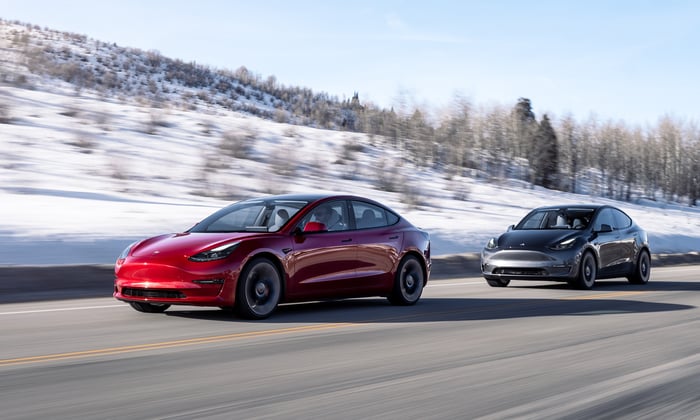
Image source: Tesla.
Tesla's big bet
The production and capital spending ramp up, not to mention the focus on Cybercabs, speaks to Musk's confidence in the ongoing development of Tesla's robotaxi rollout and its unsupervised FSD. Musk recently affirmed via a post on X that robotaxi testing (without any occupant in the car) is underway in Austin, Texas. That would be somewhat in accordance with Musk's aim of having "no safety drivers in at least large parts of Austin by the end of this year."
Furthermore, Tesla is hoping that the Netherlands vehicle authority (RDW) will approve its FSD in February 2026, an act that could open up a pathway to EUwide approval or, failing that, country-level approvals in Europe.
That would be a significant plus for opening new markets for Tesla's FSD software sales and laying the groundwork for the potential deployment of Tesla's robotaxis in Europe. It could also boost Tesla's EV sales, as FSD is a key differentiator for the company's EVs.
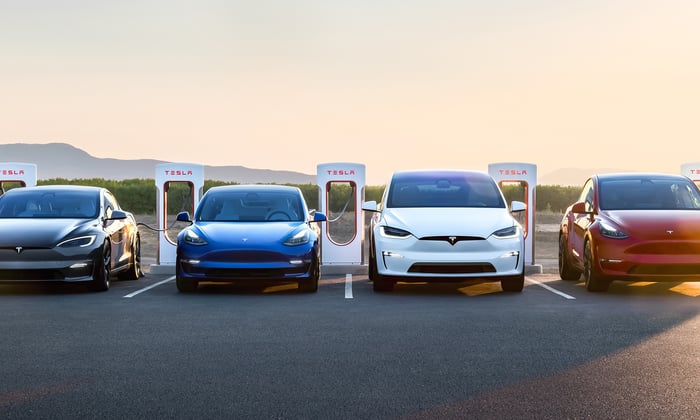
Image source: Tesla.
Where will Tesla be at the end of 2026?
If all goes to plan, Tesla will continue to expand its robotaxi coverage, having achieved approval for unsupervised robotaxis (a feature a Cybercab requires, as Musk's initial conception is for them not to have steering wheels and pedals), and growth in EV sales from the second quarter onward.
As such, it could end the year with the robotaxi rollout in strong growth mode, backed by Cybercab deployment and FSD growth in Europe. In addition, Tesla's EV sales could receive a boost, with more releases of stripped-down versions of its Y and 3 models.
Alternatively, the production ramp and capital spending ramp up may prove misplaced if Tesla doesn't achieve unsupervised robotaxi and FSD approvals (Europe) in a timely fashion. Risk is rising, but so is the potential reward.
Whichever way, next year is the year of the all-in bet on FSD. Hopefully, Tesla and the regulatory bodies will deliver.
Lee Samaha has no position in any of the stocks mentioned. The Motley Fool has positions in and recommends Tesla. The Motley Fool has a disclosure policy.