
- PREMIUM
- LIVE QUOTES
- INSTITUTIONS
 Index Options


 State Street
 CME Group
 Nasdaq
 Cboe
Cboe TradingView
 Wall Street Journal
Does Kancelaria Medius (WSE:KME) Have A Healthy Balance Sheet?
Howard Marks put it nicely when he said that, rather than worrying about share price volatility, 'The possibility of permanent loss is the risk I worry about... and every practical investor I know worries about.' So it seems the smart money knows that debt - which is usually involved in bankruptcies - is a very important factor, when you assess how risky a company is. Importantly, Kancelaria Medius S.A. (WSE:KME) does carry debt. But is this debt a concern to shareholders?
What Risk Does Debt Bring?
Debt is a tool to help businesses grow, but if a business is incapable of paying off its lenders, then it exists at their mercy. Part and parcel of capitalism is the process of 'creative destruction' where failed businesses are mercilessly liquidated by their bankers. However, a more frequent (but still costly) occurrence is where a company must issue shares at bargain-basement prices, permanently diluting shareholders, just to shore up its balance sheet. Of course, plenty of companies use debt to fund growth, without any negative consequences. The first thing to do when considering how much debt a business uses is to look at its cash and debt together.
What Is Kancelaria Medius's Debt?
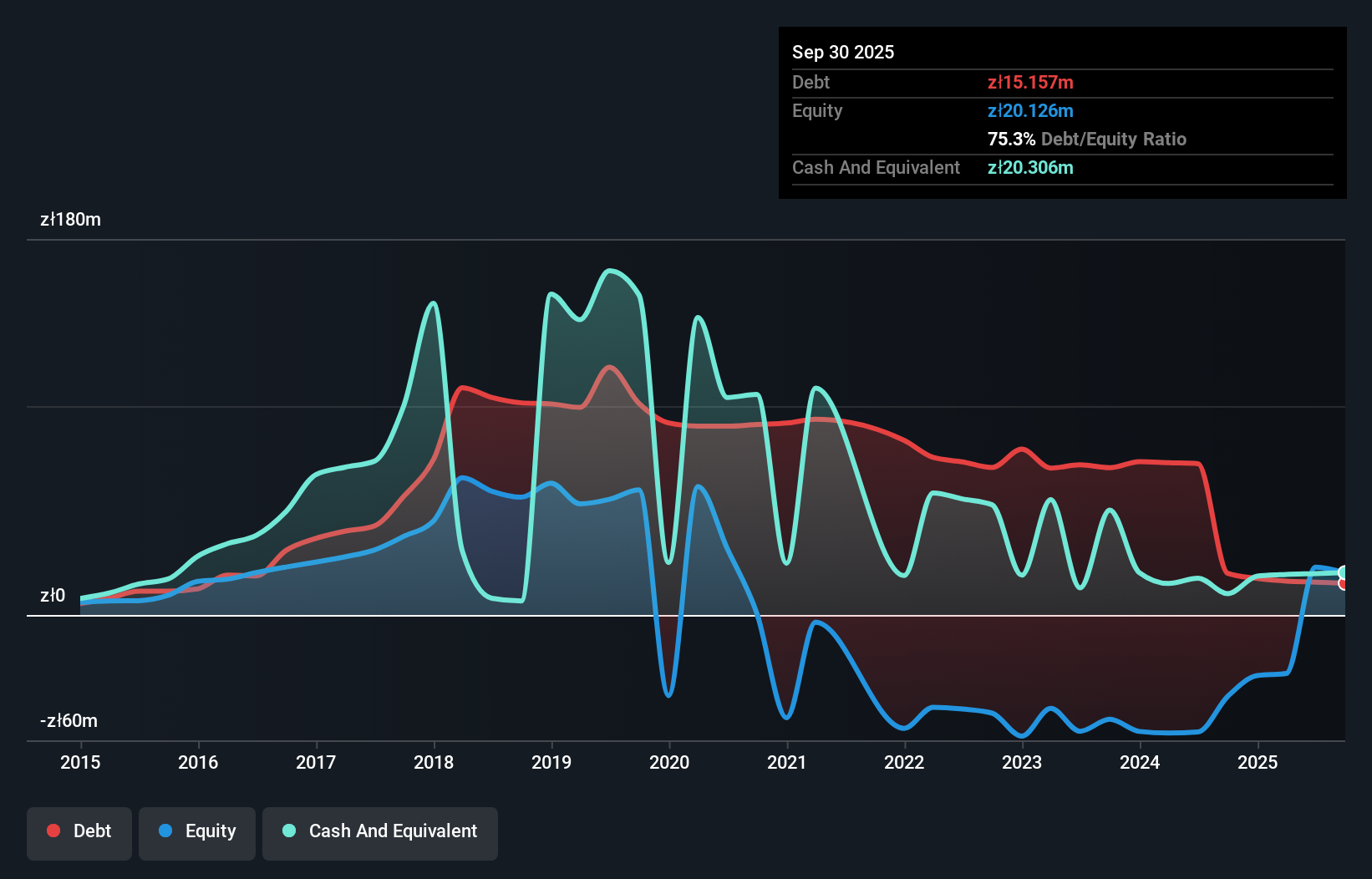
As you can see below, Kancelaria Medius had zł15.2m of debt at September 2025, down from zł20.0m a year prior. However, its balance sheet shows it holds zł20.3m in cash, so it actually has zł5.15m net cash.
How Strong Is Kancelaria Medius' Balance Sheet?
The latest balance sheet data shows that Kancelaria Medius had liabilities of zł7.66m due within a year, and liabilities of zł16.2m falling due after that. Offsetting these obligations, it had cash of zł20.3m as well as receivables valued at zł8.0k due within 12 months. So its liabilities outweigh the sum of its cash and (near-term) receivables by zł3.52m.
Kancelaria Medius has a market capitalization of zł9.70m, so it could very likely raise cash to ameliorate its balance sheet, if the need arose. But we definitely want to keep our eyes open to indications that its debt is bringing too much risk. While it does have liabilities worth noting, Kancelaria Medius also has more cash than debt, so we're pretty confident it can manage its debt safely.
Check out our latest analysis for Kancelaria Medius
In addition to that, we're happy to report that Kancelaria Medius has boosted its EBIT by 42%, thus reducing the spectre of future debt repayments. When analysing debt levels, the balance sheet is the obvious place to start. But it is Kancelaria Medius's earnings that will influence how the balance sheet holds up in the future. So when considering debt, it's definitely worth looking at the earnings trend. Click here for an interactive snapshot.
Finally, a business needs free cash flow to pay off debt; accounting profits just don't cut it. While Kancelaria Medius has net cash on its balance sheet, it's still worth taking a look at its ability to convert earnings before interest and tax (EBIT) to free cash flow, to help us understand how quickly it is building (or eroding) that cash balance. Over the last three years, Kancelaria Medius actually produced more free cash flow than EBIT. That sort of strong cash generation warms our hearts like a puppy in a bumblebee suit.
Summing Up
Although Kancelaria Medius's balance sheet isn't particularly strong, due to the total liabilities, it is clearly positive to see that it has net cash of zł5.15m. And it impressed us with free cash flow of zł8.4m, being 151% of its EBIT. So we don't think Kancelaria Medius's use of debt is risky. There's no doubt that we learn most about debt from the balance sheet. However, not all investment risk resides within the balance sheet - far from it. To that end, you should be aware of the 2 warning signs we've spotted with Kancelaria Medius .
At the end of the day, it's often better to focus on companies that are free from net debt. You can access our special list of such companies (all with a track record of profit growth). It's free.
Have feedback on this article? Concerned about the content? Get in touch with us directly. Alternatively, email editorial-team (at) simplywallst.com.
This article by Simply Wall St is general in nature. We provide commentary based on historical data and analyst forecasts only using an unbiased methodology and our articles are not intended to be financial advice. It does not constitute a recommendation to buy or sell any stock, and does not take account of your objectives, or your financial situation. We aim to bring you long-term focused analysis driven by fundamental data. Note that our analysis may not factor in the latest price-sensitive company announcements or qualitative material. Simply Wall St has no position in any stocks mentioned.