
- PREMIUM
- LIVE QUOTES
- INSTITUTIONS
 Index Options


 State Street
 CME Group
 Nasdaq
 Cboe
Cboe TradingView
 Wall Street Journal
Is Texas Pacific Land Now Attractive After a 31% Slide Despite Mixed Valuation Signals
- If you are wondering whether Texas Pacific Land is a bargain or a value trap at today’s price, you are not alone. This article will unpack what the numbers are really saying.
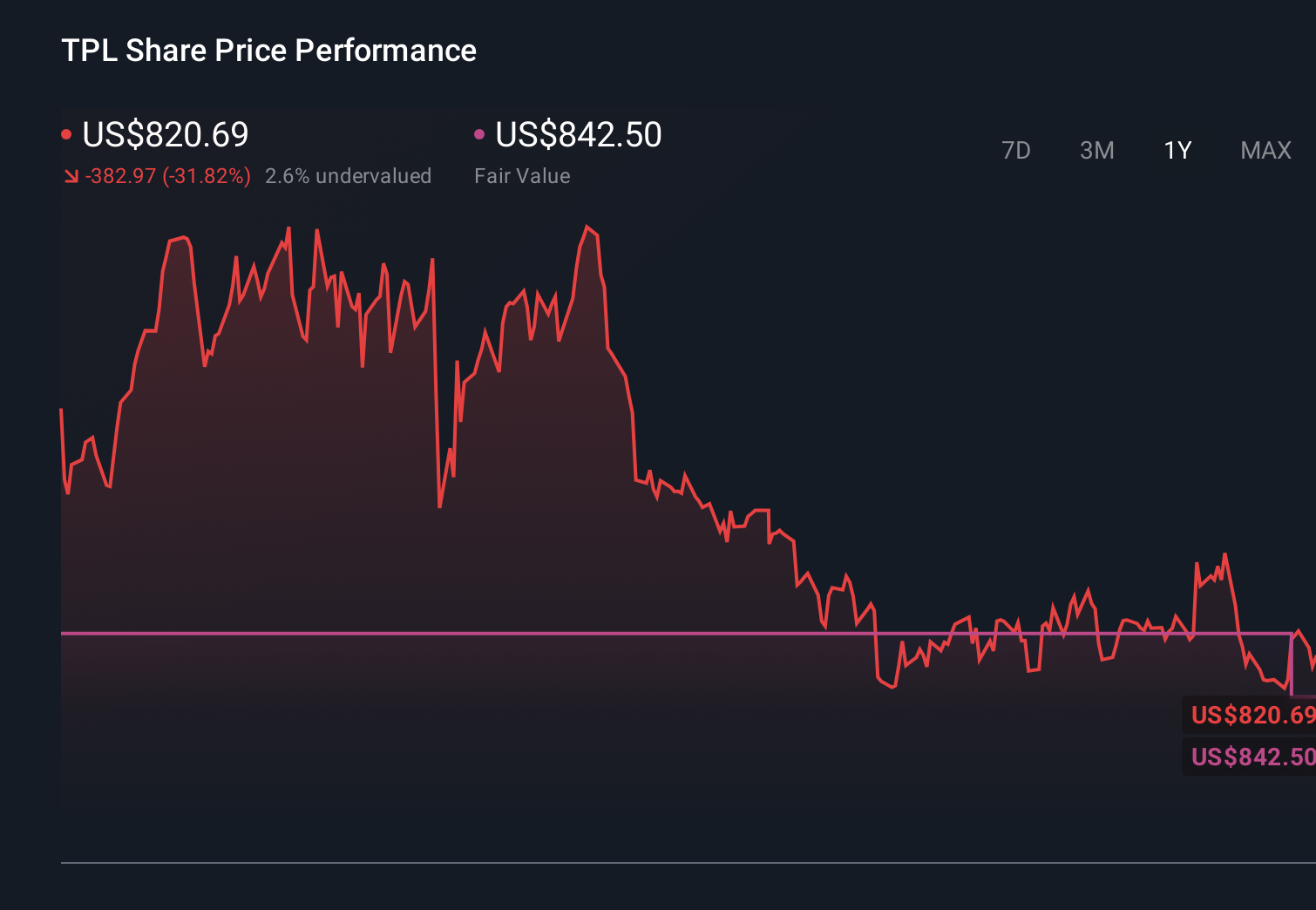
- The stock has slipped about 6.8% over the last week and 19.7% over the past month, extending a tough run that has it down roughly 30.5% year to date and 31.4% over the last year, while still being up about 274.1% over five years.
- Recently, the market has been reacting to shifting expectations around land and royalty plays in the energy space. Investors are debating how sustainable cash flows are in a more volatile commodity environment. At the same time, broader sector rotation and changing risk appetite have pushed many energy names, including Texas Pacific Land, into sharper focus for value oriented investors.
- On our checklist of six valuation tests, Texas Pacific Land scores only 1 out of 6. This might surprise investors who remember its long run up and are now eyeing the pullback. Next, we will walk through the main valuation approaches behind that score and then finish with a more holistic way to assess what this stock could really be worth.
Texas Pacific Land scores just 1/6 on our valuation checks. See what other red flags we found in the full valuation breakdown.
Approach 1: Texas Pacific Land Discounted Cash Flow (DCF) Analysis
A Discounted Cash Flow model estimates what a business is worth today by projecting the cash it can generate in the future and then discounting those cash flows back to the present. For Texas Pacific Land, the analysis uses a 2 Stage Free Cash Flow to Equity model based on cash flow projections.
The company generated about $370.7 Million in free cash flow over the last twelve months. Analyst and model based projections see this rising steadily, with free cash flow expected to reach roughly $1.0 Billion in 2035, according to a mix of analyst estimates and Simply Wall St extrapolations. All figures are in $ and reflect the long term cash generation potential from the company’s land and royalty portfolio.
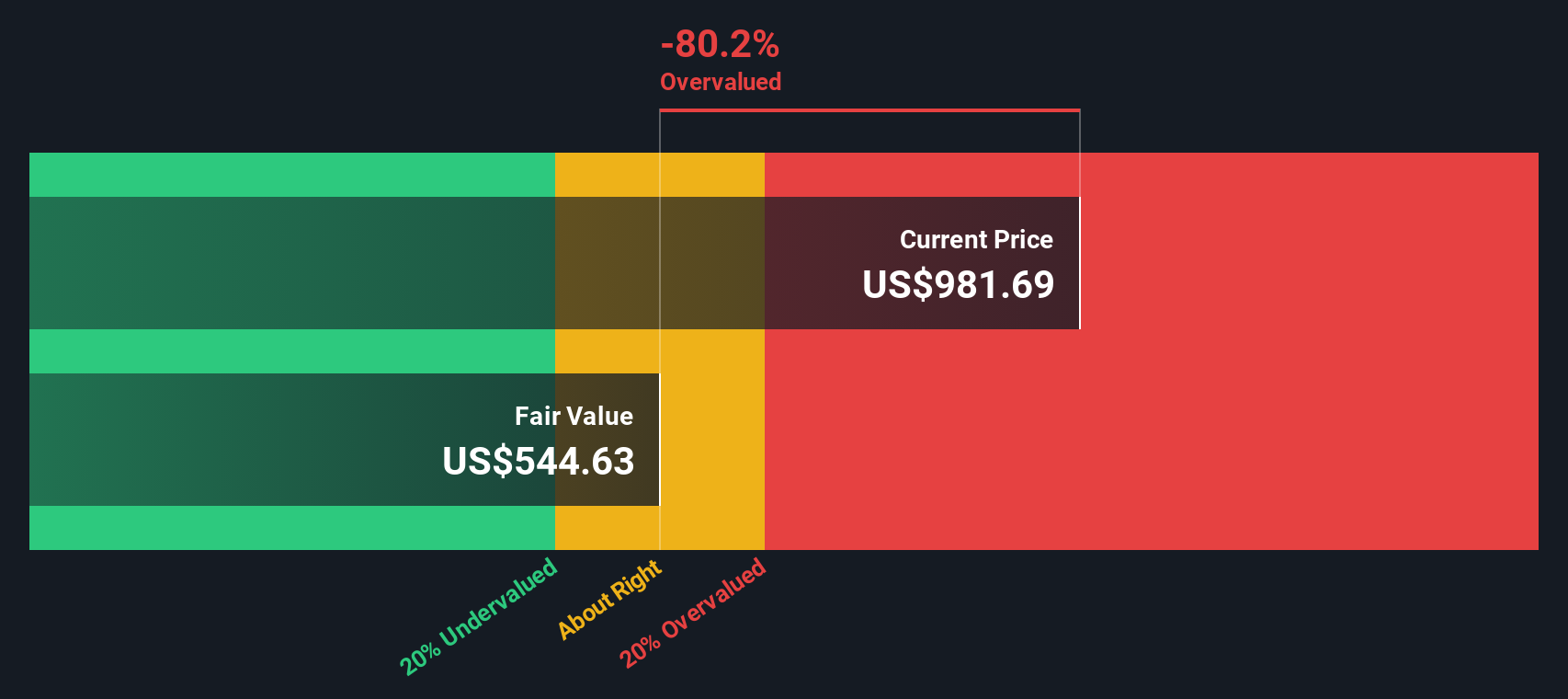
When these projected cash flows are discounted back, the model arrives at an intrinsic value of about $905.48 per share. That implies the stock is trading at roughly a 9.4% discount to its estimated fair value, suggesting the current price is broadly in line with fundamentals rather than a deep bargain or an obvious trap.
Result: ABOUT RIGHT
Texas Pacific Land is fairly valued according to our Discounted Cash Flow (DCF), but this can change at a moment's notice. Track the value in your watchlist or portfolio and be alerted on when to act.
Approach 2: Texas Pacific Land Price vs Earnings
For a profitable company like Texas Pacific Land, the price to earnings ratio is a useful way to gauge how much investors are willing to pay today for each dollar of current earnings. In general, stronger and more reliable earnings growth, along with lower perceived risk, can justify a higher PE multiple, while slower growth or higher uncertainty usually warrants a lower one.
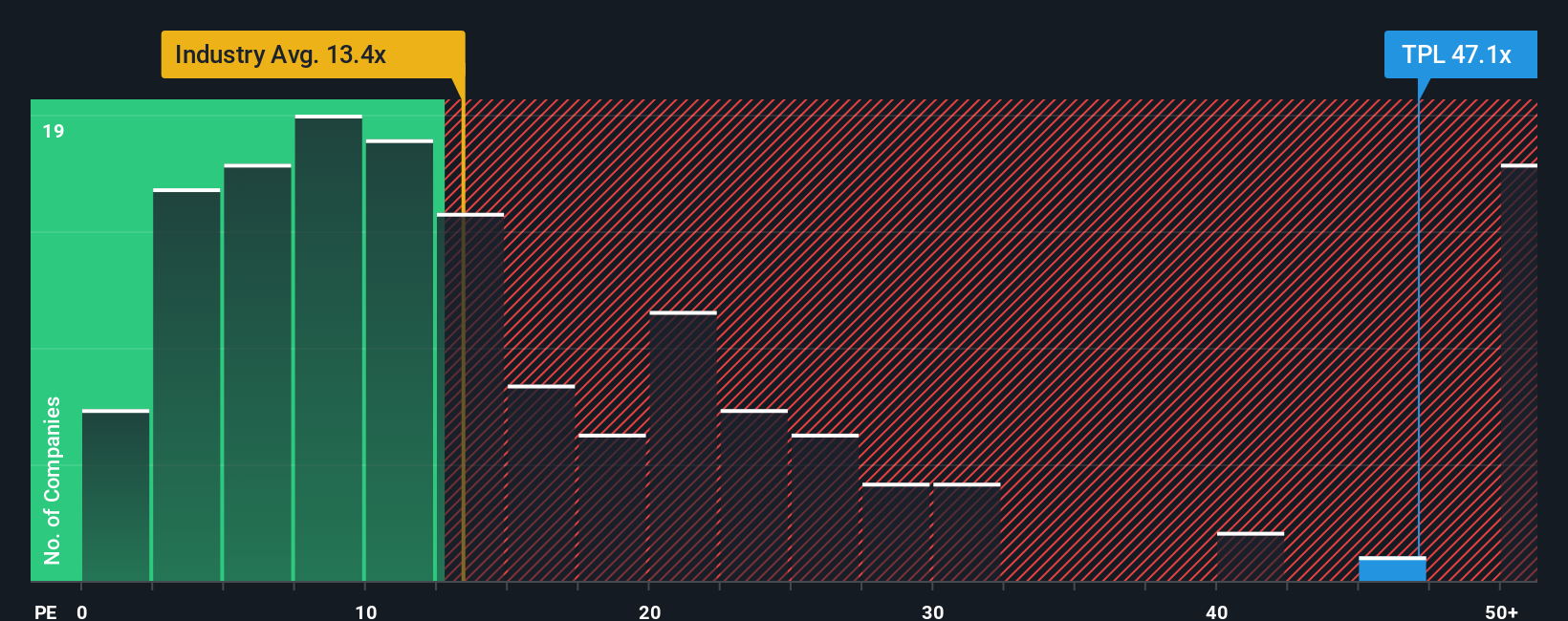
Texas Pacific Land currently trades on about 39.6x earnings, which is sharply higher than the Oil and Gas industry average of around 12.8x and also above its peer group average of roughly 13.4x. To move beyond these simple comparisons, Simply Wall St uses a proprietary Fair Ratio, which estimates what a more appropriate multiple might be after accounting for factors such as earnings growth, profitability, industry dynamics, company size and specific risks. For Texas Pacific Land, that Fair Ratio comes out at about 18.4x, well below the actual PE of 39.6x, indicating that the market is paying a substantial premium relative to what those fundamentals would typically support.
Result: OVERVALUED
PE ratios tell one story, but what if the real opportunity lies elsewhere? Discover 1463 companies where insiders are betting big on explosive growth.
Upgrade Your Decision Making: Choose your Texas Pacific Land Narrative
Earlier we mentioned that there is an even better way to understand valuation, so let us introduce you to Narratives. These are simply investor created stories that connect your view of Texas Pacific Land’s future revenue, earnings and margins to a financial forecast and ultimately to a fair value estimate. All of this happens inside a straightforward tool on Simply Wall St’s Community page that millions of investors already use to decide when to buy or sell by comparing their Narrative Fair Value to the current share price. Those fair values update automatically as new news or earnings arrive. One investor might build a cautious Texas Pacific Land Narrative that bakes in slower Permian growth, rising water regulation and a lower future PE that results in a Fair Value well below today’s price. Another might create a more optimistic Narrative that assumes resilient royalties, expanding water services and a still premium but slightly lower PE multiple, arriving at a Fair Value closer to the current market price and leading to very different but clearly reasoned decisions.
Do you think there's more to the story for Texas Pacific Land? Head over to our Community to see what others are saying!
This article by Simply Wall St is general in nature. We provide commentary based on historical data and analyst forecasts only using an unbiased methodology and our articles are not intended to be financial advice. It does not constitute a recommendation to buy or sell any stock, and does not take account of your objectives, or your financial situation. We aim to bring you long-term focused analysis driven by fundamental data. Note that our analysis may not factor in the latest price-sensitive company announcements or qualitative material. Simply Wall St has no position in any stocks mentioned.
Have feedback on this article? Concerned about the content? Get in touch with us directly. Alternatively, email editorial-team@simplywallst.com