
- PREMIUM
- LIVE QUOTES
- INSTITUTIONS
 Index Options


 State Street
 CME Group
 Nasdaq
 Cboe
Cboe TradingView
 Wall Street Journal
Is It Too Late to Consider Southwest After Its 27% Surge and Lofty Valuation Multiple?
- If you are wondering whether Southwest Airlines at around $41.72 is still a deal or if the easy money has already been made, you are not alone. This stock is back on a lot of investors' radar.
- The share price has jumped 9.9% over the last week and 27.1% over the past month, lifting year-to-date gains to 25.0% and putting the 1-year return at 30.5%, despite the stock still being slightly down, about 2.5%, over 5 years.
- These moves have come as investors reassess airlines that are rebuilding capacity and routes, while regulators and management teams continue to focus on reliability and customer experience in the wake of prior operational disruptions. At the same time, shifts in travel demand, competitive pricing, and ongoing industrywide cost pressures are shaping expectations about which carriers can defend margins if conditions become more challenging again.
- Despite the rebound, Southwest Airlines only scores 2/6 on our valuation checks, suggesting pockets of value but also areas where the market may be pricing in more optimism. Next, we will unpack what that score really means across different valuation approaches and finish with a more intuitive way to think about what the stock is truly worth.
Southwest Airlines scores just 2/6 on our valuation checks. See what other red flags we found in the full valuation breakdown.
Approach 1: Southwest Airlines Discounted Cash Flow (DCF) Analysis
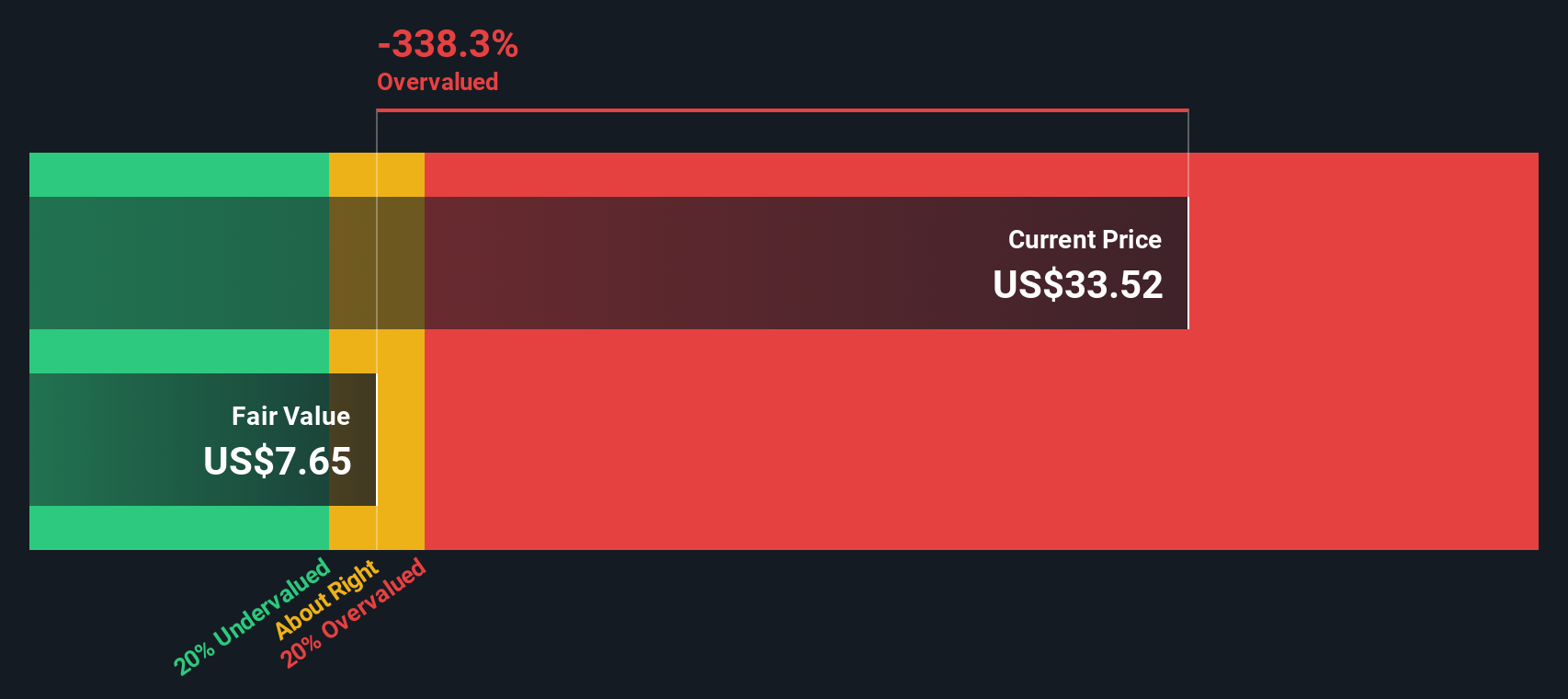
A Discounted Cash Flow model estimates what a company is worth by projecting future cash flows and discounting them back to today in dollar terms. For Southwest Airlines, the 2 Stage Free Cash Flow to Equity model starts from last twelve months free cash flow of roughly -$998 million, reflecting ongoing investment and industry pressures.
Analysts see cash flows turning positive over the next few years, with projections of about $2.03 billion by 2029. Beyond the analyst window, Simply Wall St extrapolates further growth, driving free cash flow into the multi billion dollar range by the mid 2030s. All of these future cash flows are discounted back to today to arrive at an estimated intrinsic value of about $203.33 per share.
Against a recent share price around $41.72, the DCF suggests Southwest is trading at roughly a 79.5% discount to its estimated intrinsic value, implying substantial upside if these cash flow assumptions prove accurate.
Result: UNDERVALUED
Our Discounted Cash Flow (DCF) analysis suggests Southwest Airlines is undervalued by 79.5%. Track this in your watchlist or portfolio, or discover 906 more undervalued stocks based on cash flows.
Approach 2: Southwest Airlines Price vs Earnings
For profitable companies, the price to earnings ratio is often the go to yardstick because it directly links what investors are paying today to the profits the business is currently generating. In general, faster growing, more resilient businesses can justify higher PE ratios, while companies with slower growth or higher risk typically deserve a lower, more conservative multiple.
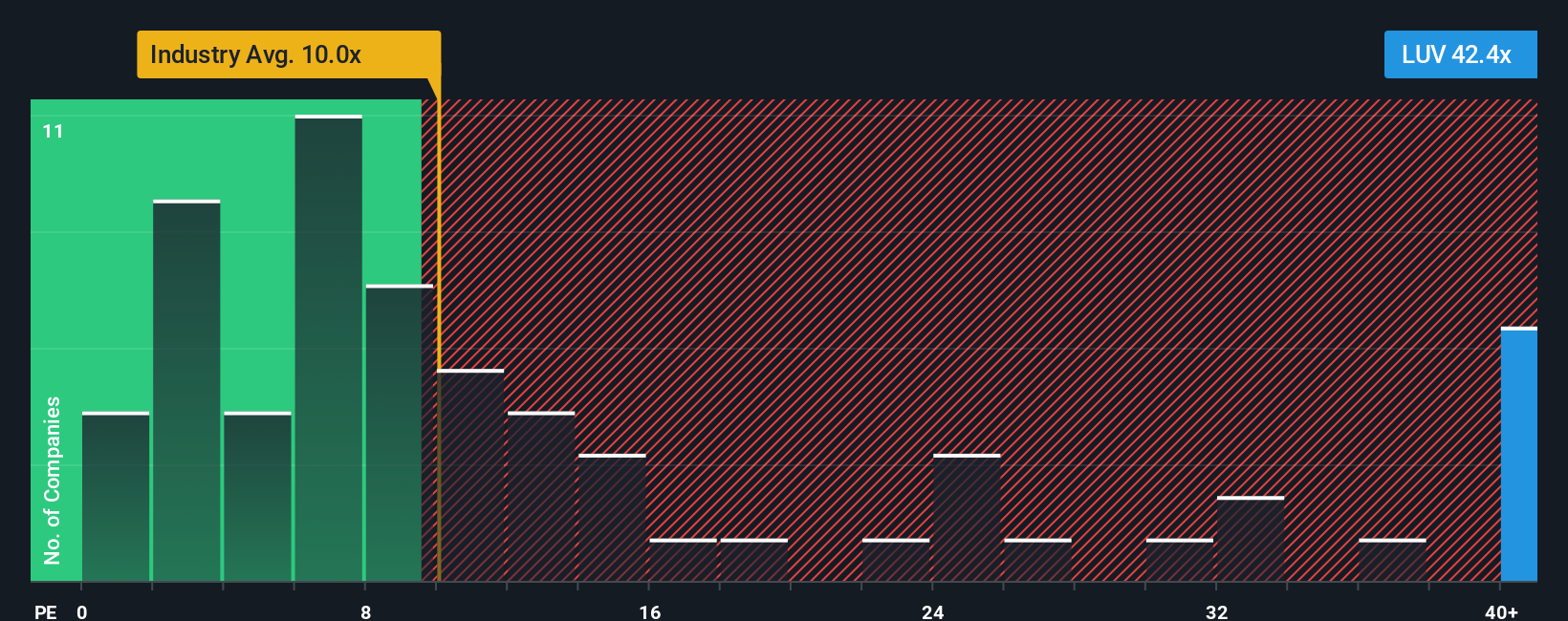
Southwest currently trades on a PE of about 56.9x, which is well above the broader Airlines industry average of roughly 9.3x and also ahead of the peer group average near 19.4x. To put this in better context, Simply Wall St calculates a Fair Ratio of around 29.6x for Southwest, a proprietary estimate of what a reasonable PE should be once you factor in its earnings growth outlook, profit margins, risk profile, industry dynamics and market cap.
This Fair Ratio framework can be more informative than a simple comparison with peers or the industry, because it adjusts for company specific strengths and weaknesses rather than assuming every airline should trade at the same multiple. Comparing Southwest’s current 56.9x PE to the 29.6x Fair Ratio suggests the stock is priced ahead of what its fundamentals would justify.
Result: OVERVALUED
PE ratios tell one story, but what if the real opportunity lies elsewhere? Discover 1450 companies where insiders are betting big on explosive growth.
Upgrade Your Decision Making: Choose your Southwest Airlines Narrative
Earlier we mentioned that there is an even better way to understand valuation. Let us introduce Narratives, an easy tool on Simply Wall St’s Community page that lets you attach your story about Southwest Airlines to the numbers. You can set your own assumptions for future revenue, earnings and margins, link that story to a forecast, and then to a Fair Value you can compare with today’s price to decide whether to buy, hold or sell. The platform keeps your Narrative automatically updated as news and earnings arrive. A bullish investor might build a Narrative around expanding partnerships, premium seating and loyalty economics that points to a Fair Value well above the current price. A more cautious investor could emphasize macro uncertainty, competition and execution risks, resulting in a much lower Fair Value even though both are looking at the same company.
Do you think there's more to the story for Southwest Airlines? Head over to our Community to see what others are saying!
This article by Simply Wall St is general in nature. We provide commentary based on historical data and analyst forecasts only using an unbiased methodology and our articles are not intended to be financial advice. It does not constitute a recommendation to buy or sell any stock, and does not take account of your objectives, or your financial situation. We aim to bring you long-term focused analysis driven by fundamental data. Note that our analysis may not factor in the latest price-sensitive company announcements or qualitative material. Simply Wall St has no position in any stocks mentioned.
Have feedback on this article? Concerned about the content? Get in touch with us directly. Alternatively, email editorial-team@simplywallst.com