
- PREMIUM
- LIVE QUOTES
- INSTITUTIONS
 Index Options


 State Street
 CME Group
 Nasdaq
 Cboe
Cboe TradingView
 Wall Street Journal
With 17% blood loss in two days, is the collapse of Broadcom (AVGO.US) a trap or a pie?
The Zhitong Finance App learned that last Friday, the stock price trend of Broadcom (AVGO.US) can be called “unbearable”: the closing price of the day was 359.93 US dollars, a sharp drop of 46.44 US dollars from the previous day, a drop of 11.43%. By the close of trading this Monday, its stock price had not stopped falling, continuing to fall by nearly 6%, and finally closed at $339.81. Is such a ferocious sell-off actually reasonable? Seek Alpha analyst Michael Fitzsimmons discussed the situation in depth. According to reports, Fitzsimmons is not only a retired electronics engineer, but has also been deeply involved in the investment field for many years and is a senior investor.

Figure 1
Fitzsimmons has always favored Broadcom over the past few years, and there is a profound reason behind this. At the end of the day, Broadcom has the advantages of an “AI three-piece” that can be called an industry benchmark: first, it is an XPU AI-optimized processor specially designed for hyperscale data centers, which can efficiently handle complex computational requirements; second, it is a switching chip that is the king in the field of cutting-edge high-speed network equipment and has excellent performance in network transmission performance; third, VMware virtualization and enterprise software with strategic cooperation. This combination enables VMware to run full stack on Nvidia (NVDA.US) and AMD (AMD.US) GPUs.
Furthermore, as a retired computer engineer, Fitzsimmons can say without exaggeration that Broadcom CEO Hock Tan (Hock Tan) is one of the sharpest and most visionary heads of the industry; when it comes to “business,” he also has a long and legendary history of acquisitions — always making the company he bought more efficient, more profitable, and squeezing a steady stream of free cash flow. VMware is just the latest in this brilliant acquisition chain.
The investment logic behind it is roughly like this. Next, let's follow Fitzsimmons' perspective and focus directly on Broadcom's financial report for the fourth quarter of fiscal year 2025.
Fourth quarter earnings of fiscal year 2025
In Fitzsimmons's eyes, Broadcom's financial report for the fourth quarter of fiscal year 2025 was another beautiful answer: quarterly revenue of US$18 billion, up 28% year on year, and earnings per share according to US GAAP surged 93% year on year; semiconductor business revenue of US$111 billion, accounting for 61% of total revenue, up 35% year on year; infrastructure software business revenue of 6.9 billion US dollars, accounting for 39% increase year on year. However, such bright numbers were actually labeled “disappointing.”
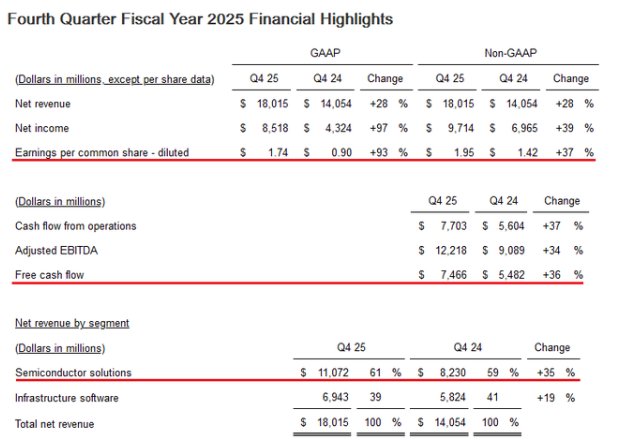
Figure 2
Broadcom has shown strong strength in terms of free cash flow and shareholder returns. In terms of quarterly data, Broadcom's free cash flow for the quarter reached 7.5 billion US dollars, accounting for 41.4% of revenue. Compared with the same period last year, it surged 36%. This growth rate once again far exceeded the 28% increase in revenue. Extending its focus to the entire 2025 fiscal year, Broadcom's free cash flow reached an astonishing 26.9 billion US dollars, corresponding total revenue of 63.9 billion US dollars, and a free cash flow profit margin of 42.1%.

Figure 3
Compared to competitor AMD, Broadcom's advantage in terms of cash flow is overwhelming. AMD's second-quarter free cash flow margin was only 15.0%, about one-third of Broadcom's 42.7% in the same period; even though AMD's newly announced free cash flow for the third quarter was US$1.53 billion, accounting for 16.6% of revenue. Although this is an improvement over the previous period, it is still less than half of the level shown by Broadcom this week.
Thanks to this cash flow momentum, Broadcom brought a series of good news to shareholders: dividends increased by 10% to $0.65 per share in the first quarter of fiscal year 2026; long-term debt decreased by $4.3 billion at the end of the year, and total long-term debt fell by $8.2 billion; the board extended the share repurchase plan, with a balance of $7.5 billion, valid until the end of 2026; and cash and cash equivalents at the end of the quarter, $16.2 billion, compared to $10.7 billion at the end of the previous fiscal quarter. Once again, despite the impressive results, all of this is still described as “disappointment.”
Broadcom's AI Order Wave: The Market Debate Behind the $73 Billion Backlog
In the earnings conference call, Broadcom CEO Chen Fuyang once again revealed some major news that shocked the industry: he revealed that the company received another order of up to 11 billion US dollars from the same important customer, Anthropic, which is expected to be delivered by the end of 2026; at the same time, he also revealed cooperation information from the fifth XPU customer. The order amount reached 1 billion US dollars, and the delivery time is also scheduled for the end of 2026.
It is worth mentioning that Anthropic's $11 billion order is specially tailored for Google's Ironwood TPU. It will be delivered in the form of a full cabinet, and will include networking equipment and interconnection technology. This is actually a complete “system-level” solution.
This brings up a key fact: Google (GOOGL.US) is Broadcom's largest AI customer, and its latest Ironwood TPU not only has excellent performance, but is no longer just for internal use, thus bringing a rolling stream of orders to Broadcom. Meta (META.US) and Anthropic have already placed orders, and Fitzsimmons believes more customers will follow. Reading this, are there any words you want to rush out and sell stocks? Fitzsimmons didn't, anyway. So is the backlog of orders the “culprit” that made the market fry and smash the market? The answer is still: wrong, for the following reasons.
Chen Fuyang's opening remarks before answering questions are as follows: Fitzsimmons currently has an order backlog of over 10 billion US dollars, and the newly launched 102 Tb/s Tomahawk 6 switch chip is still taking orders at a record speed; and this is only the tip of the iceberg. Fitzsimmons has also taken record orders for optical components such as DSPs and lasers, as well as PCI Express switches, all of which are used in AI data centers; in addition to XPU, the total number of orders currently in its hands exceeds that of With $73 billion, accounting for almost half of Broadcom's $162 billion consolidated backlog, Fitzsimmons expects this $73 billion AI order to be delivered within the next 18 months. It still sounds like they're still going strong, so what's the problem?
It turns out that Broadcom's $73 billion backlog of AI orders unexpectedly became the target of “criticism.” Just because this figure “fell short” of some people's expectations, analysts couldn't wait to compare Broadcom and Oracle's earlier performance explosion and sharp drop in stock prices, as if the two were already in the same predicament. In the conference call, analysts seemed to be deeply obsessed with this $73 billion order data. They selectively ignored Broadcom's overall backlog of orders of up to 162 billion US dollars. The opening statement was “73 billion dollars is too low.” It seems that the story has already come to an end. However, the truth is far from as simple as they assert.
What mistakes do many analysts and investors make
First, Fitzsimmons has been listening to all of Chen Fuyang's phone calls since holding Broadcom in mid-2019. He clearly told everyone that he will never be held hostage to give overly optimistic guidance, let alone easily provide revenue forecasts for the full year 2026; he has always “low guidance and high delivery,” and his financial forecasts are extremely conservative. Moreover, in the rapidly changing artificial intelligence boom, which competent analyst would force him to give accurate guidance for a full 12 months? Totally out of touch with reality.
So the first mistake is not understanding the CEO's conservative style, thereby misinterpreting the AI backlog. Second, this $73 billion is just a snapshot of orders at the end of fiscal year 2025; Chen Fuyang repeatedly emphasized over the phone that it was finally clear that the 73 billion dollars is only the “lowest” AI revenue for the next 6 quarters — “You could say that 73 billion is the backlog we have today and will be shipped in the next 6 quarters; given Fitzsimmons's delivery cycle, more orders will be included in the shipping window for these 6 quarters. So from one perspective, this $73 billion is the lowest revenue for 6 quarters, but the actual figure will be much higher as new orders pour in.”
Since Broadcom will continue to take orders and is taking “a large number” of orders, how would Chen Fuyang describe the current order flow? “As the first and only model of its kind, the speed at which it takes orders is still breaking records.” He also added: “I fully anticipate that 73 billion dollars will continue to grow in these 18 months, and the numbers will roll up over time. It's hard for me to accurately depict the full picture of 2026, so I'd rather not give a guide for the whole year, just Q1, and then Q2 later; are you asking if this is an accelerating trend? My answer is that as 2026 progresses, this is likely to be an accelerated trend.” A brilliant Q4 earnings report, combined with the CEO's anticipated “accelerated growth” of orders, became a reason to break the market? In Fitzsimmons's view, this is pure emotional absurd logic.

Figure 4
What surprised Fitzsimmons even more was hearing Broadcom being compared to Oracle — just ridiculous. First, Broadcom's free cash flow is strong, but Oracle has already lost cash for three consecutive quarters, with free cash flow of $13.18 billion in the second quarter of fiscal year 2026; second, Broadcom is reducing its debt, and it is not to build a data center like Oracle, but to acquire VMware — this strategic merger and acquisition not only expands the high-margin software sector, but also rapidly generates collaborative cash flow. Comparing Broadcom to Oracle is unfounded, illogical, or even irresponsible.

Figure 5
valuation
In terms of valuation, after Broadcom was bloodwashed last Friday, the stock still had a significant TTM price-earnings ratio of 30.8 times, but this is the truth that Munger warned Buffett: if you want to buy a high-quality growth company, you have to be willing to pay a premium; furthermore, Broadcom's forward-looking price-earnings ratio is no longer that exaggerated, and the high portion of TTM has been dragged down once by VMware's acquisition and integration costs.

Figure 6
The market is also seriously ignoring its free cash flow — Broadcom generated about $6.10 of free cash flow per share in the past year. Compared with the New Year's interest rate of $2.60, it can be seen that the cash flow is strong enough to keep shareholder returns for many years. Let me ask, the company's annual revenue increased by 28%, free cash flow of 26.9 billion US dollars and increased 39% year over year, average annual dividend increase of 10%, a sharp drop in net debt, $162 billion in cash at the end of the year, and a consolidated backlog of 162 billion US dollars (2.5 times the revenue of 63.89 billion yuan in fiscal year 2025!) , For companies that are still “speeding up” the order flow, how should they be valued?
On the rapidly changing AI circuit, of course, this is an extremely rhetorical question, but with the above growth indicators, combined with Chen Fuyang, a seasoned and discerning leader, and Broadcom's “AI 3-piece” product portfolio, Fitzsimmons believes that its position is in the same first tier as Nvidia and Google, and the current price and valuation can be called collecting money. After all, Broadcom was able to rank in the top 10 of the S&P 500 by market capitalization, surpassing Berkshire and Tesla, for no reason.
Fitzsimmons just finished reading Morningstar analyst William Kerwin's latest report. He described AI revenue growth as “impressive and accelerating” and raised Broadcom's fair value from $365 to $480. This jump is extremely rare for Morningstar. Remember, without changing other conditions, the stock price of a company with an annual growth rate of 15% can double in five years, while Broadcom just handed over a consolidated annual increase of 28%, which is likely to continue to surpass the 2026 fiscal year.
Profit margin risk
As for profit margin risk, Chen Fuyang was asked if AI TPU and XPU gross margins below the semiconductor average would drag down overall profits. CFO Kristen Spears already gave an answer in his opening remarks: quarterly gross profit margin of 77.9%, higher than initial guidance, benefiting from increased software revenue and semiconductor product portfolio optimization; VMware's gross margin was higher than that of the semiconductor sector, and it grew rapidly — the gross margin of the infrastructure software division was 93%, up a full two percentage points from 91% in the same period last year. She also stated, “Although the semiconductor product portfolio reduced gross margin by 50 basis points month-on-month, favorable operating leverage increased operating margins by 70 basis points month-on-month to 66.2%.”
As debt continues to fall and interest expenses decrease, operating leverage will continue to gain strength; in fact, the semiconductor sector's operating profit margin was 59%, an increase of 250 basis points over the previous year. In response to Bernstein analyst Stacy Rasgon, Chen Fuyang also confronted the question: “Of course, the gross margin of AI revenue is lower than that of the software business, but Fitzsimmons expects AI revenue to grow extremely fast, which will have a leverage effect on the operating expenses side, so that the absolute operating profit margin will continue to grow at a high level; even if gross margin falls, operating leverage will still bring benefits at the operating profit level.” This has been emphasized over and over in the past few phone calls, and actual financial results prove that they have predicted the evolution of profit margins in the face of rapid AI revenue growth — operating leverage is indeed improving.
Summarize
In summary, Fitzsimmons believes that analysts and investors made two major mistakes in “interpreting” Broadcom's earnings report this week: first, they didn't understand Chen Fuyang's consistent conservative guidance style, and therefore completely misunderstood the AI backlog; second, comparing Broadcom to Oracle is not only unreasonable, but even irresponsible in FitzSimmons's view.
However, the sharp drop in stock prices on Friday was a big gift for investors who have not yet opened positions; Fitzsimmons increased their positions again on the same day at around $360 and $350 respectively. Although the original position was full, every time they took advantage of the fear to increase their positions with Broadcom, they paid off handsomely. Fitzsimmons seriously doubts that this time would be any different.
That being said, the entire market was clearly shocked last Friday. It wasn't just Broadcom: the S&P 500 fell 1.1%, the NASDAQ 100 fell 1.7%, tripled the NASDAQ ETF fell 1.9%, and Nvidia also fell 3.3%; it wouldn't be surprising if this week saw another sell-off due to panic, profit settlement, and year-end tax plans.

Figure 7
Until this week's fireworks show, Broadcom was the best performing big tech stock of the year, far ahead. At the end of the article, a comparison of total returns over the past year is presented: Broadcom still dominates, leaving behind Google in second place — Google is Fitzsimmons' other favorite, partly because of the deep collaboration between its TPU and Broadcom, and of course there are many other reasons.