
- PREMIUM
- LIVE QUOTES
- INSTITUTIONS
 Index Options


 State Street
 CME Group
 Nasdaq
 Cboe
Cboe TradingView
 Wall Street Journal
The investment income of 40 million US dollars cannot stop the stock price diving by nearly 15% during the day. What is the current value of Viva Biotech (01873)?
On the evening of December 14, Viva Biotech (01873) issued an announcement announcing that the global biopharmaceutical company Swedish Orphan Biovitrum AB (“Sobi” for short) has reached an acquisition agreement with Arthrosi, which has participated in the investment incubation of VIA Biotech. Under the terms of the agreement, the acquisition of Sobi will pay a total transaction consideration of up to US$1.5 billion, including US$950 million in advance payments (subject to customary adjustments) and up to US$550 million in regulatory and commercial milestone payments. The deal is expected to close in the first half of 2026.
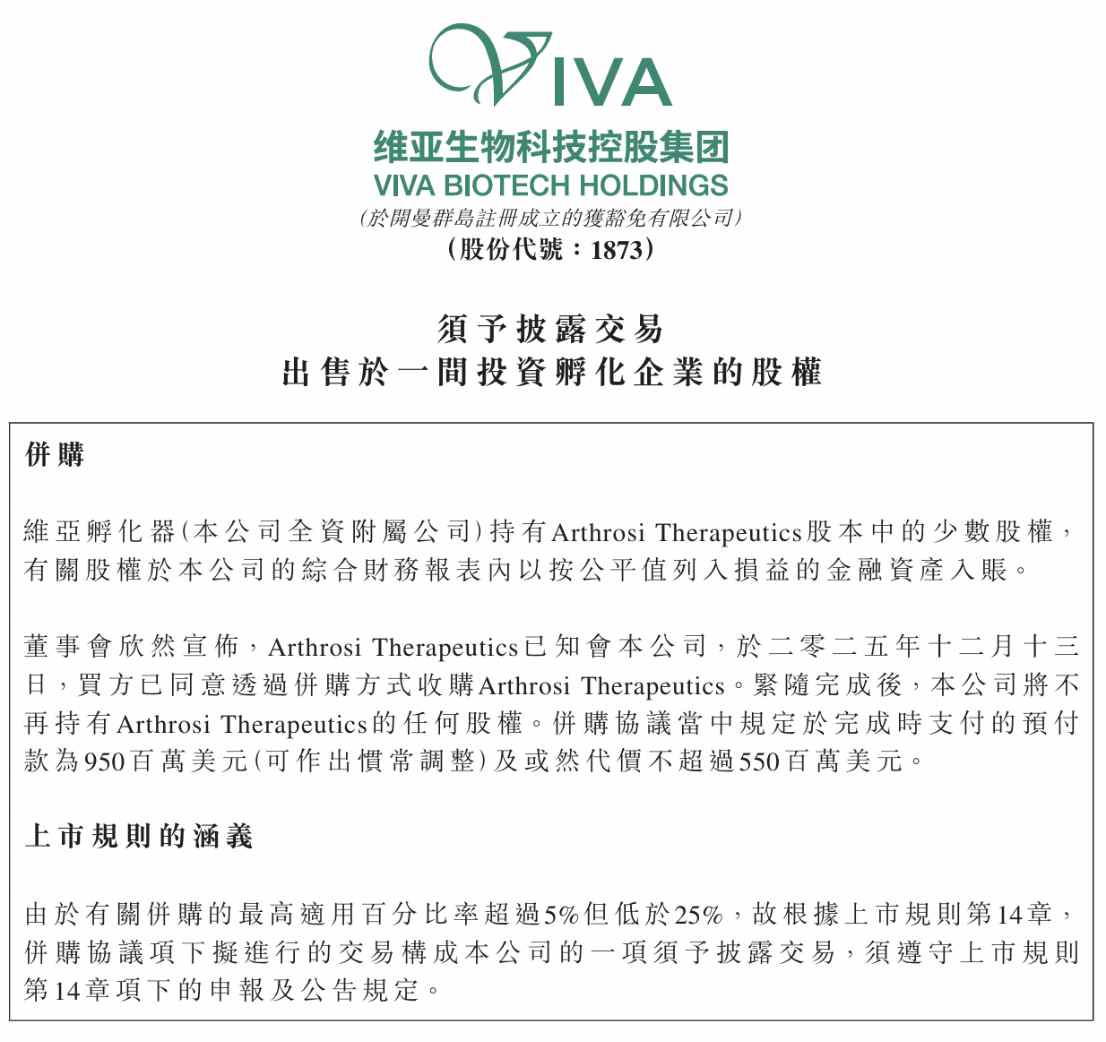
In the announcement, ViaBio mentioned that according to this transaction, it is expected to receive a return on investment of up to 40 million US dollars. The exact amount will depend on the achievement of milestones such as subsequent regulatory approval and commercialization progress. And this also brought an opportunity for ViaBio's stock price to “soar up.”
The Zhitong Finance App observed that on December 15, Viva Biotech opened higher in early trading. Within 5 minutes of opening, the company's stock price reached a maximum of HK$2.21, an increase of 13.92%. However, market sentiment remained high for only about 10 minutes. After that, ViaBio's stock price growth narrowed. Before the early trading session closed, the company's stock price even fell “underwater” for a while, and the stock price fluctuation reached 14.95% in early trading.
After 2 months of continuous decline, the market is more inclined to “fall into the bag for safety”?
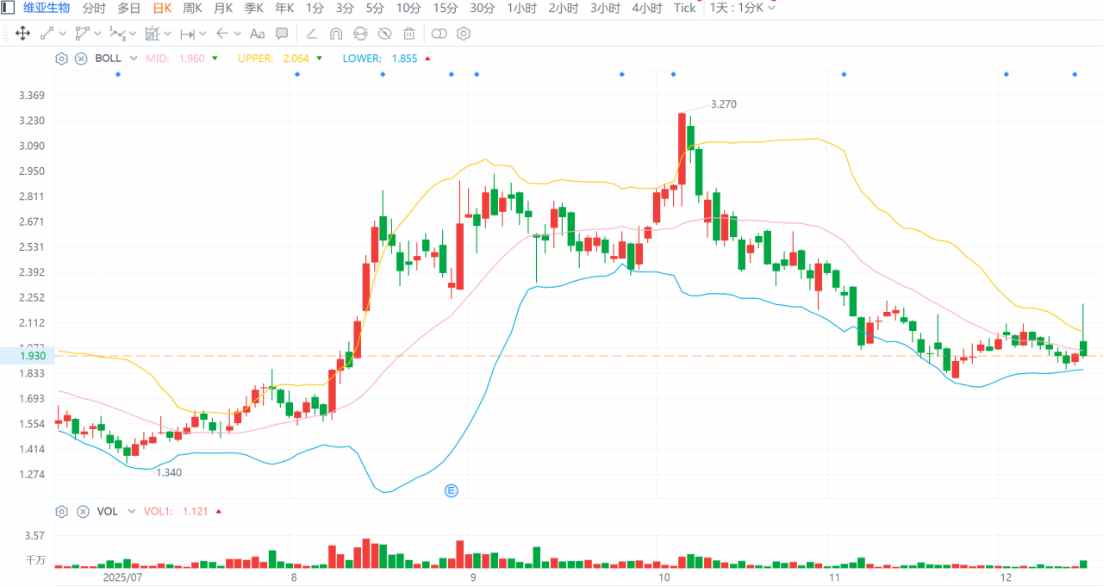
Over the past two months, ViaBio's stock price has continued to recover. After hitting an intraday high of HK$3.27 on October 8 this year, ViaBiotech began a 2-month pullback. The stock price continued to decline and fell to an intraday low of HK$1.8 on November 24. The biggest share price drop reached 44.95%.
Looking at the long-term timeline, in fact, Viva Biotech's previous upward process was not consistent; instead, it was divided into two periods of concentrated boosting in August and October. In the first segment of the market, Viva Biotech launched on August 8. The BOLL line opened upward for 6 consecutive trading days, and the BOLL line closed sharply on the same day. After that, the company's stock price followed the BOLL line for 6 consecutive trading days, which will directly pull to a phased high of HK$2.84.
Looking at volume, this round of increase is characterized by a “sharp rise in volume and price”. During the stock price increase phase, with the exception of the market adjustment on August 12, ViaBio's daily stock turnover exceeded 20 million shares, which was significantly higher than the average daily turnover during the previous sideways trading phase.
However, after the previous month of sideways fluctuations, Viva Biotech showed a clear “lack of momentum” during the second round of pull-up in October. According to the Zhitong Finance App, this round of market prices began on September 29 and reached a new high during the year after “Lianyang”. From a technical point of view, the overall direction is to move upward from the BOLL line and return to the middle track position after only 2 trading days. However, during the three trading days from October 2 to 6, none of the company's stock prices broke through the BOLL online track or opened an upward opening. It wasn't until October 8 that a Dayang line was pulled out to reach the BOLL online track.
Also, in terms of volume, unlike the booming market in August, ViaBio's October was not accompanied by an increase in trading volume. From October 2 to 6, the company's daily turnover even declined continuously, with a minimum trading volume of only 3.3051 million shares. On October 8, when the company's stock price closed up 13.94%, the daily trading volume was only 16.7017 million shares, while the maximum daily trading volume in the previous round reached 42.67 million shares.
It's also not hard to see that in the October market, Viva Biotech's off-market coin holders had a unanimous wait-and-see attitude, and the result of the lack of chip acceptance was that in-market fundraisers continued to sell under pressure over the next 2 months, which also caused the company's stock price to fluctuate and fall.
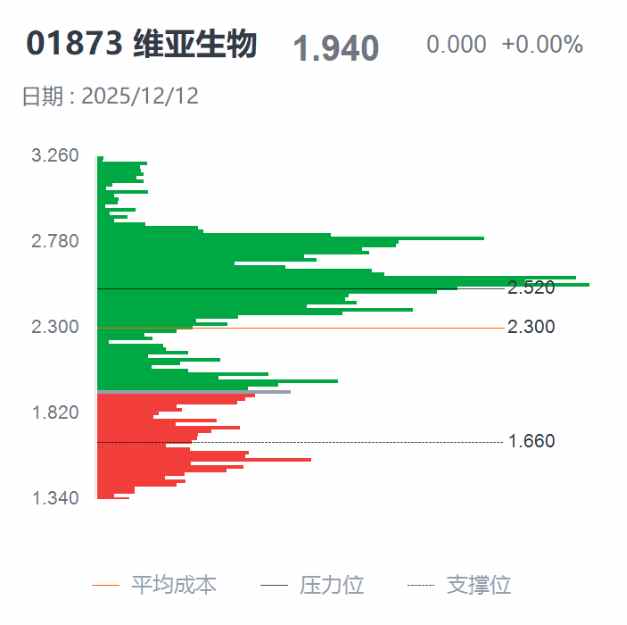
Judging from the chip distribution chart, after 2 months of continuous decline in stock prices, ViaBio's chip profit ratio fell from 100% on October 8 to 24.69% on December 12, but the average chip cost remained high at HK$2.30, while the chip peak remained around HK$2.50, indicating that currently OTC coin holders have not bottomed out of the market, and a large number of locked chips are waiting to be unlocked.
On December 15, Viva Biotech surged more than 13% in early trading, and its stock price rebounded to a maximum of HK$2.21. Although it still falls short of the average cost line, some profit fundraisers still chose to “fall into the bag for safety”. The lack of acceptance from outside the market and the accelerated exit from the market eventually led to a sharp rise and fall in ViaBiotech's stock price on the same day.
“Service for Shares” is entering a cashing period
Recently, in the direction of US stocks, Broadcom and Oracle both experienced sharp declines in stock prices after financial reports were disclosed, causing negative sentiment in the market to spread rapidly, driving the NASDAQ and S&P 500 indices lower. As an AI concept stock for Hong Kong stocks in the medical direction, ViaBio naturally cannot avoid this global “cooling-off period for AI investment.”
Judging from various opinions in the market, the current global AI industry has not stalled, but the capital market's investment attitude towards it is clearly shifting from fanaticism to prudence. A company's valuation, profit margin, and cash flow are beginning to become important indicators for investors to consider.
For Viabiotics, the positive impact of AI on it has gradually been reflected in its performance and financial data. In fact, ViaBiotech began deploying AI pharmaceuticals 5 years ago, and the company's one-stop innovative drug development service platform has also evolved from “AI assisted” to “AI-driven”. As a result, AI is gradually becoming an important driving force for ViaBio's revenue. Currently, the company's AI-related orders account for 12% of new orders, and is showing an increasing trend.
According to the company's 2025 interim results previously announced, the company's current revenue was 832 million yuan, a year-on-year decrease of 15.27%; shareholders' profit attributable to shareholders was 122 million yuan, an increase of 4.28% over the previous year. According to the announcement, the company's gross margin was 40.8%, an increase of 6.3 percentage points compared to the same period last year. This was mainly due to the optimization and adjustment of Langhua's business structure, the improvement of CRO business operation efficiency, and the growth of new business segments.
At the same time as the AI pharmaceutical business is growing steadily, ViaBiotech's VBI model has also begun to pay off.
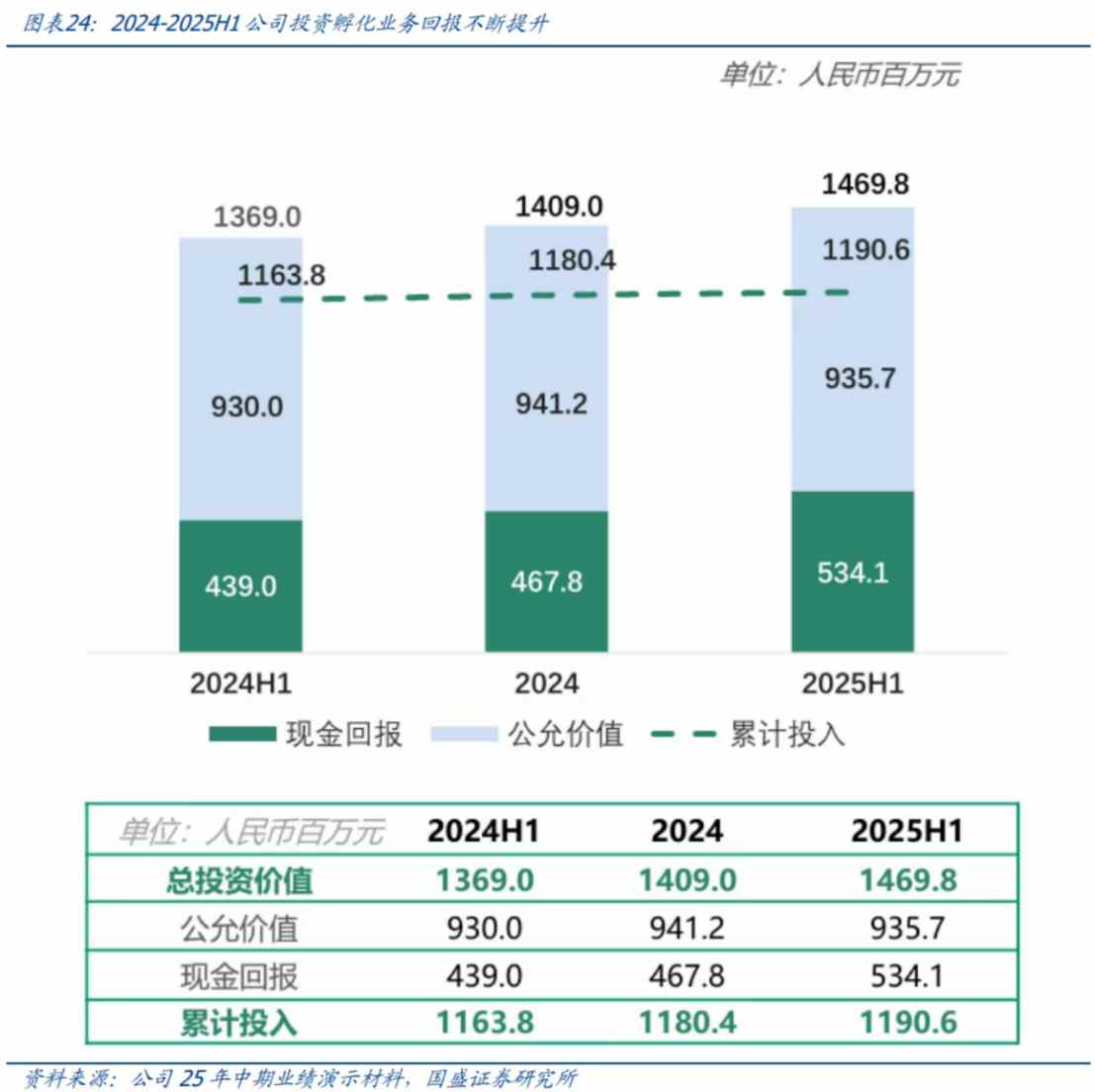
According to the Zhitong Finance App, in addition to its main CRO+CDMO business, ViaBiotech is also actively investing in incubation to launch an “Equity for Service (EFS)” (Equity for Service (EFS)) model in a different way from traditional CXO passively accepting orders, with the aim of tapping into high-potential biomedical startups. The core of this model is that Viva Biotech uses what it excels at and is most urgently needed by startups in exchange for part of the shares of high-potential biomedical startups, thereby achieving rich 'financial returns' in the later stages.
According to Guosheng Securities statistics, as of 2025H1, Viva Biotech has invested in a total of 93 enterprises. Eighteen companies have fully or partially withdrawn, and received a total of nearly 76.5 million yuan in repayment. The total number of incubated company product pipelines reached 228. Of these, 186 pipelines are in the pre-clinical stage, and 42 pipelines have entered the clinical stage.
In addition, eight investment incubators completed a new round of financing, totaling more than US$294 million. In 2025, H1, the investment income from changes in fair value was approximately RMB 52.6 million. In addition, there are several projects with potential exit possibilities, which are expected to gradually receive cash payments and redeem corresponding investment returns over the next few years.
The acquisition of Arthrosi through Sobi at a total transaction price of up to 1.5 billion US dollars is expected to receive a return on investment of 40 million US dollars, which is another example of ViaBiotech's VBI model ushered in a cash out period.
Judging from the overall valuation, after 2 months of declining prices, ViaBiotech's PS valuation is currently only 2.05 times, far lower than the industry average of 8.66 times, and this valuation is also 12% lower than ViaBiotech's own PS valuation in the past three months, which is relatively low in valuation. Against the backdrop of the company's overall improving fundamentals, the current price of ViaBiotech deserves some attention from investors.