
- PREMIUM
- LIVE QUOTES
- INSTITUTION
 Index Options


 State Street
 CME Group
 Nasdaq
 Cboe
Cboe TradingView
 Wall Street Journal
“Collection+holdings reduction” began a 3-month decline, and Xintai Healthcare (02291) started the 2026 “Guarantee War” ahead of schedule?
On November 19, the lowest intraday price of Xintai Healthcare (02291) hit HK$17.95. This is the first time since a single-day increase of 49.26% on April 22 this year that the company's stock price has fallen below HK$18.
The Zhitong Finance App has observed that since then, its stock price has declined more than once. On December 8, Xintai Healthcare closed at HK$17.20, one step away from the recent phased low of HK$17.01. In fact, Xintai Healthcare's downward cycle began on August 26, and this has to start with the majority shareholder reducing their holdings.
Controlling shareholders reduce their holdings and wait and see while holding coins on the market
In advance of the Hong Kong stock market on August 26, Xintai Medical issued a “controlling shareholder reduction” announcement, stating that its controlling shareholder Lepu Healthcare “sold a total of 11.14 million H shares of the Company through a bulk transaction on August 26, 2025, at a price of HK$22.79, accounting for about 3.21% of the total number of shares issued by the Company on the date of this announcement (sale matters),” and stated, “Lepu Medical is confident in the Group's business operations.”

Immediately after the announcement was revealed, it triggered a sell-off by market fundraisers on the same day. On August 26, Xintai Medical's stock price fell rapidly after opening. The stock price dived nearly 9% within 1 minute; the biggest drop in the stock price was more than 12% within half an hour. In the end, the company's stock price was low throughout the day, eventually closing down 12.75%. The opening price of HK$27.60 became the highest point of the day for Xintai Healthcare and the phased high point after that.
Since then, Xintai Medical has begun a downward cycle that has continued for more than 3 months. From a technical point of view, the sharp drop on August 26 directly lowered the company's stock price from the BOLL line to the bottom, and then “seven consecutive losses” drove the BOLL line to continue to expand its opening downward.
Although Xintai Medical's stock price showed signs of a rebound for 2 trading days after that, and the stock price briefly touched BOLL's middle track, no obvious support for an increase in trading volume was observed, and it failed to form an effective physical K-line breakthrough. Technically, it is a “false breakthrough” in the BOLL line index. As a result, after a longer period of “11 consecutive losses,” Xintai Medical's stock price returned to the lower BOLL line, and then continued to fall between the middle and lower BOLL line where the fluctuation narrowed.
Although in the holdings reduction announcement, Xintai Medical stated that its controlling shareholder “has full confidence in the Group's business operations and the sale is aimed at improving the liquidity of the Company's shares,” from a quantitative perspective, Xintai Medical only reached 16.1642 million shares on the day the holdings reduction announcement was issued, and the trading volume continued to exceed 1 million shares in the first three trading days of the beginning of the downward cycle. Since then, Xintai Medical's average daily stock trading volume was less than 1 million shares.
Generally speaking, continued sluggish market trading and numerous declines reflect the lack of confidence of investors in the market about stock value growth, and the consistent wait-and-see attitude of off-market funders.
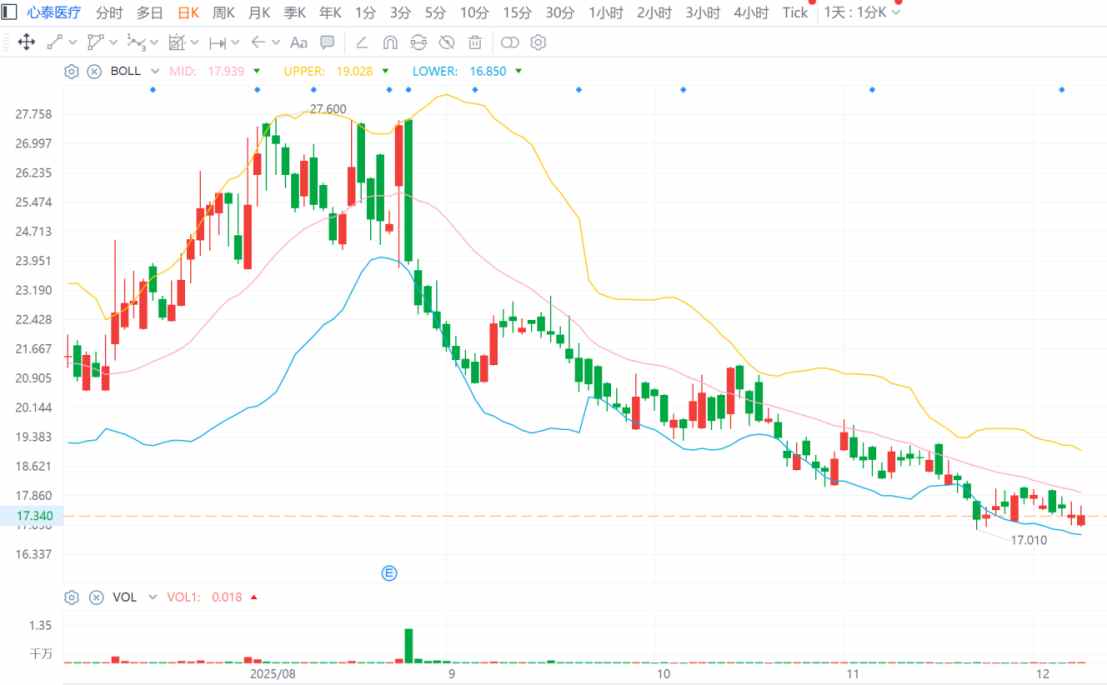
Whether from a technical or quantitative perspective, Xintai Healthcare's stock price showed no signs of a short-term rebound. Meanwhile, the continued fluctuation and decline in stock prices and market capitalization has also begun to destabilize Xintai Medical's Hong Kong Stock Connect position.
According to data from the Zhitong Finance App, the next round of regular adjustments to the Hang Seng Index and Hong Kong Stock Connect will be in March next year. The review results will be announced on February 25, and the review cycle will be from January 1, 2025 to December 31, 2025. Currently, the average daily market value of Xintai Healthcare during the review period was HK$6.885 billion, which is only HK$814 million higher than the current market capitalization threshold of HK$6.071 billion. Considering that it is now in early December, it is only about 20 days until the end of the Hong Kong Stock Connect review period for the latest round of adjustments, so as long as there are no sudden sharp fluctuations in market value, Xintai Medical can maintain Hong Kong Stock Connect's position during the new adjustment period. However, if a subsequent rebound in stock prices and market capitalization is not achieved, Xintai Medical's “exit” risk may continue to plague it.

Is harvesting an opportunity or a “monster of the flood”?
One week before the controlling shareholder of Xintai Medical announced the reduction in holdings, on August 19, the Sichuan Pharmaceutical Equipment Bidding and Procurement Service Center and the Inner Mongolia Autonomous Region Pharmaceutical Procurement Network issued a notice: the filing of historical procurement data for structural heart disease occlusive medical consumables was officially launched. <结构心脏病封堵器类医用耗材省际联盟集中带量采购方案 (征求意见稿) >Then, on October 22, the Fujian Provincial Health Insurance Administration issued the “Notice Concerning Public Consultation”.
On November 12, the Fujian Provincial Health Insurance Administration also issued the “Provincial Alliance Centralized Volume Procurement Notice for Structural Heart Disease Blockers” (No. 1) (No. 2), officially announcing that Fujian Province will take the lead in this interprovincial consortium collection of structural heart disease blockers, and that the allied provinces will cover the whole country. The document clarifies the scope of this collection: all provinces (autonomous regions and municipalities directly under the Central Government) across the country have formed procurement alliances to carry out centralized volume procurement of medical consumables for structural heart disease occlusions. Furthermore, any medical institution using structural heart disease blockers and medical consumables such as delivery systems in 2024 is required to participate in this collection.

The above measures mean that this year, the inter-provincial alliance collection led by Fujian Province has been upgraded to a national joint procurement.
Since as of October, Sichuan, Shanxi, Inner Mongolia and other places have completed the reporting of historical procurement data, and Hainan has also clearly participated in the Fujian Alliance's structural heart disease blocker collection project, so the market generally believes that this is or is currently an inter-provincial alliance collection targeting the most complete category and coverage of “structural heart disease blocker medical consumables”, which will have a scale effect or promote a comprehensive price reduction for occluder consumables.
In fact, this is not the first time that medical consumables such as structural heart disease blockers have been included in the collection. As early as 2023, Hebei Province led the collection of the Sanming Alliance and the Beijing-Tianjin-Hebei “3+N” Alliance collection included “atrial septal defect blockers” and “left ventricular occlusions and their delivery systems” in the scope of collection, respectively. In December of last year, “unclosed arterial catheter blockers, ventricular septal defect blockers, and left atrial ear blockers” were also included in the collection process in Anhui Province.
According to the Zhitong Finance App, an occluder is an important device for interventional treatment of structural heart disease. On the product side, cardiac occulators mainly include congenital heart disease blockers and cardiogenic stroke prevention blockers. In terms of market size, according to estimates, in 2025, the market size of heart blockers (including congenital heart disease blockers and cardiogenic stroke blockers) in China will exceed 6 billion yuan, and will maintain rapid double-digit growth.
Judging from the market pattern, the field of congenital heart disease blockers has now been replaced by domestic production. According to Frost & Sullivan's data, as early as 2021, Xintai Medical and Xianjian Technology occupied the first and second place respectively in the market share, with an overall localization rate of 95%; in the field of cardiogenic stroke blockers, imported brands still dominate. According to the 2022 “Blue Book on Chinese Medical Devices” data, Boston Scientific accounted for 67% of China's left ventricular occlusion market, and Xianjian Technology accounted for 25%.
Referring to Hebei Union's collection to Anhui collection, the average price reduction of the selected products collected twice fell from 64.9% to 33.29%, and the decline was moderate.
Back to Xintai Healthcare, judging from its performance, the company's revenue from congenital heart disease occluder products in the first half of this year was 161 million yuan, accounting for 48.7% of the total revenue for the current period. This is an increase of 24.8% over 129 million yuan in the same period last year, and the proportion of total revenue for the same period has stabilized at around 50%. As can be seen, congenital heart disease blockers are currently the core revenue source for Xintai Medical.
In this context, the quality of the collection results may directly affect the subsequent performance of Xintai Medical. If the results of this nationwide joint procurement show that the price reduction is in line with expectations, Xintai may be able to use this to accelerate the market penetration rate of its products; conversely, the company's profits may be significantly impacted in the short term. In fact, the current low daily stock trading volume of Xintai Healthcare reflects the wait-and-see attitude of OTC coin holders. And the day the results of this round of national joint procurement were released may be a key turning point for Xintai Medical.