
- PREMIUM
- LIVE QUOTES
- INSTITUTION
 Index Options


 State Street
 CME Group
 Nasdaq
 Cboe
Cboe TradingView
 Wall Street Journal
Silver hit a new high after breaking $60 for the first time! Will the epic bull market continue under the multiple favorable resonance of gains crushing gold during the year?
The Zhitong Finance App learned that as traders bet that the Federal Reserve will further relax monetary policy and supply continues to be tight, spot silver continued to rise on Wednesday after breaking through the important mark of 60 US dollars/ounce on Tuesday, once again breaking a new record high. As of press release, spot silver had risen more than 1% to 61.30 US dollars/ounce.
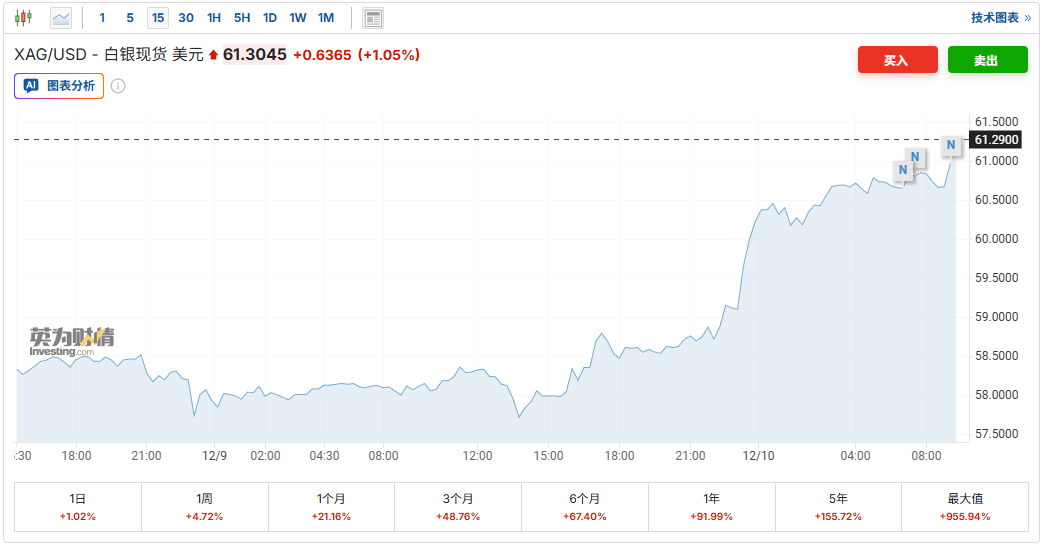
Multiple factors contributed to the strong rise of silver
The price of silver has more than doubled this year so far. As a comparison, although gold also rose 60% this year and broke through the $4,200 mark, it is still less strong than silver in terms of strength. As a result, the gold and silver ratio fell below 70 times, for the first time since July 2021.
Silver's impressive performance in recent times has, on the one hand, benefited from rising expectations for the Fed to cut interest rates. The Federal Reserve will announce its latest interest rate decision in the early hours of Thursday morning Beijing time. After a period of obvious hesitation about the direction of the Federal Reserve's decision, the market is now basically convinced that the Federal Reserve will cut interest rates by 25 basis points, reducing the federal funds rate to 3.5%-3.75%. Meanwhile, traders are currently betting that the Federal Reserve will cut interest rates twice in 2026.
Traders are also watching for potential candidates for the next Federal Reserve Chairman to find telltale signs of a monetary policy path. Kevin Hassett, head of the White House National Economic Council and a loyal supporter of Trump, is seen as a popular candidate to replace Federal Reserve Chairman Powell. On Tuesday, when asked if he eventually became the chairman of the Federal Reserve would push for the “sharp interest rate cut” that Trump is expecting, Hassett said, “If the data shows we can do this then — just like now — I think there's plenty of room to do it.” When asked if that meant cutting interest rates by more than 25 basis points, Hassett answered, “Yes.”
At the same time, supply shortages are becoming a structural driver of rising silver prices. Last month, record amounts of silver flowed into London, putting pressure on other trading centers. Warehouse inventories linked to the Shanghai Futures Exchange recently fell to their lowest level in ten years. The shortage of spot goods between regions has led to the “migration” of silver across regions, and there are even extreme situations where air cargo rather than sea freight is needed to meet delivery needs. This reflects the extreme tightness of the physical market. Although the physical flow of silver into London eased the historic supply squeeze in October, other markets are facing severe supply restrictions. At present, China's silver inventory is at a ten-year low.
Over the past decade, global silver production has continued to decline, particularly in Central and South America, due to mine closures, resource depletion, and infrastructure challenges. Also, about 70% of silver is mined as a by-product of associated minerals such as copper, lead, zinc, and gold. This means that even if the price of silver rises, miners will not increase production just for the sake of silver, unless the profitability of the main metal is high enough, causing supply to respond slowly to the price. According to the Silver Association, the silver market is expected to experience an annual deficit for the fifth year in a row in 2025 as industry and demand continue to rise due to limited production.
Furthermore, industrial demand for silver is rapidly exploding. As the best known visible light reflector, one of the strongest electrical conductors, and a metal with natural bactericidal properties, demand for silver in the solar energy, new energy, electronic components, AI hardware, and smartphone industries continues to grow. And after silver was added to the US list of key minerals last month, traders are seeking clear information on whether the US will impose additional tariffs on silver.
The continued inflow of capital into silver ETFs also supported the rise of this precious metal. Data shows that last week, total capital inflows to silver ETFs hit a record high in a single week since July. This is a strong sign that investors believe that silver's gains will continue.
The hot silver market is causing concerns about a collapse. Is this time different?
While silver has more than doubled this year, there are also concerns that silver will have a disappointing ending after such a sharp rise. These bearish sentiments are based on historical experience. After all, after hitting record highs twice in 1980 and 2011, silver then plummeted rapidly.
Senior strategist Mike McGlone said last week that the astonishing increase in silver's price doubling this year was “somewhat unsettling.” He pointed out that given the high volatility of silver, its price could soar to $75 an ounce or fall back to $40 an ounce. He pointed out that silver has always been prone to extreme gains — the current price is 83% above its five-year average — and historically, such gains have often not ended well. He warned that the annual silver market fluctuation rate is about 30%, which means that if the price fluctuates by a standard deviation next year, it may push silver to a high of 75 US dollars per ounce, or to a low of 40 US dollars per ounce.
However, Sprott Money analyst Craig Hemke doesn't think so. He said the situation was different; “The current economic, monetary, and physical conditions are completely different from 1980 and 2011.” Craig Hemke believes that the price pattern that silver is showing is more similar to gold's breakthrough market in 2023 and 2024, rather than the silver bull market in 1980 and 2011.
Although the future is likely to see further consolidation and a period of sideways trading, Craig Hemke believes that a real breakthrough for silver is still in the future. He said, “It's not 1980 or 2011. The price of silver will not collapse, nor has it just formed a double peak. On the contrary, just like gold two years ago, the price of silver is bottoming out near and above its old historical high, and the real breakthrough will not be until early 2026.” He added that next year's breakthrough is likely to push silver to a new all-time high. “The price of gold has doubled since the March 2024 breakthrough, and a similar increase in silver will bring its price to $100 per ounce in mid to late 2027.”
In addition, Citibank analysts also said in a report last week that based on the Federal Reserve's interest rate cuts, strong investment demand, and physical shortages, the price of silver may rise to 62 US dollars per ounce within the next three months.