
- PREMIUM
- LIVE QUOTES
- INSTITUTIONS
 Index Options


 State Street
 CME Group
 Nasdaq
 Cboe
Cboe TradingView
 Wall Street Journal
Kraken Robotics' (CVE:PNG) Promising Earnings May Rest On Soft Foundations
Kraken Robotics Inc. (CVE:PNG) just reported some strong earnings, and the market reacted accordingly with a healthy uplift in the share price. We did some analysis and think that investors are missing some details hidden beneath the profit numbers.
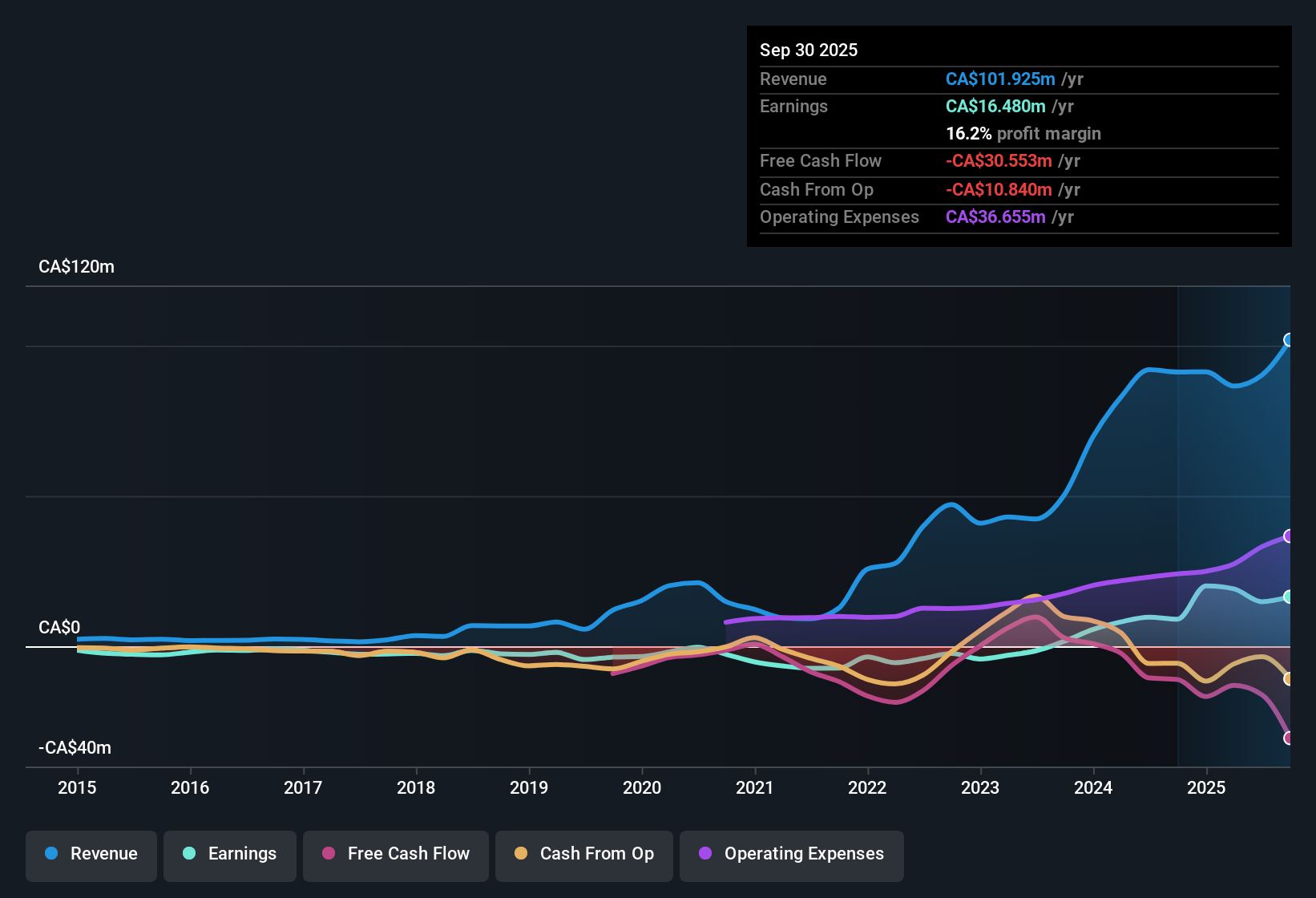
A Closer Look At Kraken Robotics' Earnings
In high finance, the key ratio used to measure how well a company converts reported profits into free cash flow (FCF) is the accrual ratio (from cashflow). In plain english, this ratio subtracts FCF from net profit, and divides that number by the company's average operating assets over that period. You could think of the accrual ratio from cashflow as the 'non-FCF profit ratio'.
That means a negative accrual ratio is a good thing, because it shows that the company is bringing in more free cash flow than its profit would suggest. That is not intended to imply we should worry about a positive accrual ratio, but it's worth noting where the accrual ratio is rather high. To quote a 2014 paper by Lewellen and Resutek, "firms with higher accruals tend to be less profitable in the future".
Over the twelve months to September 2025, Kraken Robotics recorded an accrual ratio of 0.49. As a general rule, that bodes poorly for future profitability. And indeed, during the period the company didn't produce any free cash flow whatsoever. Even though it reported a profit of CA$16.5m, a look at free cash flow indicates it actually burnt through CA$31m in the last year. We also note that Kraken Robotics' free cash flow was actually negative last year as well, so we could understand if shareholders were bothered by its outflow of CA$31m. Having said that, there is more to consider. We must also consider the impact of unusual items on statutory profit (and thus the accrual ratio), as well as note the ramifications of the company issuing new shares.
See our latest analysis for Kraken Robotics
That might leave you wondering what analysts are forecasting in terms of future profitability. Luckily, you can click here to see an interactive graph depicting future profitability, based on their estimates.
In order to understand the potential for per share returns, it is essential to consider how much a company is diluting shareholders. In fact, Kraken Robotics increased the number of shares on issue by 17% over the last twelve months by issuing new shares. As a result, its net income is now split between a greater number of shares. To celebrate net income while ignoring dilution is like rejoicing because you have a single slice of a larger pizza, but ignoring the fact that the pizza is now cut into many more slices. You can see a chart of Kraken Robotics' EPS by clicking here.
A Look At The Impact Of Kraken Robotics' Dilution On Its Earnings Per Share (EPS)
Three years ago, Kraken Robotics lost money. The good news is that profit was up 83% in the last twelve months. But EPS was less impressive, up only 45% in that time. And so, you can see quite clearly that dilution is influencing shareholder earnings.
In the long term, earnings per share growth should beget share price growth. So Kraken Robotics shareholders will want to see that EPS figure continue to increase. But on the other hand, we'd be far less excited to learn profit (but not EPS) was improving. For that reason, you could say that EPS is more important that net income in the long run, assuming the goal is to assess whether a company's share price might grow.
The Impact Of Unusual Items On Profit
Kraken Robotics' profit suffered from unusual items, which reduced profit by CA$2.0m in the last twelve months. In the case where this was a non-cash charge it would have made it easier to have high cash conversion, so it's surprising that the accrual ratio tells a different story. While deductions due to unusual items are disappointing in the first instance, there is a silver lining. We looked at thousands of listed companies and found that unusual items are very often one-off in nature. And that's hardly a surprise given these line items are considered unusual. Assuming those unusual expenses don't come up again, we'd therefore expect Kraken Robotics to produce a higher profit next year, all else being equal.
Our Take On Kraken Robotics' Profit Performance
In conclusion, Kraken Robotics' accrual ratio suggests that its statutory earnings are not backed by cash flow; but the fact unusual items actually weighed on profit may create upside if those unusual items to not recur. On top of that, the dilution means that shareholders now own less of the company. Considering all this we'd argue Kraken Robotics' profits probably give an overly generous impression of its sustainable level of profitability. If you want to do dive deeper into Kraken Robotics, you'd also look into what risks it is currently facing. Our analysis shows 2 warning signs for Kraken Robotics (1 doesn't sit too well with us!) and we strongly recommend you look at them before investing.
In this article we've looked at a number of factors that can impair the utility of profit numbers, and we've come away cautious. But there is always more to discover if you are capable of focussing your mind on minutiae. Some people consider a high return on equity to be a good sign of a quality business. While it might take a little research on your behalf, you may find this free collection of companies boasting high return on equity, or this list of stocks with significant insider holdings to be useful.
Have feedback on this article? Concerned about the content? Get in touch with us directly. Alternatively, email editorial-team (at) simplywallst.com.
This article by Simply Wall St is general in nature. We provide commentary based on historical data and analyst forecasts only using an unbiased methodology and our articles are not intended to be financial advice. It does not constitute a recommendation to buy or sell any stock, and does not take account of your objectives, or your financial situation. We aim to bring you long-term focused analysis driven by fundamental data. Note that our analysis may not factor in the latest price-sensitive company announcements or qualitative material. Simply Wall St has no position in any stocks mentioned.