
- PREMIUM
- LIVE QUOTES
 Index Options


 State Street
 CME Group
 Nasdaq
 Cboe
Cboe TradingView
 Wall Street Journal
Jinxin Reproduction (01951): Does the HK$100 million repurchase bring a “profit signal”?
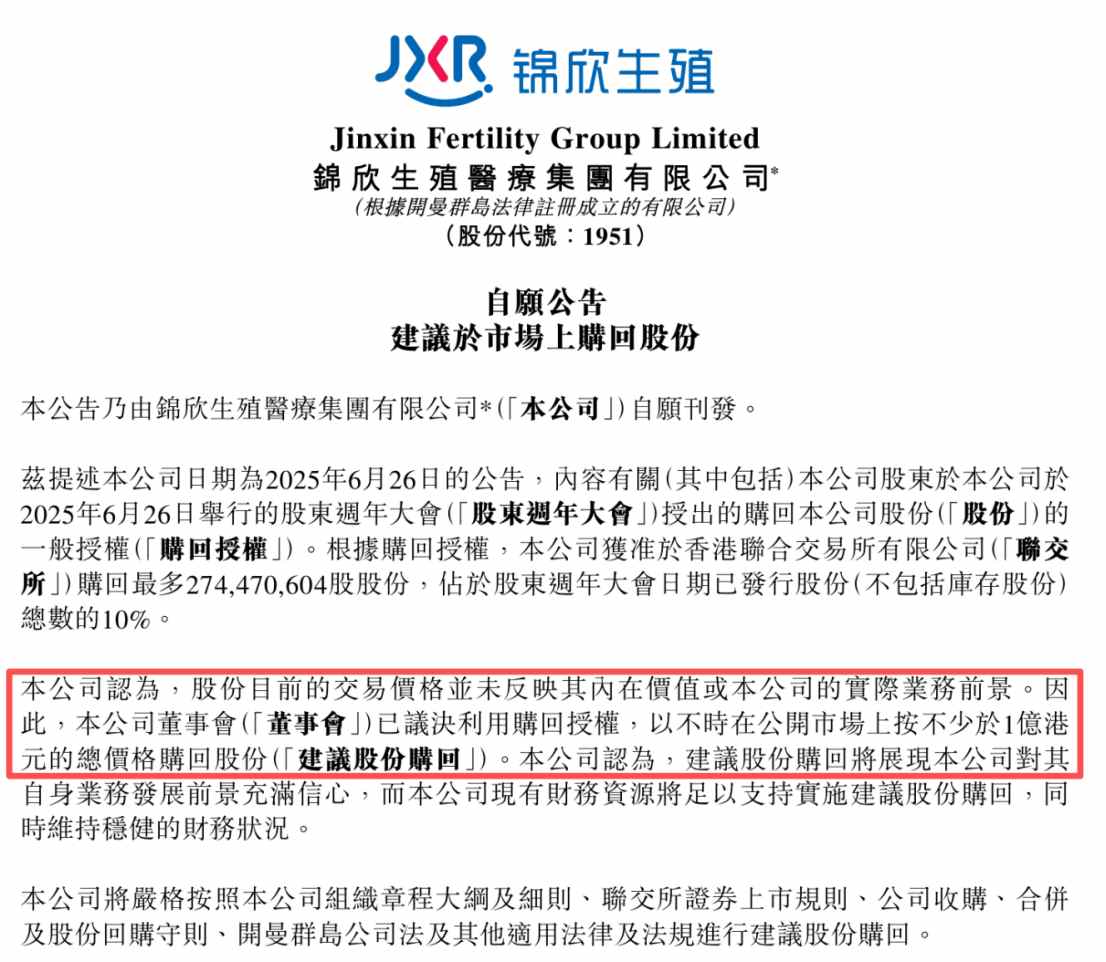
On the evening of December 1, Jinxin Production (01951) issued an announcement announcing “the intention to buy back the shares at a total price of not less than HK$100 million”, believing that “the current transaction price of the shares does not reflect their intrinsic value or the actual business prospects of the Company.”
The Zhitong Finance App observed that since hitting a phased stock price high on July 29 this year, Jinxin Fertility's stock price fluctuated and fell all the way. On November 24, the intraday stock price once fell to HK$2.33, hitting a new low during the new year. Looking at the long-term timeline, this year is also the fifth year that its stock price has fallen continuously. Based on the 2021 high of HK$23.79, Jinxin Fertility's stock price has already dropped 90%. Therefore, Jinxin Fertility chose to announce the repurchase at this point, apparently hoping to boost market confidence.
Is the Hong Kong Stock Exchange bottom-up bet, and the repurchase brings a “profit signal”?
As mentioned above, since hitting a phased high on July 29, Jinxin Fertility's stock price has been in a volatile downward channel. Specifically, after crossing the BOLL line by drastically crossing the BOLL line on July 29 and drawing a big negative line, Jinxin Fertility broke out of a “deep V trend” within 20 days, rapidly falling to near the downtrend, then rising more than 15% within 5 trading days to pull the stock price back to the upper track. However, a long upward line on August 18 also heralded the exhaustion of many forces.
On August 19, Jinxin Fertility began a rapid downward period of nearly 13 consecutive years. In the process, the BOLL line opened downward, leading to a rapid decline in stock prices. Looking at volume, Jinxin's daily trading volume continues to shrink during this stage, indicating that OTC holders are in a wait-and-see state of holding coins, and the market's carrying capacity is lacking. As a result, stock prices continue to fall and trading volume is scarce.
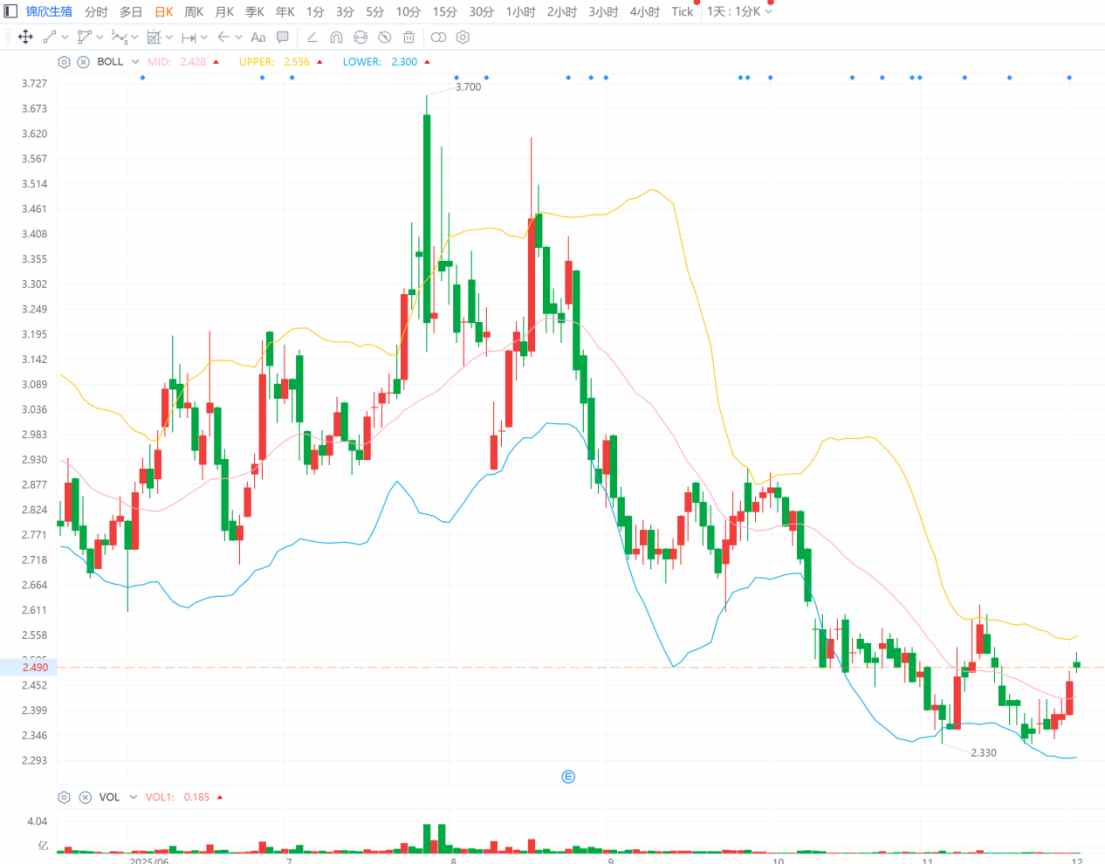
As can be seen, the company's stock price stopped falling at the beginning of September. Since then, Jinxin's reproductive stock price has basically fluctuated mechanically along the BOLL line and bottom track, but it has remained in a state of endless empty decline. No support for increased trading volume has been observed, and no effective physical K-line breakthrough has been formed. Technically, it is a “false breakthrough” in the BOLL line index.
Looking at the recent past, even after hitting BOLL's online trajectory on November 13, Jinxin's stock price still showed a 2.33% correction the next day, and once again experienced “six consecutive losses” and returned to the BOLL offline trend on November 21.
Although after 4 months of continuous decline, Jinxin's reproductive market sentiment fell to a freezing point. As a Hong Kong stock market standard, this performance also triggered the “muscle memory” of Hong Kong Stock Connect funds.
According to the Zhitong Finance App, in Jinxin's brokerage transactions in the past 60 days, the top five sellers were Goldman Sachs, Hong Kong and Shanghai HSBC, China Securities International, Huatai Financial Holdings, and Nanyang Commercial Bank, which sold 87.60.84 million shares, 31.24,500 shares, 7.324,500 shares, and 5,029 million shares, respectively. From the buyer's perspective, the two major Hong Kong stock exchange channels, Shanghai and Shenzhen, were Jin Xin's top two net buyers, buying 75.56,500 shares and 71.824,300 shares respectively.
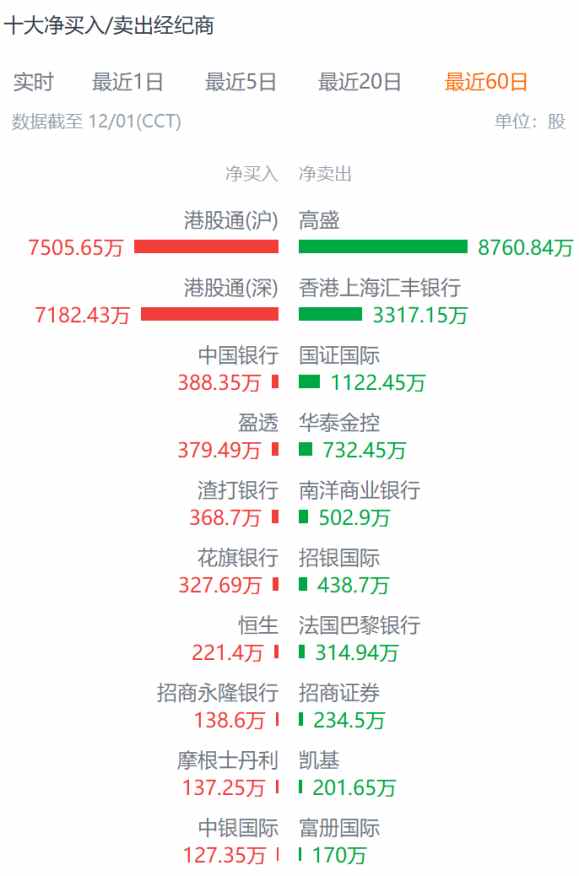
Based on the Hong Kong Stock Connect shareholding records, the shareholding ratio of Hong Kong Stock Connect funds to Jinxin Fertility has risen markedly since September this year. As of December 1, it had reached 53.83%. The purchase period corresponds to the downward trend of Jinxin Fertility from September to the end of November this year. However, in the recent rebound of Jinxin Fertility's market, the Hong Kong Stock Connect Fund reverses the previous “buy the more you fall, the more you sell” operation and chose to increase the position and cut the bottom. In the past 5 days, the total net purchase volume of shares through the Hong Kong Stock Connect channel reached 27.119 million shares, continuing to be Jinxin's top net buyer.

Repurchase or warm-up, stock price rebound still needs strong fundamental support
On December 2, the Hong Kong stock giant biotech announced the repurchase of 104 million shares. This news directly contributed to the share price increase of 13% in the afternoon. On the other hand, Jinxin Production's stock price closed up only 1.63% the day after the buyback was announced, and then opened lower in early trading on December 3, and the stock price fell 1.6% for a while. This performance clearly fell short of many investors' expectations.
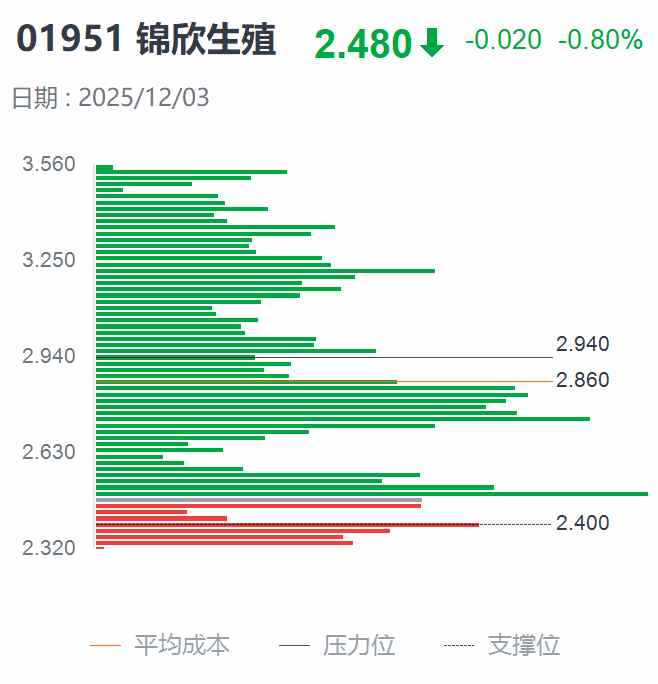
Looking at the recent chip distribution chart, after more than 3 months of fluctuating decline, Jinxin's stock price has reached a clearly weak range. There are a large number of secure slots above, and the chip gathering area is already below the average cost line of HK$2.86. Even though there has been a recent rebound, the overall chip profit ratio is only 14.92%. On the other hand, after the company announced the buyback, its stock volume also only rose slowly, indicating that OTC fundraisers may still be in a state of cautious entry. When the willingness to exchange funds on and off the market is not strong, the upward resistance of the main capital will also be relatively greater, which has affected the rebound in Jinxin's short-term stock price to a certain extent.
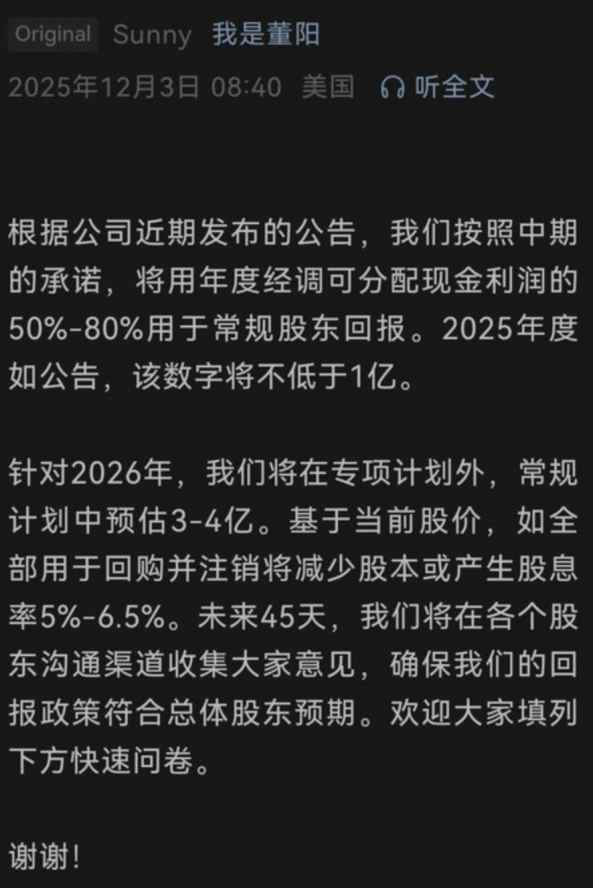
To further boost confidence, Dong Yang, CEO of Jinxin Fertility, posted an article on his personal account before the Hong Kong Stock Market on December 3, saying, “For 2026, we will estimate 300 to 400 million dollars in the regular plan in addition to the special plan. Based on current stock prices, if used entirely for repurchase and cancellation, the share capital will be reduced or a dividend ratio of 5%-6.5% will be generated.”
In fact, as far as Jinxin Fertility is concerned, in order to boost market confidence, cancelling buybacks is on one side, and improving the company's fundamentals is on the other.
According to the Zhitong Finance App, according to the 2025 interim results disclosed by the company in late August this year. According to financial reports, the company's revenue for the first half of the year was 1,288 billion yuan, down 10.7% year on year, compared to 1,443 billion yuan in the same period last year; net loss was 1.04 billion yuan, changing from profit to loss year on year. Profit for the same period last year was 190 million yuan. After excluding impairment and other non-recurring and non-cash items, the company's adjusted net profit for the current period was approximately RMB 82.3 million, a year-on-year decrease of 68.3%.
In the financial report, the company blamed the decline in performance on four major factors: 1. In order to cultivate a new growth curve, the volume and price of the core assisted reproduction business decreased by about 8%, medical insurance fees also reduced the average price of a single cycle by 7% to 8%, and the increase in the share of artificial insemination further lowered customer unit prices; 2. Domestic birth intentions continued to decline, and traditional delivery volume plummeted by nearly a quarter, directly dragging down obstetrics and related revenue; 3. In order to cultivate a new growth curve, the company increased investment in several new departments and businesses, leading to an increase in the cost side; 4. Also, some assets in Laos showed signs of depreciation, goodwill, intangible One-off accrual provisions for assets and other financial assets further erode profits.
Simply put, in the first half of this year, the main reason for Jinxin Fertility's poor performance was due to multiple factors such as a sharp drop in domestic business volume and price and one-time depreciation of overseas assets.
This performance has led many institutions to lower their revenue and profit forecasts for Jinxin Fertility 2025-2027. Among them, BOC International lowered Jinxin Fertility's revenue forecast for 2025 to 2027 by 17% to 18%, lowered the adjusted net profit forecast by about 50%, and also lowered the target price to HK$3.3. The rating was lowered to “neutral”, believing that the current valuation is quite reasonable;
Meanwhile, CITIC Lyon also has a neutral attitude towards Jinxin Fertility 2025, and lowered the company's 2025-2027 revenue forecast by 12% to 20% and the net profit forecast by 27% to 31%. It is expected that 2025 will have a net loss to reflect the results of the first half of the year and cautious expectations for the coming year. Meanwhile, based on the revised forecast and higher target price-earnings ratio, the company's target price was lowered from HK$3.8 to HK$3.5.
However, based on Jinxin Fertility's statement that all adverse factors were released centrally in the first half of the year, it is expected that business conditions will improve in the second half of the year. Therefore, CITIC Lyon expects it to gradually return to the right track from 2026 to 2027. According to the announcement disclosed by Jinxin Fertility on October 24 this year, as of the end of the third quarter of 2025, the company's cumulative IVF egg retrieval cycle decline narrowed from 8.3% in the first half of the year to 5.2%, and improvements in the company's overall operation began to show. This also made the market look more forward to the company's 2025 annual report results data.