
- PREMIUM
- LIVE QUOTES
- INSTITUTION
 Index Options


 State Street
 CME Group
 Nasdaq
 Cboe
Cboe TradingView
 Wall Street Journal
Profitability of AI tools questioned Snowflake (SNOW.US) weak guidance triggers stock price dives
The Zhitong Finance App learned that Snowflake (SNOW.US) announced results for the third fiscal quarter that exceeded expectations on Wednesday. However, the operating margin outlook provided by the company fell short of analysts' expectations, and its product revenue forecasts failed to meet investors' expectations for a higher growth rate, which raised investors' concerns about the profitability of its new artificial intelligence (AI) tools. Affected by this, the company's stock price fell after the market.
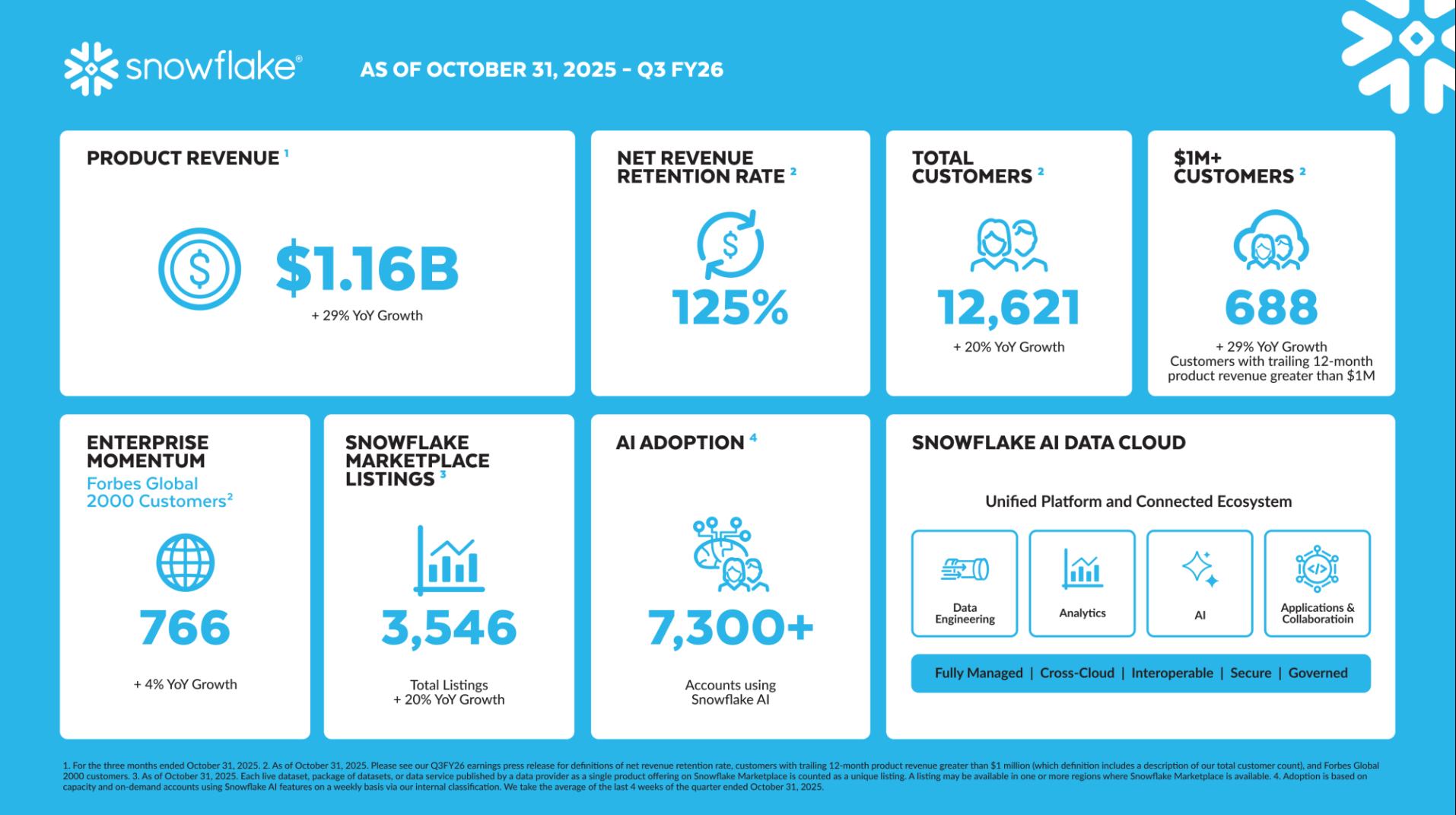
Financial reports show that in the third fiscal quarter ending October 31, the company's revenue was 1.21 billion US dollars, higher than analysts' previous estimate of 1.18 billion US dollars. Among them, product revenue increased 29% year over year to 1.16 billion US dollars, accounting for about 95% of the company's total revenue, exceeding the general forecast of about 1.14 billion US dollars. The amount of remaining performance obligation, which measures the size of the order, increased 37% to $7.88 billion, higher than analysts' estimate of $7.23 billion. Adjusted earnings per share were 35 cents, which was also higher than analysts' estimates of 31 cents.
Looking ahead, however, the company expects an adjusted operating margin of about 7% for the fourth fiscal quarter ending January, which is lower than analysts' average forecast of 8.5%. Product revenue is expected to be around $1,195-1.2 billion, up 27% year over year, just slightly above the average forecast of $1.19 billion.
“Given the sharp rise in stock prices since this year, investors would have expected the company to provide guidance on a growth rate of more than 30%,” said D.A. Davidson analyst Gil Luria. “But we believe this growth will be achieved in the next quarter, thus continuing to drive the stock price upward.”
After the financial report was announced, the company's share price fell by more than 9% in after-hours trading, but after announcing a partnership with Anthropic, it recovered some of its losses. Since this year, the stock's cumulative increase has reached 72%.
According to information, as enterprises' demand for data organization, storage, and security grows, Snowflake, which focuses on developing cloud-based enterprise data organization, analysis and storage software, continues to benefit from the expansion of AI demand.
Since Sridhar Ramaswamy became CEO in early 2024, the company has focused on integrating AI tools and data within the platform, and reached four acquisition deals this year, mainly aimed at strengthening this strategic layout. On Wednesday, the company also announced a $200 million partnership with Anthropic PBC to integrate the startup's Claude AI model into its platform.
However, since hitting a 2025 high of $277.14 on November 3, its stock price has declined somewhat. Recently, technology stocks continue to face market concerns about the AI bubble — although companies continue to invest heavily, they have yet to receive significant substantial returns.
In addition to bubble concerns, investors are also closely watching the competitive pressure Snowflake faces, particularly competition with companies such as Databricks.
According to a November report, Snowflake's main competitor, Databricks, a private data software provider, is negotiating a new round of financing, and the valuation is expected to exceed 130 billion US dollars. If this valuation is reached, the startup's market value would be significantly higher than Snowflake's market value of $89.7 billion at the close of Wednesday.
Bernstein analyst Firoz Valliji said before the earnings report was released: “In the long run, we are encouraged by the innovative initiatives and focus on execution under the new CEO, but we are still concerned that competition in its core market is becoming increasingly intense.”
D.A. Davidson's Luria isn't worried, though. “In the current software industry environment, Snowflake is facing a significant tailwind, and the threat posed by Databricks is limited,” he further added. “We continue to learn that although the two businesses have intersected, there is still plenty of room for development.”