
- PREMIUM
- LIVE QUOTES
- INSTITUTION
 Index Options


 State Street
 CME Group
 Nasdaq
 Cboe
Cboe TradingView
 Wall Street Journal
MIE Holdings (HKG:1555) May Have Issues Allocating Its Capital
When it comes to investing, there are some useful financial metrics that can warn us when a business is potentially in trouble. More often than not, we'll see a declining return on capital employed (ROCE) and a declining amount of capital employed. Ultimately this means that the company is earning less per dollar invested and on top of that, it's shrinking its base of capital employed. In light of that, from a first glance at MIE Holdings (HKG:1555), we've spotted some signs that it could be struggling, so let's investigate.
Return On Capital Employed (ROCE): What Is It?
For those that aren't sure what ROCE is, it measures the amount of pre-tax profits a company can generate from the capital employed in its business. The formula for this calculation on MIE Holdings is:
Return on Capital Employed = Earnings Before Interest and Tax (EBIT) ÷ (Total Assets - Current Liabilities)
0.13 = CN¥112m ÷ (CN¥1.3b - CN¥391m) (Based on the trailing twelve months to June 2025).
Therefore, MIE Holdings has an ROCE of 13%. On its own, that's a standard return, however it's much better than the 5.3% generated by the Oil and Gas industry.
Check out our latest analysis for MIE Holdings
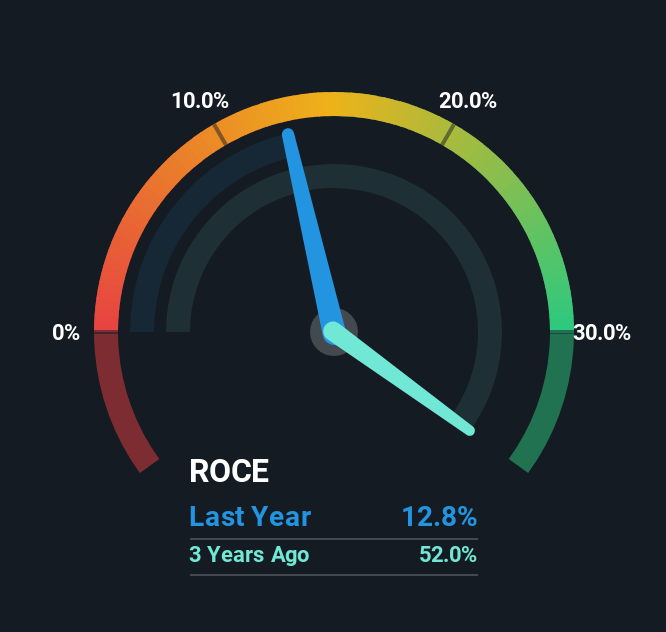
While the past is not representative of the future, it can be helpful to know how a company has performed historically, which is why we have this chart above. If you'd like to look at how MIE Holdings has performed in the past in other metrics, you can view this free graph of MIE Holdings' past earnings, revenue and cash flow.
What Can We Tell From MIE Holdings' ROCE Trend?
The trend of ROCE at MIE Holdings is showing some signs of weakness. Unfortunately, returns have declined substantially over the last three years to the 13% we see today. What's equally concerning is that the amount of capital deployed in the business has shrunk by 33% over that same period. The combination of lower ROCE and less capital employed can indicate that a business is likely to be facing some competitive headwinds or seeing an erosion to its moat. If these underlying trends continue, we wouldn't be too optimistic going forward.
On a related note, MIE Holdings has decreased its current liabilities to 31% of total assets. So we could link some of this to the decrease in ROCE. What's more, this can reduce some aspects of risk to the business because now the company's suppliers or short-term creditors are funding less of its operations. Some would claim this reduces the business' efficiency at generating ROCE since it is now funding more of the operations with its own money.
Our Take On MIE Holdings' ROCE
In summary, it's unfortunate that MIE Holdings is shrinking its capital base and also generating lower returns. Long term shareholders who've owned the stock over the last five years have experienced a 53% depreciation in their investment, so it appears the market might not like these trends either. That being the case, unless the underlying trends revert to a more positive trajectory, we'd consider looking elsewhere.
If you want to know some of the risks facing MIE Holdings we've found 2 warning signs (1 shouldn't be ignored!) that you should be aware of before investing here.
While MIE Holdings isn't earning the highest return, check out this free list of companies that are earning high returns on equity with solid balance sheets.
Have feedback on this article? Concerned about the content? Get in touch with us directly. Alternatively, email editorial-team (at) simplywallst.com.
This article by Simply Wall St is general in nature. We provide commentary based on historical data and analyst forecasts only using an unbiased methodology and our articles are not intended to be financial advice. It does not constitute a recommendation to buy or sell any stock, and does not take account of your objectives, or your financial situation. We aim to bring you long-term focused analysis driven by fundamental data. Note that our analysis may not factor in the latest price-sensitive company announcements or qualitative material. Simply Wall St has no position in any stocks mentioned.