
- PREMIUM
- LIVE QUOTES
- INSTITUTION
 Index Options


 State Street
 CME Group
 Nasdaq
 Cboe
Cboe TradingView
 Wall Street Journal
Airframe panel quality issues become a “roadblock” Airbus lowered its annual aircraft delivery target to about 790 aircraft
The Zhitong Finance App learned that European aircraft manufacturer Airbus lowered its 2025 aircraft delivery target after discovering that its best-selling A320 series aircraft had production defects and required additional inspections. The company's latest target is to deliver around 790 aircraft this year, 30 fewer than the original target. The company said the lower delivery target was due to “recent supplier airframe panel quality issues affecting the A320 series aircraft delivery process.”
It is worth mentioning that this is the second year in a row that Airbus has been forced to lower its annual delivery target. This much-watched indicator allows investors to understand the health of the aircraft manufacturer's supply chain and factory production processes. Airbus lowered its annual delivery target of 30 aircraft to around 770 aircraft in the middle of last year, and eventually achieved that target. At the beginning of this year, Airbus gave an annual delivery target of 820 aircraft, and the company also reaffirmed this delivery target in late October.
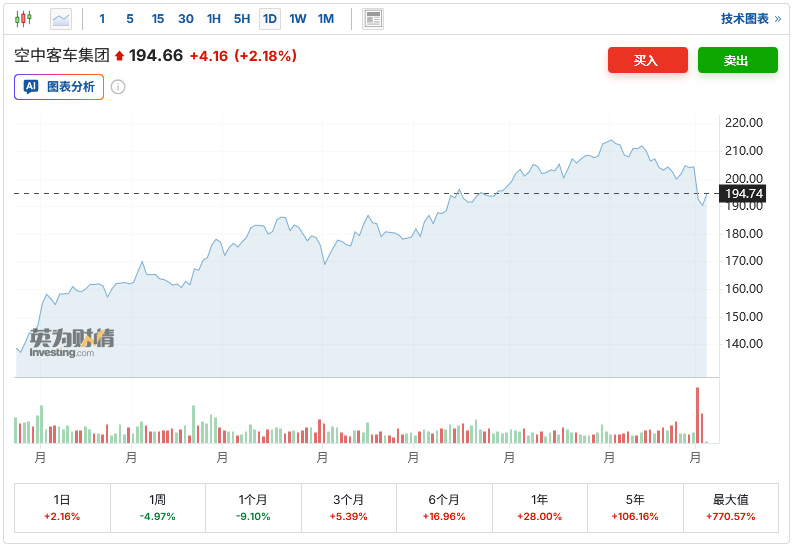
This setback highlights Airbus' dependence on a still unstable supplier network. Fortunately, Airbus has kept its annual financial target unchanged. It still expects adjusted profit before interest and tax to be around 7 billion euros, and the customer's free cash flow target before financing is about 4.5 billion euros. As investors were somewhat relieved that Airbus was maintaining its main financial targets, the company's Parisian listed shares were up 2.2% as of press time.
The latest announcement has put a temporary end to Airbus's difficult past week. On November 28, local time, Airbus issued a statement saying that a significant number of A320 series aircraft are susceptible to strong solar radiation due to flight control software and need to be grounded urgently. The company has urgently advised about 6,000 aircraft around the world that software upgrades or hardware replacements must be carried out immediately, which is equivalent to half of the global fleet in this series being recalled. The European Aviation Safety Authority simultaneously issued instructions strictly prohibiting the affected aircraft to take off passengers until the fault is resolved.
According to reports, for most A320 series aircraft, it only takes “a few hours” to restore the relevant software to the previous version that was not affected by strong solar radiation. However, some old airliners still require hardware replacement, and related operations are expected to continue for several weeks. On December 1, Airbus issued a statement on its official website saying that the vast majority of the world's approximately 6,000 A320 aircraft affected by software issues have completed necessary modifications. The company is working with airline customers to support modifications to repair the remaining less than 100 aircraft to ensure they can resume operations.
On December 1, Airbus revealed that there were quality problems with some panels on the A320 series aircraft. The company strictly inspected more than 600 aircraft already in operation or at a certain stage of production. According to industry sources, dozens of A320 series aircraft have industrial quality issues with their fuselage panels. These production defects have delayed delivery of some aircraft, but there is no indication that the problem has affected current aircraft. Airbus confirmed the news, saying it was inspecting all affected aircraft. An Airbus spokesperson said the root cause of the problem has been identified and brought under control, and all newly produced panels have met all requirements. The revelation of aircraft quality issues caused Airbus's stock price to drop nearly 11% on December 1, the worst intraday decline since April 7 this year.
Additionally, Airbus is facing issues with its newer A320neo aircraft engines. According to reports, the Pratt & Whitney PW1100G engine used in this type of aircraft had quality defects, causing hundreds of aircraft of this type to be temporarily grounded for maintenance.
AirAsia founder Tony Fernandes (Tony Fernandes) said in an interview: “Quarterly performance pressure, and sometimes competitive pressure, may cause production quality to decline. This is a great warning for everyone.” Goodbody analyst Dudley Shanley (Dudley Shanley) stated in a Wednesday report: “It is clear that the rate at which [Airbus] is increasing production to reach the original delivery target is too high.”