
- PREMIUM
- LIVE QUOTES
- INSTITUTION
 Index Options


 State Street
 CME Group
 Nasdaq
 Cboe
Cboe TradingView
 Wall Street Journal
Seven Bank (TSE:8410) Is Due To Pay A Dividend Of ¥5.50
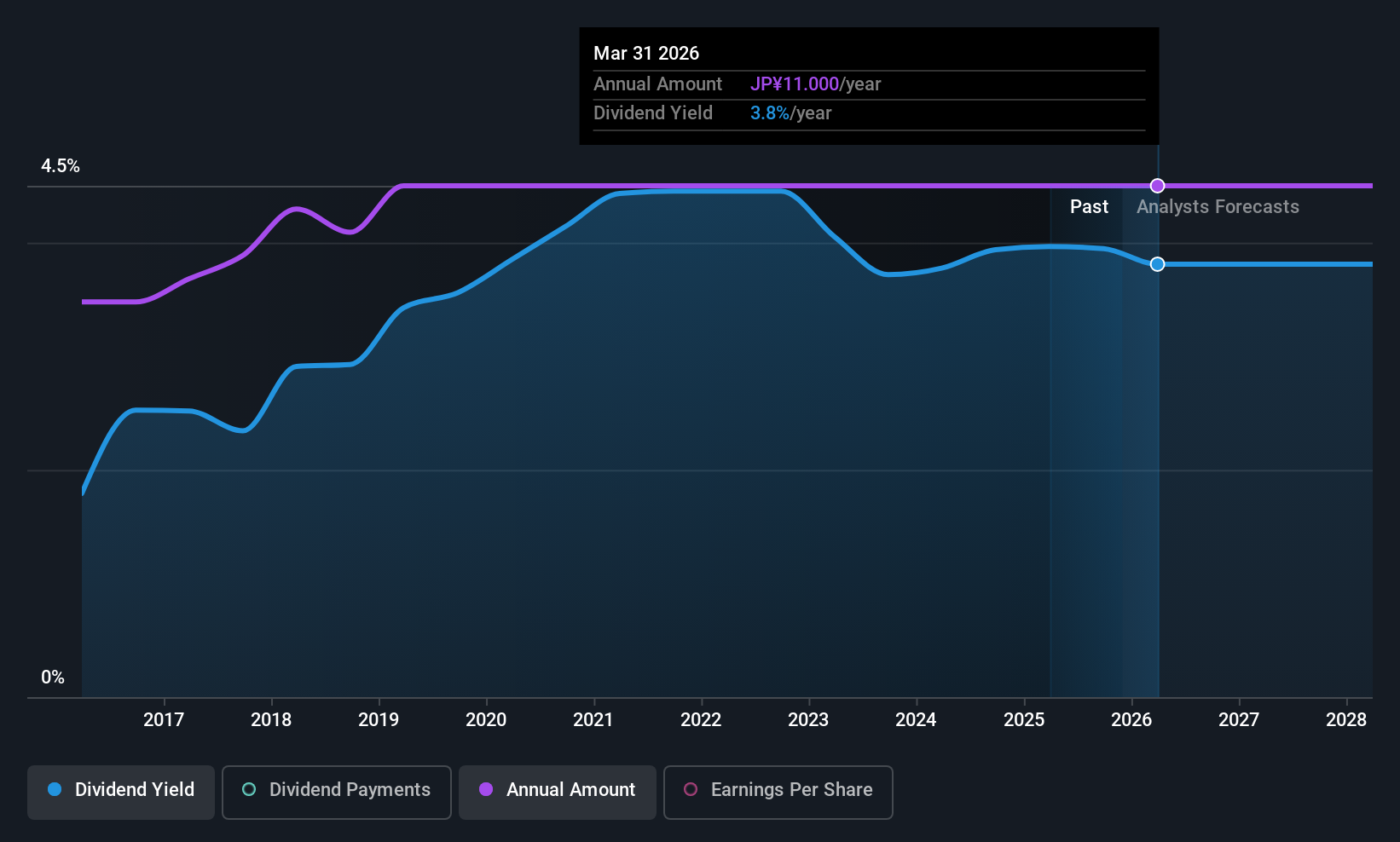
The board of Seven Bank, Ltd. (TSE:8410) has announced that it will pay a dividend of ¥5.50 per share on the 9th of June. Based on this payment, the dividend yield on the company's stock will be 3.8%, which is an attractive boost to shareholder returns.
Seven Bank's Dividend Forecasted To Be Well Covered By Earnings
If the payments aren't sustainable, a high yield for a few years won't matter that much.
Seven Bank has established itself as a dividend paying company with over 10 years history of distributing earnings to shareholders. Taking data from its last earnings report, calculating for the company's payout ratio shows 36%, which means that Seven Bank would be able to pay its last dividend without pressure on the balance sheet.
The next year is set to see EPS grow by 9.1%. Assuming the dividend continues along recent trends, we think the future payout ratio could be 70% by next year, which is in a pretty sustainable range.
View our latest analysis for Seven Bank
Seven Bank Has A Solid Track Record
The company has an extended history of paying stable dividends. Since 2015, the dividend has gone from ¥8.00 total annually to ¥11.00. This implies that the company grew its distributions at a yearly rate of about 3.2% over that duration. While the consistency in the dividend payments is impressive, we think the relatively slow rate of growth is less attractive.
Dividend Growth Is Doubtful
The company's investors will be pleased to have been receiving dividend income for some time. However, things aren't all that rosy. Seven Bank has seen earnings per share falling at 8.6% per year over the last five years. If the company is making less over time, it naturally follows that it will also have to pay out less in dividends. Earnings are predicted to grow over the next year, but we would remain cautious until a track record of earnings growth is established.
In Summary
Overall, we think Seven Bank is a solid choice as a dividend stock, even though the dividend wasn't raised this year. With shrinking earnings, the company may see some issues maintaining the dividend even though they look pretty sustainable for now. The payment isn't stellar, but it could make a decent addition to a dividend portfolio.
Market movements attest to how highly valued a consistent dividend policy is compared to one which is more unpredictable. Still, investors need to consider a host of other factors, apart from dividend payments, when analysing a company. Given that earnings are not growing, the dividend does not look nearly so attractive. See if the 3 analysts are forecasting a turnaround in our free collection of analyst estimates here. If you are a dividend investor, you might also want to look at our curated list of high yield dividend stocks.
Have feedback on this article? Concerned about the content? Get in touch with us directly. Alternatively, email editorial-team (at) simplywallst.com.
This article by Simply Wall St is general in nature. We provide commentary based on historical data and analyst forecasts only using an unbiased methodology and our articles are not intended to be financial advice. It does not constitute a recommendation to buy or sell any stock, and does not take account of your objectives, or your financial situation. We aim to bring you long-term focused analysis driven by fundamental data. Note that our analysis may not factor in the latest price-sensitive company announcements or qualitative material. Simply Wall St has no position in any stocks mentioned.