
Wall Street agencies warn: shorting US stocks is a “high-risk operation”!
The Zhitong Finance App learned that research firm 22V Research believes that despite fluctuations in the US stock market, shorting US stocks is still a dangerous thing due to the strong performance of the US economy and the market's continued enthusiasm for artificial intelligence (AI). The strategists at 22V Research believe that increased consumer spending and continued investment in AI may support productivity, thereby driving companies to achieve higher profits, which in turn will drive up stock prices.
At the time the review was published, US stocks were already in a state of turmoil. Investors have been increasingly concerned about the impact of tariffs on the economy and monetary policy in recent weeks. At the same time, investment in the field of artificial intelligence also seems to be out of touch with profit conditions. The S&P 500 index fell as much as 5.1% from its all-time high in October, but rebounded again last week — highlighting the risk of shorting in a market prone to large fluctuations.
The strategy team led by 22V co-founder and chief market strategist Dennis Debusschere said, “Shorting requires a high degree of certainty about weak economic conditions or major changes in the outlook for AI capital spending.”
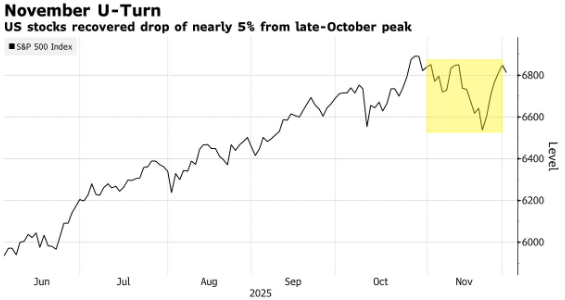
According to data collected by S3 Partners, US stock bears suffered a market capitalization loss of 80 billion US dollars, or a decline of about 4.8%, in the last week of November, which erased the previous total monthly profit of nearly 95 billion US dollars (this total profit was accumulated before last week).
Ihor Dusaniwsky, head of the company's predictive analytics department, said: “In November, stocks experienced sharp fluctuations, and in the last week almost all of the gains made in the first three weeks of the month were spat back.”
According to data provided by Goldman Sachs's professional brokerage business department, recently, the size of hedge fund holdings in US stock indices and exchange-traded funds reached the highest level in five months.
Despite increased volatility in US stocks after the strongest six-month rally since the 1950s, fundamentals still provide a strong rebuttal to the skeptics. According to Strategas Asset Management data, corporate profits are expected to increase by 12.5% over the next 12 months. And despite declining consumer confidence, Mastercard SpendingPulse data showed that Black Friday spending increased 4.1% compared to the same period last year — an indication that American consumers are still strong despite weak labor markets and concerns about inflation.
Currently, the market expects the Federal Reserve to lower interest rates at next week's policy meeting. This move should stimulate economic activity. Following the 22V model, the quantification team's model instead showed an “overall upward” trend.
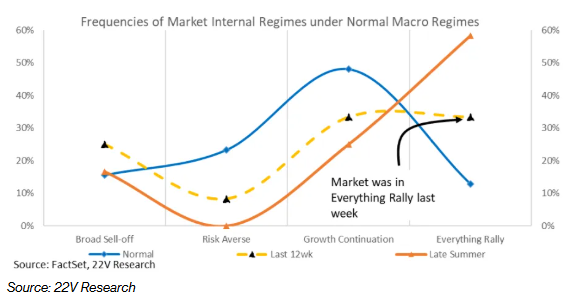
The S&P 500 index fell 0.5% on Monday, after rising 3.7% during the week shortened due to shorter vacations, to make up for the November decline. Since April, regardless of the macro environment, almost every time the index falls, individual investors and institutional investors have bottomed out.
Dave Mazza, CEO of Roundhill Investments, said: “Shorting stocks is currently extremely difficult because the weak market continues to trigger buying reactions. The November situation jumped from the worst month in decades to a good performing month, and this drastic reversal forced bears to close their positions.”
An abnormal situation in the market on Monday indicates the risk of shorting. The share price of Beyond Meat (BYND.US) soared by nearly 37% without any clear positive news. The stock traded above $190 in 2021, but dropped to $0.52 in mid-October. Within the next three days, its share price increased almost sevenfold, but then fell again. Speaking about Beyond Meat, Mazza said, “The cost of holding a short position will rise rapidly.”
Traders are also about to enter a seasonal rise in US stocks. According to data from LPL Finance, the average increase in the S&P 500 index in December was 1.4%, and it closed up 73% of the time, which was the most positive of all months. This strong trend usually occurs in the second half of the month, and the upward momentum starts to increase around the 11th day of trading.