
- PREMIUM
- LIVE QUOTES
- INSTITUTIONS
 Index Options


 State Street
 CME Group
 Nasdaq
 Cboe
Cboe TradingView
 Wall Street Journal
Eurozone inflation rebounded slightly in November, and the ECB is expected to stand still this month
The Zhitong Finance App learned that the Eurozone inflation rate rose slightly in November, which supports the ECB's view that there is currently little reason to further reduce borrowing costs. Data released on Tuesday showed that Eurozone's CPI rose 2.2% year on year in November, higher than economists' median forecast of 2.1% and the previous value of 2.1%; core CPI, which excludes volatile food and energy prices, remained flat at 2.4% year on year, in line with economists' median forecast; and service sector inflation, which has received much attention, rose slightly.
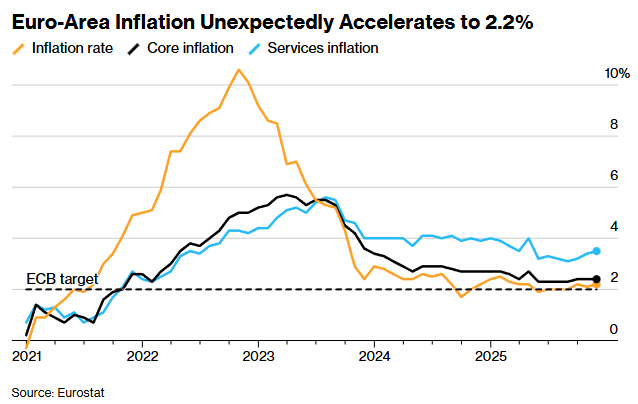
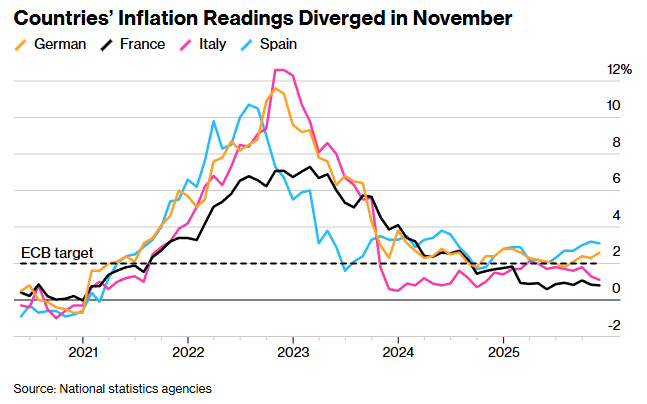
After experiencing a surge after the pandemic, the inflation rate in the Eurozone has been close to the 2% target level set by the ECB for nine consecutive months. However, due to differences in economic conditions and base effects among countries, there are large differences in the inflation situation among Eurozone member countries — inflation in Germany is accelerating, inflation in France has remained stable, and inflation in Spain and Italy has eased somewhat.
ECB President Lagarde emphasized the bank's satisfaction with the current monetary policy stance last week. “We are in a good position considering the inflation cycle we have successfully managed,” Lagarde said. She also added that interest rates were “properly set.”
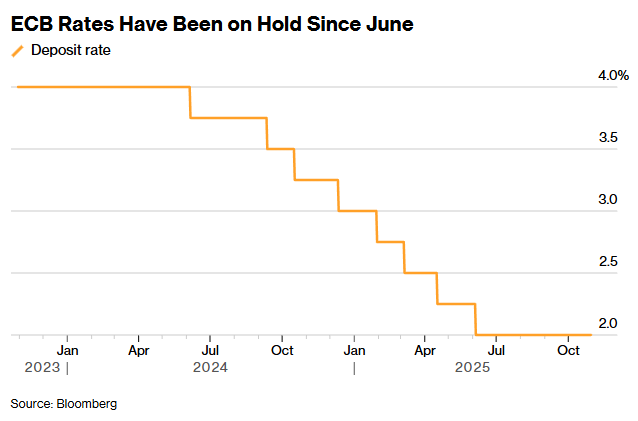
Investors and economists agree. They expect the ECB will once again keep the deposit mechanism interest rate unchanged at 2% this month. Previously, the bank had cut interest rates by 25 basis points eight times in a row, lowering the deposit mechanism interest rate all the way from a peak of 4%.
The ECB will publish a new economic forecast at its December policy meeting, which will include for the first time an outlook for 2028. The central bank's previous forecast indicated that inflation would temporarily fall below 2%. Although delays in the implementation of the EU's new carbon pricing system may further exacerbate this trend, many ECB officials warned that this factor should not be overemphasized.
Among the factors driving up inflation, wage levels are catching up with the pace of past inflation, which is the main reason for higher inflation in some sectors such as the service sector. However, ECB tracking data on collective bargaining agreements shows that future wage growth will moderate.
David Powell (David Powell), a senior Eurozone economist, said: “The stickiness of inflation in the service sector has always been the ECB's main area of concern because it most directly reflects local cost pressure. We believe the broader downward trend is likely to continue as wage growth returns to a level consistent with price stability.”
Moderate inflation prospects and increased economic recovery have prompted most analysts to predict that the ECB's benchmark interest rate will remain unchanged until 2026. Meanwhile, in the face of long-term challenges such as trade and global conflict, ECB officials, although apparently satisfied, emphasized that they are ready to act if the outlook suddenly changes.
ECB Vice President Luis de Guindos (Luis de Guindos) said on Monday: “Market expectations are stable, and interest rates are not expected to rise or fall in the next few months. However, given the uncertainties and unknowns in the international geopolitical environment, we are clearly open and ready to make adjustments.”