
- PREMIUM
- LIVE QUOTES
 Index Options


 State Street
 CME Group
 Nasdaq
 Cboe
Cboe TradingView
 Wall Street Journal
When it comes to the strongest alpha AI computing power in the stock market, it's still well deserved! Explosive demand supports the “bull market narrative” of computing power
The Zhitong Finance App learned that after US tech giant Google launched the Gemini3 AI application ecosystem in late November, this cutting-edge AI application immediately became popular all over the world, driving an instant surge in demand for Google's AI computing power. Once released, Gemini3 series products brought huge AI token processing capacity, forcing Google to drastically reduce the amount of free access to Gemini 3 Pro and Nano Banana Pro, and also imposed temporary restrictions on Pro subscribers. Combined with South Korea's recent trade export data, demand for HBM storage systems and enterprise-grade SSDs continues to be strong, further verifying that “the AI boom is still in the early stages of construction where computing power infrastructure is in short supply.”
Since Trump introduced an unprecedented aggressive tariff policy targeting the world in early April, the global AI computing power industry chain leaders such as Nvidia, Google, Broadcom, Micron, Edwin Test, SK Hynix, and IFF can be described as the core forces leading the global stock market to a massive rebound, and can be called the “strongest alpha” of the global stock market. The main reason behind this strong rebound is that global AI computing power demand continues to show a blowout expansion trend and the tariff policy led by the Trump administration has experienced multiple rounds of trade since April Significant cuts were made after negotiations.
Since the so-called “AI bubble argument” ravaged the global stock market in early November, investment themes related to AI computing power have clearly cooled down and dragged the stock market to a downward adjustment in the short term, but recently this investment theme has picked up strongly — in particular, the “Google AI ecosystem” has set off a wave of investment around the world, and these strong AI computing power leaders continue to lead the US stock market and global stock markets to a new round of strong upward trajectory. Actual statistics prove that after the AI computing power investment theme, where demand continues to show a blowout expansion, has strongly led the global stock market to rebound and repeatedly reach new highs since April, it is still the “strongest alpha” of the global stock market. The “long-term bull market” narrative logic exclusive to the global stock market AI computing power industry chain is still intact.
According to the stock analysis team of Wall Street financial giants such as Morgan Stanley, J.P. Morgan Chase, and Deutsche Bank, pessimistic remarks related to the AI bubble are unable to shake the “excess alpha attributes” brought about by AI computing power investment logic.
These institutions believe that in 2026, the AI investment theme will continue to be the core contribution of leading the US stock market to record highs. They suggest that investors continue to allocate AI-driven stocks, and believe that these stocks have strong “alpha attributes” — that is, the probability of outperforming the S&P 500 index, which is the benchmark for US stocks, and will be much higher than investment returns in other popular sectors such as consumption, energy, and mining. The so-called “alpha” is defined as the actual return on investment far exceeding the “beta return” — that is, the simultaneous return on investment data that far exceeds that achieved by tracking the benchmark stock index. The simultaneous return achieved by tracking the benchmark index is also known as “beta return” (beta).
Dan Greenhaus (Dan Greenhaus), chief strategist from Wall Street investment agency Solas Alternative Asset Management, recently said that the “AI bubble panic” that briefly appeared in the market in early November may have come to an end. Furthermore, the senior market strategist does not expect major changes in market dynamics as it moves towards a new round of bull market in 2026. He pointed out that the two core pillars of the current market — the fundamentals of the AI investment theme and the Federal Reserve's potential path to cut interest rates — are all operating in a direction beneficial to investors.
“I think investors are just facing a moment where the market decides to release some technical selling pressure and settle demand profitably,” Greenhouse explained. “In my opinion, that (AI bubble panic) is very short lived and doesn't mean anything longer.”
Gemini3 is popular all over the world, and demand for AI computing power on the global user side has surged! Google servers can't handle it anymore
Judging from recent paid user feedback and social media buzz about the latest Google Gemini AI series products, both large B-side companies and C-side individual users lament that this is “the most powerful multi-modal model of human society so far,” which is expected to exponentially revolutionize business efficiency and C-side user software collaboration efficiency. Therefore, it can be said that large Wall Street investment institutions, including Morgan Stanley and Mizuho, are bullish on Google's stock price prospects and the so-called “Google AI ecosystem” as a whole.
According to these financial giants, not only is the core participant in the “Google AI ecosystem”, Google's TPU chip development leader Broadcom (AVGO.US), expected to fully benefit from the unprecedented explosion of Google's AI computing power demand and move towards a new round of “super bull market”, participants in the Google AI ecosystem closely linked to the “optical interconnection” high-performance network infrastructure led by Google, and storage leaders focusing on enterprise-grade high-performance storage systems in data centers, will also follow the wild expansion of Google's AI computing power infrastructure and AI application ecosystem The “AI boom cycle.”
Google recently released a series of AI product portfolios based on Gemini 3, which brought huge AI token processing capacity as soon as it was released. Once the “stock god” Buffett's Berkshire Hathaway opened a position, Google's parent company Alphabet (GOOGL.US) ranked among the top ten most heavily held stocks in Berkshire. Google can recently be described as comprehensively strengthening the “AI bull market narrative”, strongly refuting the “AI bubble moment” that some investors are worried about.
Not only has the stock price of Google's parent company entered a sharp rise curve and has repeatedly reached record highs — it has surged more than 35% since mid-October and its market capitalization has begun to approach the $4 trillion supermark. The stock prices of important participants in the Google AI ecosystem, such as Broadcom, Lumentum, TSMC, and MongoDB, have all entered a wild skyrocketing pattern of rising to new highs.
According to media reports on Friday, Gemini 3 series AI application products and Google's newly released Nano Banana Pro (belonging to the Gemini 3 ecosystem), which can be called a “fairy drawing tool”, have drastically limited free usage due to the huge AI computing power requirements of users, and temporary usage restrictions have also been imposed on Pro subscribers. At about the same time, the updated iterative version of the Wensheng video app Sora2, which was launched by OpenAI some time ago, also drastically lowered the usage limit for free users.
During the most active time period last Friday EST, Bill Peebles, head of Sora at OpenAI, announced that in order to allow as many people as possible to use this popular AI application, Sora2's free users can now only generate 6 short videos a day and move away from the classic phrase of insufficient computing power — “Our AI GPU is rapidly melting.”
According to the latest AI application adjustments shown on Google's official website, free users are now only guaranteed “basic access”, and the number of times they use Gemini 3 Pro has also been changed to “the daily limit may change frequently; in addition, Nano Banana Pro's access has also been adjusted to only two images per day, with the addition that “our image generation and editing requirements are huge, and the limits may change frequently and be reset daily.”
The latest move by Google and OpenAI can be described as jointly highlighting the continued explosive expansion of global AI computing power demand. The demand for AI computing power resources closely related to AI training/inference has pushed the capacity that the underlying computing power infrastructure clusters can meet to the limit, and even large-scale AI data centers that have continued to expand recently cannot meet the extremely strong computing power needs of the world. According to several people familiar with the matter, Amin Vahdat, the head of Google Cloud's AI infrastructure, stated bluntly at a general meeting in November that Google must “double its computing power capacity every 6 months,” and that the overall goal for the next 4 to 5 years is to achieve a “1,000 times increase in capacity.”
The “Google TPU AI Computing Power Cluster” that Wall Street analysts are currently collectively focusing on is even expected to occupy 3-4 percent of the AI computing power infrastructure market in the near future. Furthermore, Google's original TPU computing power system will impact Nvidia, which currently has 90% of the market share and can be called a monopoly. According to Wall Street giants Morgan Stanley, Citi, Loop Capital, and Wedbush, the global AI infrastructure investment wave with AI computing power hardware at the core is far from over and is only at the beginning. Driven by an unprecedented “AI inference computing power demand storm”, the scale of this round of AI infrastructure investment, which will continue until 2030, is expected to reach 3 trillion to 4 trillion US dollars.
In 2026, AI will continue to be the strongest force leading US stocks to new high bull markets
Towards the end of the year, Wall Street financial giants began to show aggressive and bold new high predictions for the US stock market in 2026. The core predictive support logic is that this unprecedented artificial intelligence (AI) boom continues to reshape global economic growth and financial market prosperity. According to some institutions, the S&P 500 index is even expected to soar to an astonishing 8,000 points. As of the close of last Friday, the S&P 500 index closed at 6,849 points.
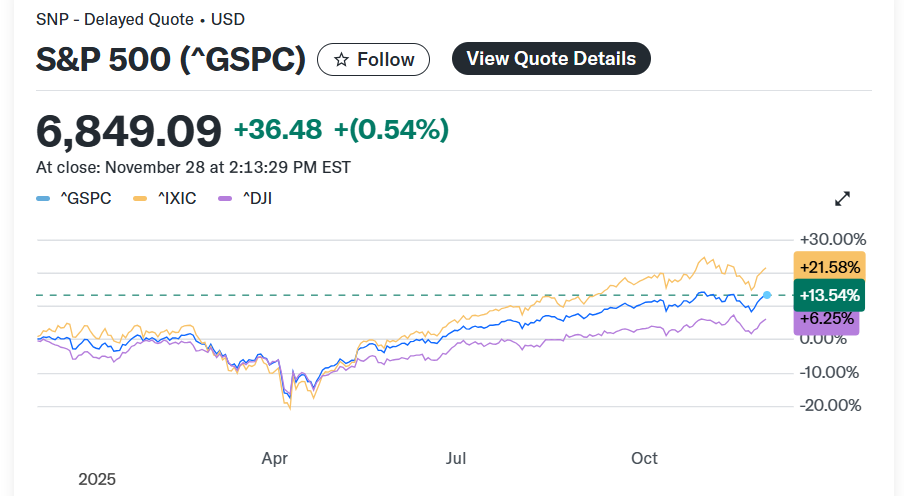
In the latest 2026 global outlook, Deutsche Bank raised the S&P 500 target to 8,000 points by the end of the year. Almost all of the reasons revolved around the AI investment cycle and strong profit support from the Big Seven US stocks. Agencies such as Morgan Stanley even anticipate that tech giants such as Microsoft and Google are in full swing to build AI data centers around AI computing power infrastructure, which will jointly drive the US economy to show a “golden-girl soft landing” in 2026.
The Dama Stock Strategist Team said that by defining 2026 as “The Year of Risk Reboot” (The Year of Risk Reboot), the market focus will shift from the macro level to the micro level. The rare “policy trio” of fiscal stimulus, monetary stimulus, and regulatory easing resonates with the unprecedented AI investment cycle, which will drive strong profit growth in US companies and push the benchmark index of US stocks, the S&P 500 index, to 7,800 points.
Damo stressed that this combination of fiscal, monetary, and regulatory policies is extremely rare when the economy is not in recession and works in a procyclical manner. The last time a similar situation occurred dates back to the late 1980s. This unique “policy dividend package” will inject strength into risk markets such as stocks, and enable investors to focus more on corporate microfundamentals such as corporate profits and AI investment.
Wall Street financial giant J.P. Morgan Chase recently released the agency's latest outlook for the US stock market in 2026, putting forward one of Wall Street's most optimistic predictions so far. It is believed that under active catalysts, the S&P 500 index is expected to break the 8,000 mark. The agency strongly believes that the US will continue to be the engine of global growth, driven by a super-investment cycle driven by artificial intelligence (AI) computing power infrastructure and resilient economic growth.
Basically consistent with Morgan Stanley's forecasting logic, J.P. Morgan Chase's extremely optimistic forecast is based on a firm belief in “American economic exceptionalism.” J.P. Morgan believes that the resilience of the US economy and the continued fermentation of the AI supercycle will allow it to continue to be the “core engine of world growth” next year, thus providing strong fundamental support for global stock markets. J.P. Morgan said that the 2026 market trading pattern will not be much different from 2025, and stocks that dominate the market will show extreme congestion and a record concentration of AI giants (that is, the Big Seven US stocks will continue to hold a high weight).
J.P. Morgan believes that the current AI-driven super-investment cycle is at the core of its optimistic outlook. This cycle has driven record capital expenditure, rapid expansion of profits, and created an “unprecedented” market concentration for AI beneficiary stocks and high-quality growth companies. The report defines these high-quality companies as those with strong profit margins, steady cash flow growth, strict return on capital, and low credit risk, and emphasizes that this technology-driven structural transformation is reshaping the market pattern.