
South Korea's exports in November reproduced double-digit growth, building an “export superengine” for memory chips and automobiles
The Zhitong Finance App learned that South Korea's exports maintained steady growth in November, benefiting from strong demand in the semiconductor and automotive sectors. Under the wave of global trade protectionism, this data provides confidence support to policymakers.
According to data released by Korea Customs on Monday, exports increased 13.3% year on year in November and 14% last month; unadjusted exports increased 8.4% year on year, and 3.5% after the October revision. Imports increased by 1.2% year-on-year during the same period, and the trade surplus reached US$9.7 billion.
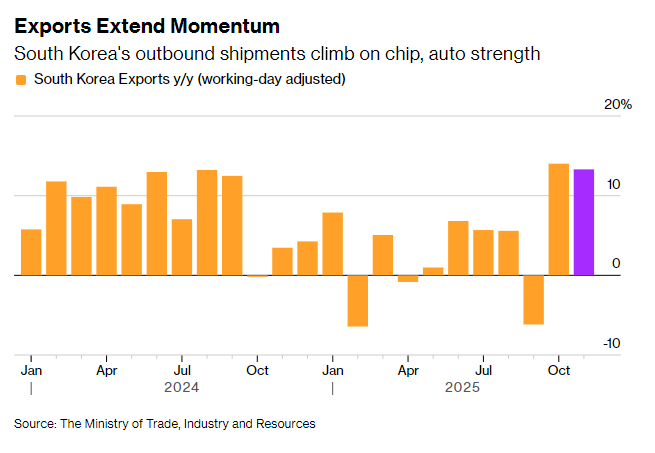
Semiconductor exports continued to lead the growth trend, and memory chip shipments continued to be extremely strong, driven by continued strong demand in the field of artificial intelligence and data centers, with a year-on-year increase of nearly 39%. Automobile exports also rebounded, with a year-on-year increase of nearly 14%. The growth momentum completely offset the drag caused by the petrochemical and other industries.
The newly released resilient export data can be described as highlighting that leaders in high-end manufacturing such as semiconductors, especially in the field of memory chips, which are critical to South Korea's economic growth, are moving towards an unprecedented supercycle driven by the continuous blowout expansion in demand for memory chips brought about by the ongoing wave of AI data center construction in full swing around the world.
Memory chips — critical to South Korea's exports and the South Korean economy. Korea is home to two of the world's largest memory chip manufacturers, SK Hynix and Samsung. Among them, SK Hynix, the global HBM hegemon, has become the core HBM supplier for Nvidia's AI GPU computing power cluster. Another South Korean storage giant, Samsung, is one of the world's largest technology companies and the world's largest supplier of consumer-grade DRAM and NAND memory chips, and enterprise-grade NAND storage components, and recently became the supplier of Nvidia's flagship AI computing power cluster products, the GB200/GB300 series of HBM storage systems that dominate AI chips.
As breakthrough AI application tools such as AI agents penetrate into various industries around the world, bringing about sky-level “AI inference terminal computing power requirements,” this means that the future prospects for AI computing power infrastructure construction such as AI chips, HBM storage systems, enterprise-grade SSDs, and high-performance networks and power equipment will still be a sea of stars. Furthermore, the end-side AI boom will also bring demand for consumer electronics-grade DRAM and NAND storage to a new round of growth curve.
On the eve of the release of this optimistic Korea trade report, the Bank of Korea kept its benchmark interest rate of 2.5% unchanged and adjusted its policy statement, suggesting that its tendency to cut interest rates further has eased from before. Central Bank Governor Lee Chang-yong said that the Monetary Policy Committee was divided on the economic outlook. Three members supported further easing, while the other three members advocated maintaining the current interest rate level in the short term. Meanwhile, the Bank of Korea slightly raised its economic growth and inflation expectations until 2026.
Following the interest rate decision, the Bank of Korea raised its economic growth forecast for 2026 to 1.8% from 1.6% forecast in August, and to 1% for 2025. This adjustment reflects the steady performance of South Korea's economic output in the third quarter, supported by strong chip exports and a steady recovery in private consumption.
Last month, South Korea and the US reached a landmark agreement to cap US import tariffs on South Korean goods at 15%, including automotive products previously subject to 25% tariffs. South Korea's ruling party proposed a special bill last week to implement the $350 billion investment promise. The South Korean government expects automobile tariffs to be reduced retroactively from November 1.
Lee Chang-yong said that with the dual support of the global semiconductor industry's upward cycle and breakthrough progress in the South Korea-US trade agreement, South Korea's export and corporate equipment investment performance will exceed expectations.
In terms of export destinations, due to US tariffs, exports from industries such as steel and auto parts were weak, causing South Korea's exports to the US to fall slightly by 0.2%; exports to China increased by 6.9%, exports to the Middle East surged by about 33%, and exports to Southeast Asia increased by 6.3%.
As exports account for more than 40% of South Korea's GDP, their continued strengthening has given the central bank more policy patience to deal with domestic risks such as rising household debt and high real estate prices.