
Should Investors Reassess Raymond James After Wealth Management Expansion and Strategic Acquisitions?
- Thinking about whether Raymond James Financial is worth your investment attention? Let’s dig into what the numbers and some recent events might mean for its true value.
- The stock has shown some short-term momentum with a 2.3% gain over the past week, though it remains roughly flat year-to-date and is still down 6.3% over the last year after strong gains in the past few years.
- Recent headlines have focused on Raymond James Financial’s expansion of its wealth management services and strategic acquisitions, which are being well received by the market. These moves provide valuable context for the stock’s recent uptick and shifting risk perceptions among investors.
- Looking at valuation, Raymond James earns a solid 5 out of 6 on our proprietary value score, indicating strong signals in most areas. We’ll break down the main valuation approaches in the sections ahead, and keep an eye out for an even sharper way to gauge value by the end of the article.
Find out why Raymond James Financial's -6.3% return over the last year is lagging behind its peers.
Approach 1: Raymond James Financial Excess Returns Analysis
The Excess Returns model provides a practical way to estimate a company's intrinsic value by assessing how much profit it generates above the cost of equity capital. For Raymond James Financial, this involves evaluating how efficiently the business converts its book value into earnings that exceed what investors require as a minimum rate of return.
Here are the key numbers driving this valuation:
- Book Value: $62.70 per share
- Stable Earnings Per Share (EPS): $13.91 per share (Source: Weighted future Return on Equity estimates from 5 analysts.)
- Cost of Equity: $5.90 per share
- Excess Return: $8.01 per share
- Average Return on Equity: 20.27%
- Stable Book Value: $68.61 per share (Source: Weighted future Book Value estimates from 5 analysts.)
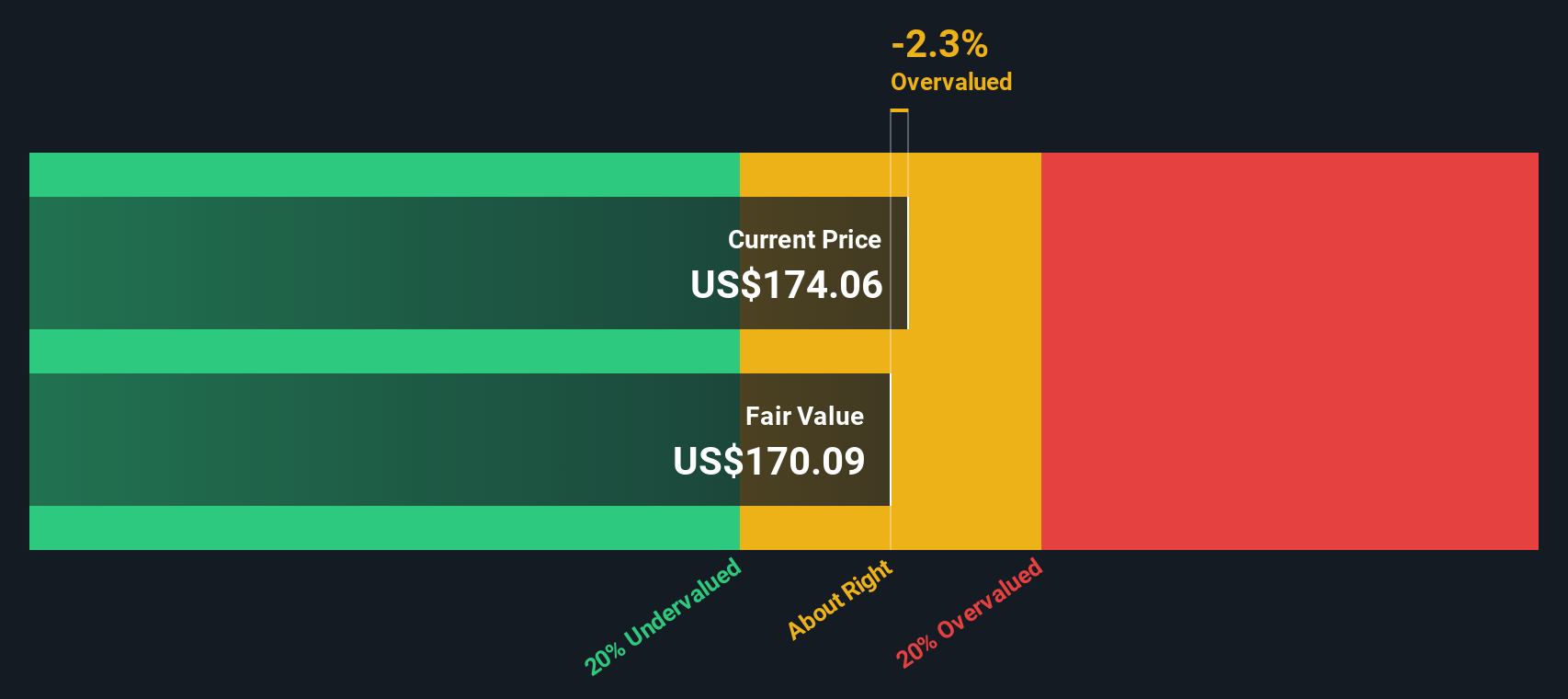
Based on this approach, the model estimates that Raymond James Financial's intrinsic value is $218.61 per share. With the current price trading at a 28.4% discount to this calculated value, the shares appear notably undervalued according to excess returns logic.
Result: UNDERVALUED
Our Excess Returns analysis suggests Raymond James Financial is undervalued by 28.4%. Track this in your watchlist or portfolio, or discover 920 more undervalued stocks based on cash flows.
Approach 2: Raymond James Financial Price vs Earnings
The Price-to-Earnings (PE) ratio is a widely used valuation metric for profitable companies like Raymond James Financial because it shows how much investors are willing to pay for each dollar of earnings. For established firms with steady profits, the PE ratio provides a simple yet effective view of market expectations for growth, profitability, and overall company risk.
A “normal” or fair PE ratio is shaped by several factors, especially growth prospects and perceived risks. Faster-growing companies typically command higher PE multiples, reflecting optimism about future earnings. Riskier or slower-growing businesses generally trade at lower PE levels. Investors also weigh industry dynamics, company size, and profit margins when deciding what is fair.
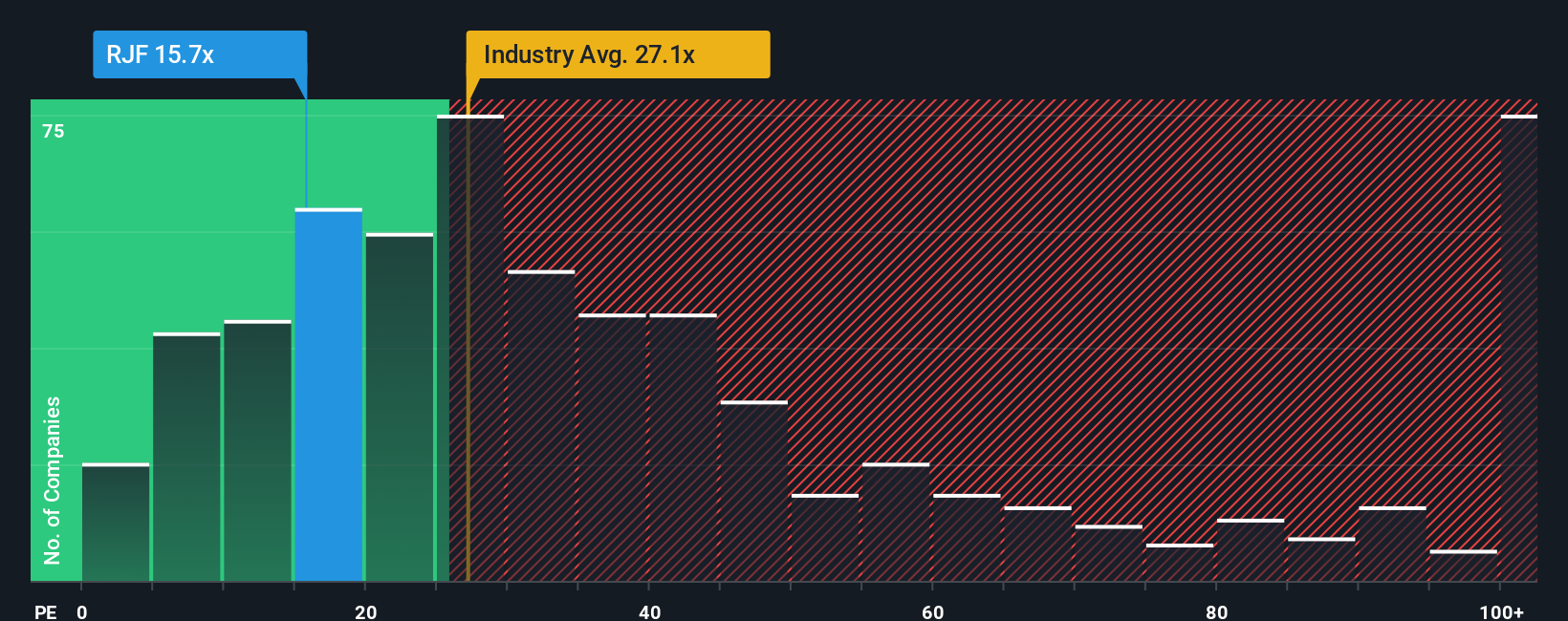
Raymond James Financial is currently trading at a PE ratio of 14.5x. This is well below both the Capital Markets industry average of 23.6x and the average of its direct peers at 26.3x. However, a direct comparison with these benchmarks does not fully capture the specifics and strengths of Raymond James.
Simply Wall St’s “Fair Ratio” offers a more tailored gauge. At 15.6x, this proprietary multiple reflects a holistic view, incorporating factors unique to Raymond James Financial, such as its earnings growth, risk profile, profit margins, industry characteristics, and market capitalization. Unlike raw peer or industry figures, the Fair Ratio adjusts for what truly makes the company unique and provides a more accurate benchmark for valuation.
Comparing the Fair Ratio of 15.6x to the current PE of 14.5x, the stock appears slightly undervalued on this basis, with Raymond James trading at a modest discount to what would be expected given its fundamentals.
Result: UNDERVALUED
PE ratios tell one story, but what if the real opportunity lies elsewhere? Discover 1443 companies where insiders are betting big on explosive growth.
Upgrade Your Decision Making: Choose your Raymond James Financial Narrative
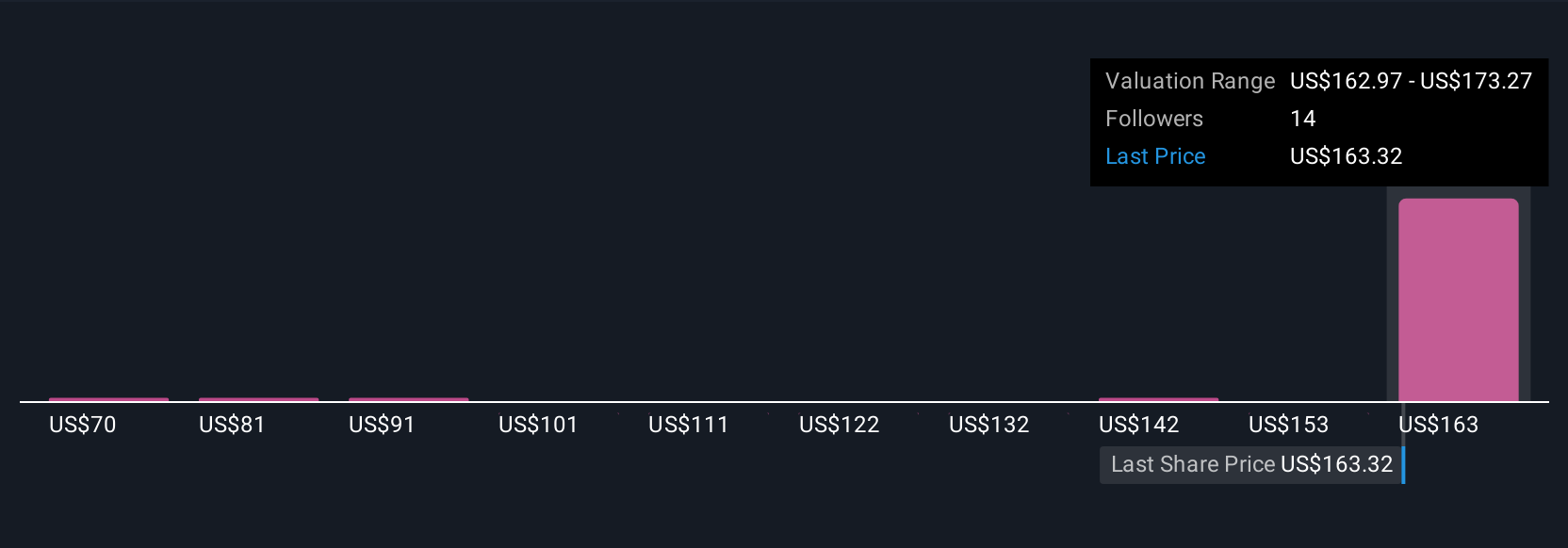
Earlier we mentioned that there is an even better way to understand valuation. Let's introduce you to Narratives. A Narrative is a simple yet powerful approach where you combine your own view of a company's story, such as why it will outperform, struggle, or simply meet expectations, with the numbers behind its future revenue, earnings, and margins. Instead of just looking at static ratios, Narratives connect your unique perspective about a business directly to a financial forecast and a calculated fair value. This approach, available on Simply Wall St's Community page, transforms complex analysis into something straightforward and actionable, helping millions of investors make confident decisions.
With Narratives, you can easily compare your own estimate of fair value to the current share price, making it clearer when to consider buying, holding, or selling. As news or earnings emerge, Narratives are dynamically updated, ensuring your story reflects the latest insights. For example, some investors may be bullish on Raymond James Financial, forecasting robust growth from successful recruitment and tech innovation, and arrive at a higher fair value. Others may focus on macroeconomic uncertainties and competitive headwinds, leading to a more conservative valuation. Narratives help you clearly see how your outlook stacks up, so you can act when the numbers and the story align.
Do you think there's more to the story for Raymond James Financial? Head over to our Community to see what others are saying!
This article by Simply Wall St is general in nature. We provide commentary based on historical data and analyst forecasts only using an unbiased methodology and our articles are not intended to be financial advice. It does not constitute a recommendation to buy or sell any stock, and does not take account of your objectives, or your financial situation. We aim to bring you long-term focused analysis driven by fundamental data. Note that our analysis may not factor in the latest price-sensitive company announcements or qualitative material. Simply Wall St has no position in any stocks mentioned.
Have feedback on this article? Concerned about the content? Get in touch with us directly. Alternatively, email editorial-team@simplywallst.com