
Is It Worth Considering Echo Investment S.A. (WSE:ECH) For Its Upcoming Dividend?
It looks like Echo Investment S.A. (WSE:ECH) is about to go ex-dividend in the next 3 days. The ex-dividend date is commonly two business days before the record date, which is the cut-off date for shareholders to be present on the company's books to be eligible for a dividend payment. The ex-dividend date is important as the process of settlement involves at least two full business days. So if you miss that date, you would not show up on the company's books on the record date. Thus, you can purchase Echo Investment's shares before the 2nd of December in order to receive the dividend, which the company will pay on the 10th of December.
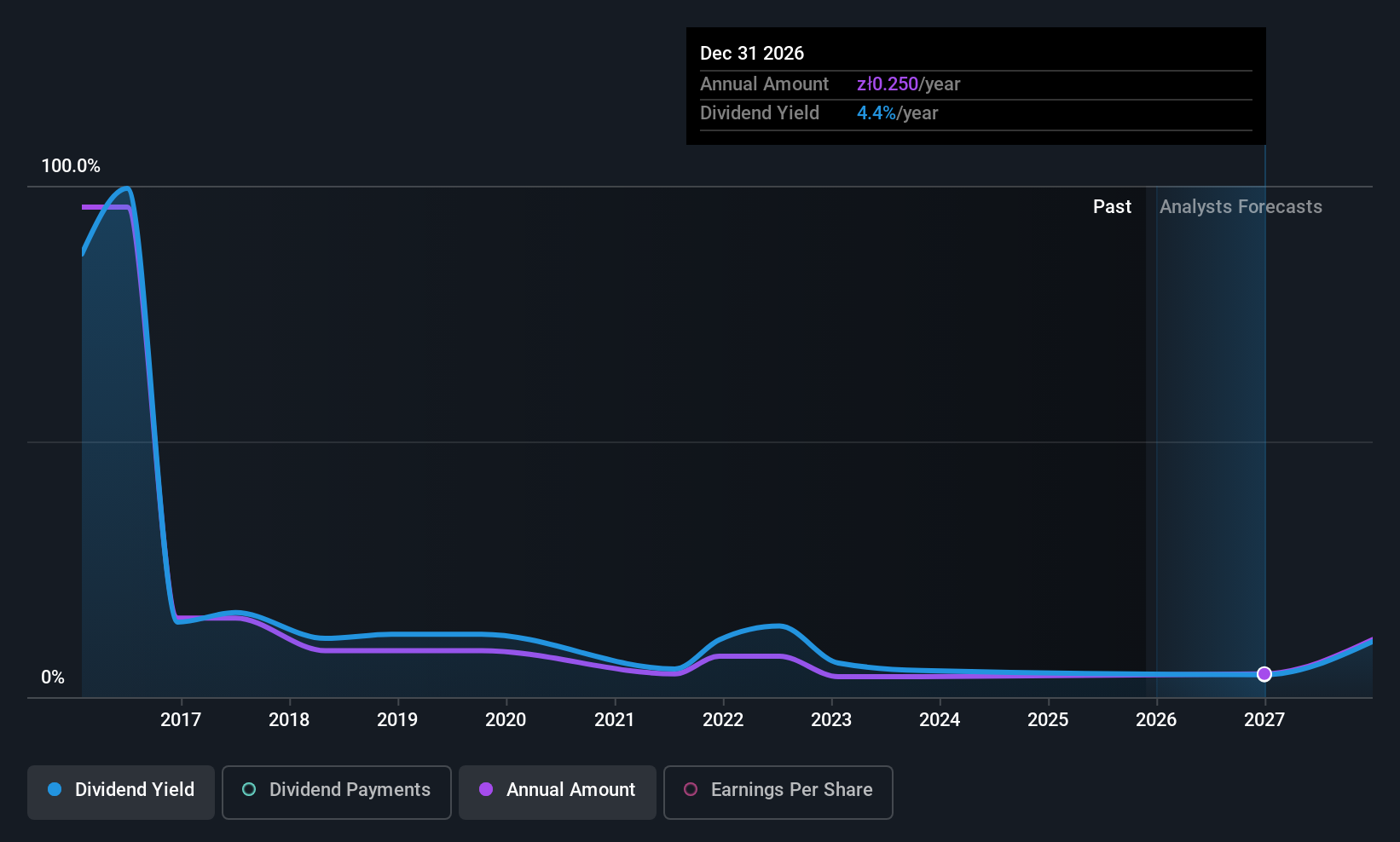
The company's next dividend payment will be zł0.80 per share, on the back of last year when the company paid a total of zł0.22 to shareholders. Based on the last year's worth of payments, Echo Investment has a trailing yield of 3.9% on the current stock price of zł5.70. We love seeing companies pay a dividend, but it's also important to be sure that laying the golden eggs isn't going to kill our golden goose! So we need to investigate whether Echo Investment can afford its dividend, and if the dividend could grow.
Dividends are usually paid out of company profits, so if a company pays out more than it earned then its dividend is usually at greater risk of being cut. Considering the lack of profitability, we also need to check if the company generated enough cash flow to cover the dividend payment. If cash earnings don't cover the dividend, the company would have to pay dividends out of cash in the bank, or by borrowing money, neither of which is long-term sustainable. It paid out 9.2% of its free cash flow as dividends last year, which is conservatively low.
Check out our latest analysis for Echo Investment
Click here to see the company's payout ratio, plus analyst estimates of its future dividends.
Have Earnings And Dividends Been Growing?
Companies with falling earnings are riskier for dividend shareholders. If earnings decline and the company is forced to cut its dividend, investors could watch the value of their investment go up in smoke. Echo Investment reported a loss last year, and the general trend suggests its earnings have also been declining in recent years, making us wonder if the dividend is at risk.
Echo Investment also issued more than 5% of its market cap in new stock during the past year, which we feel is likely to hurt its dividend prospects in the long run. It's hard to grow dividends per share when a company keeps creating new shares.
Many investors will assess a company's dividend performance by evaluating how much the dividend payments have changed over time. Echo Investment's dividend payments per share have declined at 23% per year on average over the past 10 years, which is uninspiring. While it's not great that earnings and dividends per share have fallen in recent years, we're encouraged by the fact that management has trimmed the dividend rather than risk over-committing the company in a risky attempt to maintain yields to shareholders.
We update our analysis on Echo Investment every 24 hours, so you can always get the latest insights on its financial health, here.
Final Takeaway
Should investors buy Echo Investment for the upcoming dividend? We're a bit uncomfortable with it paying a dividend while being loss-making. However, we note that the dividend was covered by cash flow. Overall we're not hugely bearish on the stock, but there are likely better dividend investments out there.
In light of that, while Echo Investment has an appealing dividend, it's worth knowing the risks involved with this stock. To that end, you should learn about the 2 warning signs we've spotted with Echo Investment (including 1 which makes us a bit uncomfortable).
A common investing mistake is buying the first interesting stock you see. Here you can find a full list of high-yield dividend stocks.
Have feedback on this article? Concerned about the content? Get in touch with us directly. Alternatively, email editorial-team (at) simplywallst.com.
This article by Simply Wall St is general in nature. We provide commentary based on historical data and analyst forecasts only using an unbiased methodology and our articles are not intended to be financial advice. It does not constitute a recommendation to buy or sell any stock, and does not take account of your objectives, or your financial situation. We aim to bring you long-term focused analysis driven by fundamental data. Note that our analysis may not factor in the latest price-sensitive company announcements or qualitative material. Simply Wall St has no position in any stocks mentioned.