
Counterpoint Research: Global smartphone shipments are expected to grow 3.3% year-on-year in 2025, driven by Apple's strong performance
The Zhitong Finance App learned that according to Counterpoint Research's latest “Smartphone Market Outlook Tracking”, global smartphone shipments are expected to increase by 3.3% year-on-year in 2025. Apple's smartphone shipments were strong overall in 2025, particularly in Q3. Counterpoint predicts Apple's share of global shipments will reach 19.4% in 2025, making it the number one smartphone brand in the world for the first time since 2011. Samsung's shipments are also expected to increase 4.6% year over year, with a global share of 18.7%, but it will still relinquish its leading position for more than ten years.
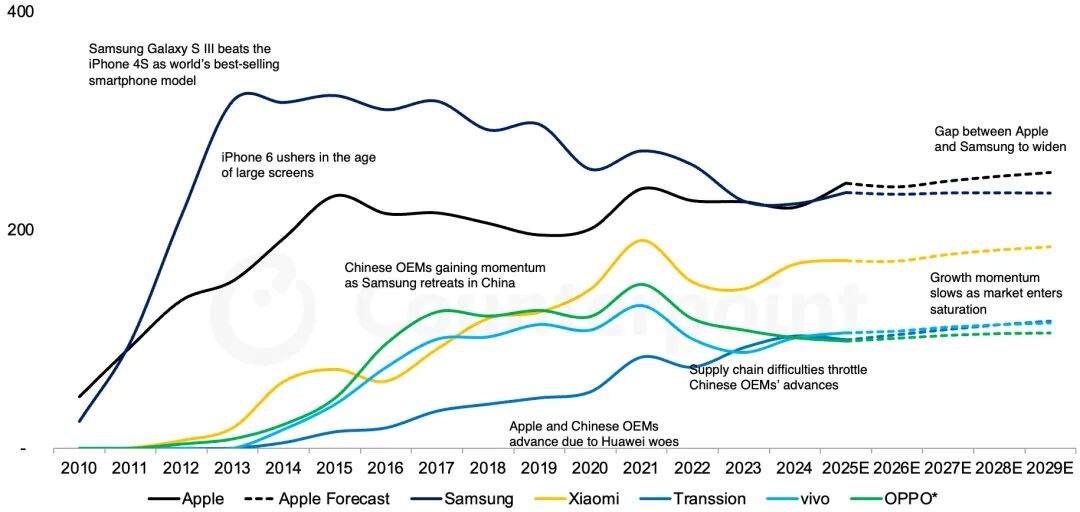
Source: Counterpoint Research Smartphone Market Surveillance and Outlook
Note: OPPO includes OPPO and OnePlus
Apple will reclaim the top spot in 2025 and stay ahead until 2029
In Q3 2025, iPhone shipments surpassed expectations, up 9% year over year. The launch of the iPhone 17 series marks an adjustment to Apple's regular product line strategy. The new iPhone Air replaced the Plus model, and the memory configuration and price gradient were adjusted accordingly.
The latest granular data (for the week ending November 1) shows that iPhones are entering a strong holiday sales season. According to Counterpoint's weekly sales tracking, the iPhone 17 series (including iPhone Air) sold 12% more in the first four weeks after it went on sale in the US than the iPhone 16 series (excluding iPhone 16e). In China, although the Air model did not participate in the initial launch, the iPhone 17 series sold 18% more during the same period than the previous generation. In Japan, sales of the iPhone 17 series also increased 7% in the first four weeks compared to the previous generation.
Referring to Apple's bullish outlook, senior analyst Yang Wang said, “In addition to the iPhone 17 series being well received by the market, the key factor in raising Apple's shipping expectations is that the switching cycle has reached a critical inflection point. Consumers who bought smartphones during the pandemic are concentrating on switching devices. Additionally, 358 million used iPhones were sold between 2023 and Q2 2025, and these users are likely to upgrade to brand new iPhones in the next few years. These factors will form a continued, impressive, and stable demand base, which is expected to support iPhone shipment growth over the next few quarters.”
In addition, Apple also benefited from a macroeconomic environment where the impact of global tariffs was lower than expected and trade and technology frictions between China and the US abated. This not only benefits the diversification of its supply chain and production base, but also significantly boosts overall demand in key growth markets such as emerging markets. Against the backdrop of rising consumer confidence driven by the appreciation of the domestic currency against the US dollar and rising economic prospects, Apple is expected to surpass Samsung in terms of annual shipments in 2025.
Apple is expected to launch the iPhone 17e in the first half of 2026, as the successor to the iPhone 16e and the second product in the “e” series. At the end of the same year, Apple is also expected to release its first folding screen iPhone, and is expected to launch the first clamshell folding iPhone at the end of 2027. With the recovery in shipments and the introduction of higher-priced folding screen products, Apple is expected to continue to be at the top of the global smartphone market revenue rankings within this decade. By expanding the multi-price product layout (including the increasingly rich “e” series) and possible adjustments to the pace of Pro and basic releases, Apple is strategically adjusting its position to capture growing high-end consumer demand in emerging markets and further consolidate its influence in the sub-high-end segment where the growth rate is expected to surpass the overall market.
The delayed release of Apple Intelligence, or “more personalized Siri,” did not affect iPhone sales. It is expected that when related features and software enhancements are introduced in 2026, they will further drive the wave of switching. Counterpoint also predicts that Apple will launch major innovations in 2027 to mark the 20th anniversary of the iPhone. With users' preferences for the iOS ecosystem, a high level of collaboration between devices, and a large existing user base that is about to enter the update period, Apple will continue to lead the way this decade.
Samsung's solid performance in 2025, but not enough to maintain the number one position in the world
Supported by a flexible supply chain that has absorbed most of the impact of tariffs, Samsung's shipments are expected to grow by around 5% in 2025. Through stronger configurations and more competitive pricing strategies, the A Series will further strengthen Samsung's growth momentum in emerging markets, especially as key regions such as India, Southeast Asia, the Middle East, and Africa continue to maintain steady growth. In mature markets, Samsung is expected to maintain its market share in the next few years as the high-end trend continues and the fundamentals of markets such as North America, Europe, and East Asia stabilize. However, despite these benefits, it will be difficult for Samsung to regain the number one position in the world from 2025 to 2029 in the face of increasingly fierce competition from Chinese smartphone brands in the middle and low end markets.
Major Chinese smartphone brands maintain steady growth; rankings are expected to remain stable until 2029
Chinese smartphone brands are increasingly reliant on overseas markets to gain growth, and their growth path in regions such as India, Southeast Asia, Middle East Africa, and Latin America is clearer than the already saturated and competitive domestic market. Meanwhile, Chinese brands are speeding up the shift to higher price segments, investing in high-end devices, AI features, and folding screens to increase profit margins and reduce dependence on the lower end market. But supply chain uncertainty is still hampering the expansion of companies. Of particular note, the shortage of LPDDR4 memory has worsened, and the prices of most memory products have risen sharply, which has posed challenges to Chinese smartphone brands and impacted the low-end smartphone market. Therefore, remain cautious about the growth of Chinese smartphone brands in 2026, and the top four brands are expected to grow at an annual rate of only 1.7%. Despite this, Chinese smartphone brands are shifting from quantity-driven strategies to a more balanced, value-oriented growth path, and strengthening overall resilience by accelerating the global layout. As the focus shifts from simply pursuing shipment volume and share to high-quality growth, Chinese smartphone brands will also gradually move towards a stronger path of revenue growth.