
Subdued Growth No Barrier To SOL S.p.A.'s (BIT:SOL) Price
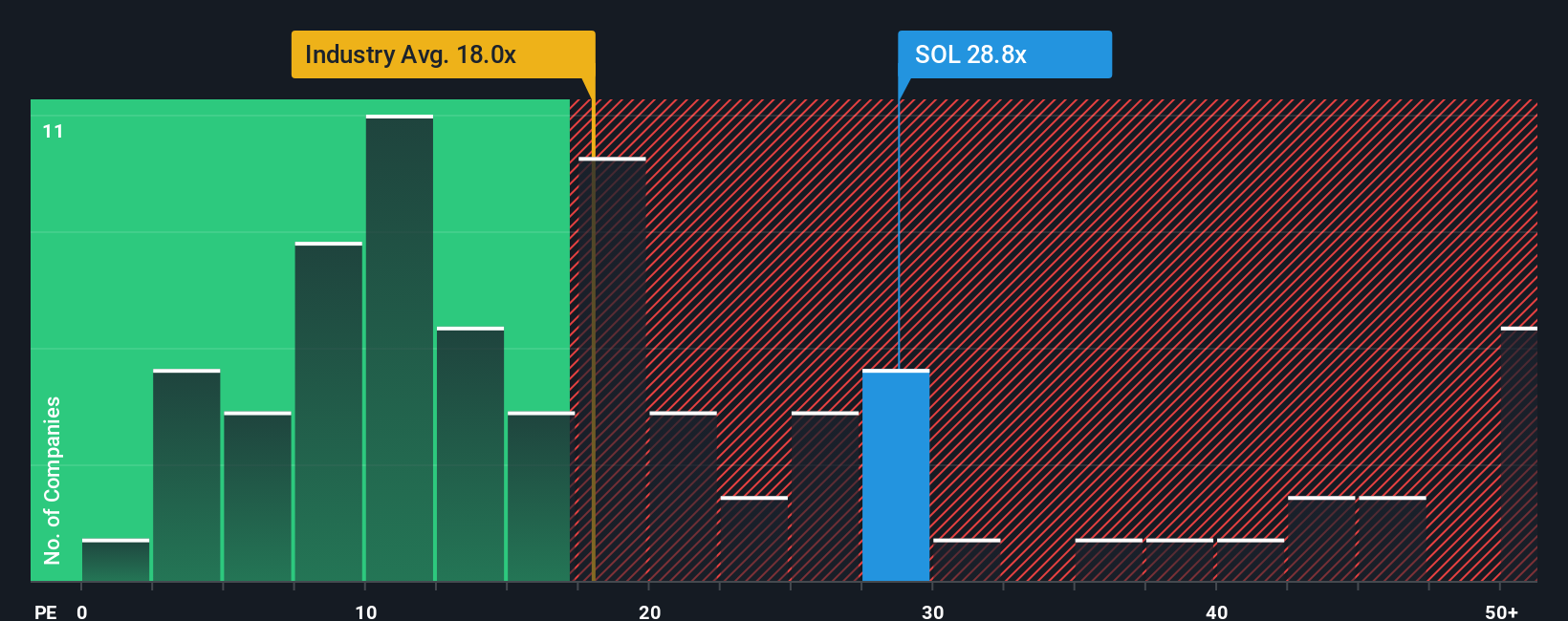
When close to half the companies in Italy have price-to-earnings ratios (or "P/E's") below 16x, you may consider SOL S.p.A. (BIT:SOL) as a stock to avoid entirely with its 28.8x P/E ratio. Nonetheless, we'd need to dig a little deeper to determine if there is a rational basis for the highly elevated P/E.
SOL certainly has been doing a good job lately as it's been growing earnings more than most other companies. The P/E is probably high because investors think this strong earnings performance will continue. You'd really hope so, otherwise you're paying a pretty hefty price for no particular reason.
Check out our latest analysis for SOL
How Is SOL's Growth Trending?
In order to justify its P/E ratio, SOL would need to produce outstanding growth well in excess of the market.
Taking a look back first, we see that the company managed to grow earnings per share by a handy 11% last year. This was backed up an excellent period prior to see EPS up by 51% in total over the last three years. Therefore, it's fair to say the earnings growth recently has been superb for the company.
Looking ahead now, EPS is anticipated to climb by 7.6% per annum during the coming three years according to the three analysts following the company. With the market predicted to deliver 16% growth each year, the company is positioned for a weaker earnings result.
In light of this, it's alarming that SOL's P/E sits above the majority of other companies. Apparently many investors in the company are way more bullish than analysts indicate and aren't willing to let go of their stock at any price. Only the boldest would assume these prices are sustainable as this level of earnings growth is likely to weigh heavily on the share price eventually.
What We Can Learn From SOL's P/E?
Generally, our preference is to limit the use of the price-to-earnings ratio to establishing what the market thinks about the overall health of a company.
Our examination of SOL's analyst forecasts revealed that its inferior earnings outlook isn't impacting its high P/E anywhere near as much as we would have predicted. When we see a weak earnings outlook with slower than market growth, we suspect the share price is at risk of declining, sending the high P/E lower. This places shareholders' investments at significant risk and potential investors in danger of paying an excessive premium.
A lot of potential risks can sit within a company's balance sheet. Our free balance sheet analysis for SOL with six simple checks will allow you to discover any risks that could be an issue.
If you're unsure about the strength of SOL's business, why not explore our interactive list of stocks with solid business fundamentals for some other companies you may have missed.
Have feedback on this article? Concerned about the content? Get in touch with us directly. Alternatively, email editorial-team (at) simplywallst.com.
This article by Simply Wall St is general in nature. We provide commentary based on historical data and analyst forecasts only using an unbiased methodology and our articles are not intended to be financial advice. It does not constitute a recommendation to buy or sell any stock, and does not take account of your objectives, or your financial situation. We aim to bring you long-term focused analysis driven by fundamental data. Note that our analysis may not factor in the latest price-sensitive company announcements or qualitative material. Simply Wall St has no position in any stocks mentioned.