
The AI boom is detonating the “supercycle” of memory chips! Supply shortages and price increases may continue until 2026
The Zhitong Finance App has learned that several technology companies, including Dell Technologies (DELL.US) and HP (HPQ.US), have warned that due to the surge in demand brought about by artificial intelligence (AI) infrastructure construction, there may be a shortage of memory chips next year. Consumer electronics manufacturers, including the Xiaomi Group, have issued warnings of potential price increases, while companies such as Lenovo Group have begun to stock up on memory chips to cope with anticipated cost increases. Market research firm Counterpoint Research predicts this month that by the second quarter of next year, the price of memory modules will rise 50%.
The shortage of memory chips may drive up manufacturing costs for products ranging from mobile phones to medical devices and automobiles. Such chips are used in almost all modern electronic devices that store data. Under the influence of the AI boom, memory chip makers are allocating more production capacity to meet the demand for new, more complex, and more profitable products used in AI systems, leading to a shortage of more common types of memory.
Dell Technology's chief operating officer Jeff Clarke (Jeff Clarke) said in a conference call with analysts on Tuesday that the company has never seen “costs change at the current rate.” He said the company has seen a tightening supply of dynamic random access memory (DRAM) — including high-bandwidth memory (HBM) for AI and chips for personal computers (PCs) — as well as hard drives and so-called NAND flash memory, and “the cost base for all products is rising.”
Dell Technologies will work to adjust its configuration and product portfolio, but Clark said he believes the impact will inevitably affect customers. He said the Texas-based computer manufacturer will consider all options, including repricing some devices.
HP CEO Enrique Lores (Enrique Lores) said the company believes the second half of 2026 will be particularly challenging and will raise prices if necessary. He said, “For the second half of the year, we are taking a cautious approach in terms of guidance, while we are implementing positive actions such as introducing more memory vendors and reducing memory usage in our products.” The company estimates that memory accounts for 15 to 18 percent of the cost of a typical PC.
Apple (AAPL.US) gave one of the most optimistic assessments. The company's chief financial officer, Kevan Parekh, acknowledged in a conference call with analysts that there was a “slight downturn” in memory prices and that “the cost structure of some new products is indeed slightly higher.” But he stressed that Apple is managing costs very well. Similar to Lenovo, Apple's position as one of the largest customers (if not the largest customers) of many manufacturers in the electronics supply chain helps it ensure favorable terms for continuous supply.
The “supercycle” of memory chips has arrived! Supply shortages may continue until 2026
After ChatGPT was released in November 2022 and sparked a boom in generative AI and the global boom in AI data center construction, memory chip makers began allocating more production capacity to high-bandwidth memory (HBM) chips.
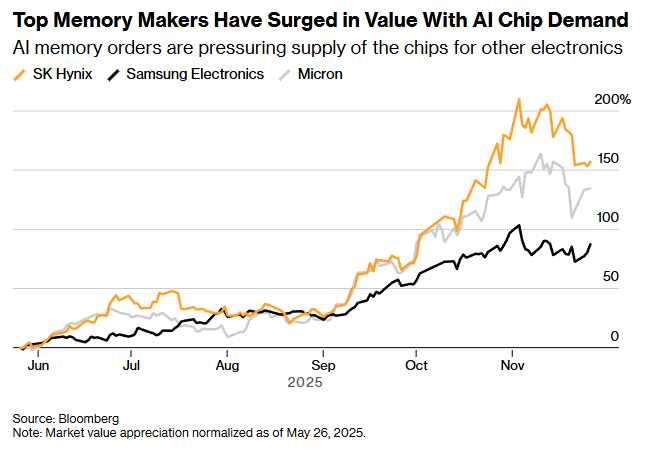
AI memory orders are squeezing memory supply for other electronic products
Competition for mature chips from Chinese rivals is becoming increasingly intense, prompting two companies, Samsung and SK Hynix, which control about 70% of the global DRAM chip market, to accelerate the shift to high-end chips. Since the beginning of 2025, these manufacturers have gradually adjusted their strategies, gradually reducing and even planning to completely stop the production of DDR4 memory particles from the end of 2025 to the beginning of 2026, and completely shift production capacity to more profitable and technologically advanced products such as DDR5 and HBM.
Morgan Stanley expects tech giants including Google, Amazon, Meta, Microsoft, and CoreWeave to invest $400 billion in artificial intelligence infrastructure this year. This boom in AI also coincides with traditional data centers and personal computers entering a new renewal cycle. Analysts pointed out that combined with mobile phone sales exceeding expectations, this together exacerbated the tight supply of non-HBM memory chips and boosted their prices.
According to reports, taking 4GB DDR4X as an example, the particle spot market rose 3-4 times from a low of 7 US dollars/piece at the beginning of this year to more than 30 US dollars/piece in mid-November; using 64G eMMC as an example, flash memory rose nearly 1.5 times from 3.2 US dollars/piece at the beginning of the year to over 8 US dollars/piece recently. Also, as demand for eSSD from overseas AI servers increased, NAND flash memory followed DRAM particles and began to rise sharply in price.
As the supply of ordinary memory chips has tightened, the global memory chip industry seems to be entering what many analysts call a “supercycle,” and equipment manufacturers are frantically hoarding memory chips. Tobey Gonnerman, president of semiconductor distributor Fusion Worldwide, said, “Demand has surged in the past month or two. The market is indeed changing amazingly fast. The rush to buy is intensifying and will continue to escalate. Customers generally adopt a double/triple order strategy, which is similar to the situation when there were many shortages in the past.”
The sharp rise in the price of memory chips has driven the stock prices of Samsung Electronics, SK Hynix, and Micron Technology (MU.US) to rise sharply in recent months. SK Hynix said last month that it has sold out all of its memory chip production capacity next year, and Micron expects the tight supply situation to continue until 2026. Shares of Japan's Kioxia Holdings, which focuses on NAND production, have risen several times since it went public in December last year, which has also benefited from the tight supply environment.
SMIC notes that in the context of manufacturers prioritizing supply to Nvidia (NVDA.US), memory shortages are showing. The company warned that memory shortages could limit automotive and electronics production in 2026.
Sanjeev Rana, head of research at CLSA Korea Securities, said after Samsung Electronics' earnings report last month: “Demand for all memory-related products — whether advanced memory or traditional memory — is extremely strong, and supply is lagging behind.” “We are likely to see DRAM and NAND price increases continue for several quarters from now.”